The ABC Employee Classification System: A Guide to Talent Review
 By: Alan Gohary, Minot Center Director
As a business owner or manager, understanding and managing your workforce’s potential is crucial in today’s competitive business landscape. One effective method for reviewing talent is the ABC Player Classification System. This approach helps managers categorize employees based on their performance, attitude, and overall impact on the organization. When used thoughtfully, it can help leaders identify strengths within their teams while also recognizing areas that may need improvement.
The ABC Player System groups employees into three general categories: A Players, B Players, and C Players. Each group reflects a different level of contribution and engagement within the organization.
A Players are top performers who often act as catalysts for positive change. They tend to take initiative, help move the organization forward, and influence the performance and attitude of others. Common characteristics include:
-
Proactive and open to driving change
-
Willing to take ownership and admit mistakes
-
Collaborative across teams and departments
-
Natural leaders who coach and support others
-
Strong examples of the organization’s core values
B Players are dependable contributors who play an important role in maintaining stability and productivity. While they may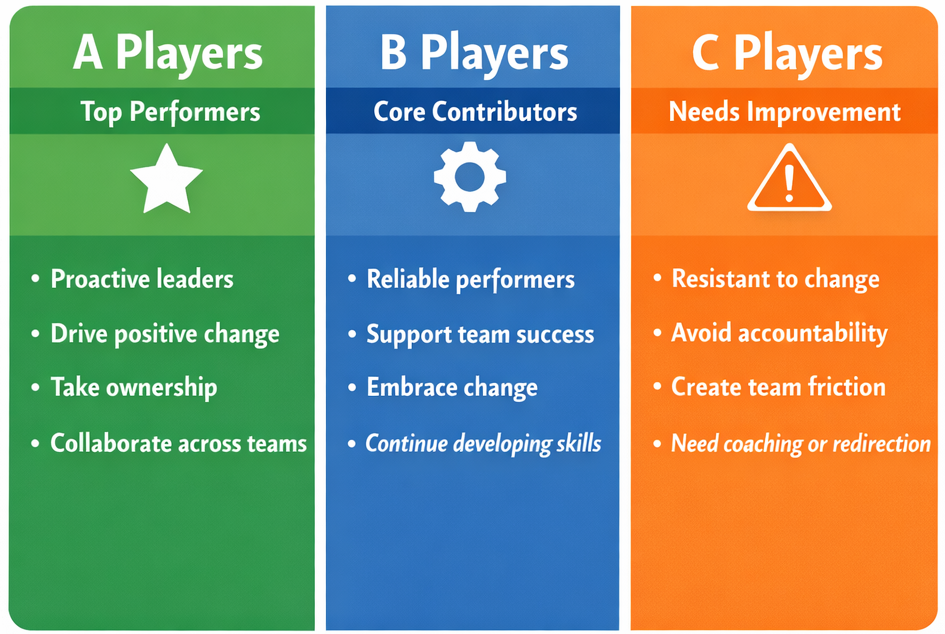 not always drive change themselves, they consistently support team success. B Players typically:
-
Execute their responsibilities well
-
Embrace change and problem-solve when challenges arise
-
Take responsibility for correcting mistakes
-
Work effectively within their teams
-
Recognize areas where they can continue to grow
C Players are employees who struggle with performance or workplace behavior and may hinder progress if challenges are not addressed. These employees may:
-
Resist change and prefer a rigid structure
-
Avoid admitting mistakes or shifting responsibility
-
Create tension or drama within teams
-
Lacks key traits that support a positive workplace culture
Conducting a talent review using the ABC Player System requires a thoughtful and consistent approach. Managers should begin by familiarizing themselves with the characteristics of each player type and observing employee performance over time. By comparing behaviors and contributions against the ABC criteria, leaders can begin identifying where each employee may fall within the classification system.
A typical talent review process may include the following steps:
-
Prepare by understanding the traits associated with each player category
-
Observe employee performance, behavior, and team impact over time
-
Evaluate employees against the ABC characteristics
-
Classify employees into A, B, or C categories
-
Document the results for future reference and development planning
When applying this system, it is important to focus on patterns rather than isolated incidents. A single mistake or success should not define an employee’s overall contribution. Managers should consider each individual’s long-term impact on the organization while remaining objective and avoiding personal bias. It is also important to remember that these classifications are not permanent. With the right guidance, training, and motivation, employees can move between categories as their skills and performance evolve.
After completing the classification process, business owners and managers can develop strategies to support their teams more effectively. This may include retaining and rewarding A Players, providing development opportunities for B Players, and creating improvement plans or transition strategies for C Players.
By implementing the ABC Player System, leaders can gain valuable insight into their workforce and make more informed decisions about talent development. Over time, this structured approach can help strengthen team performance and position the organization for long-term success.



Comments