Edmontosaurus (some assembly required)
A once-in-a-lifetime opportunity, the UND Harold Hamm School of Geology & Geological Engineering welcomes volunteers to get hands-on with real dinosaur fossils
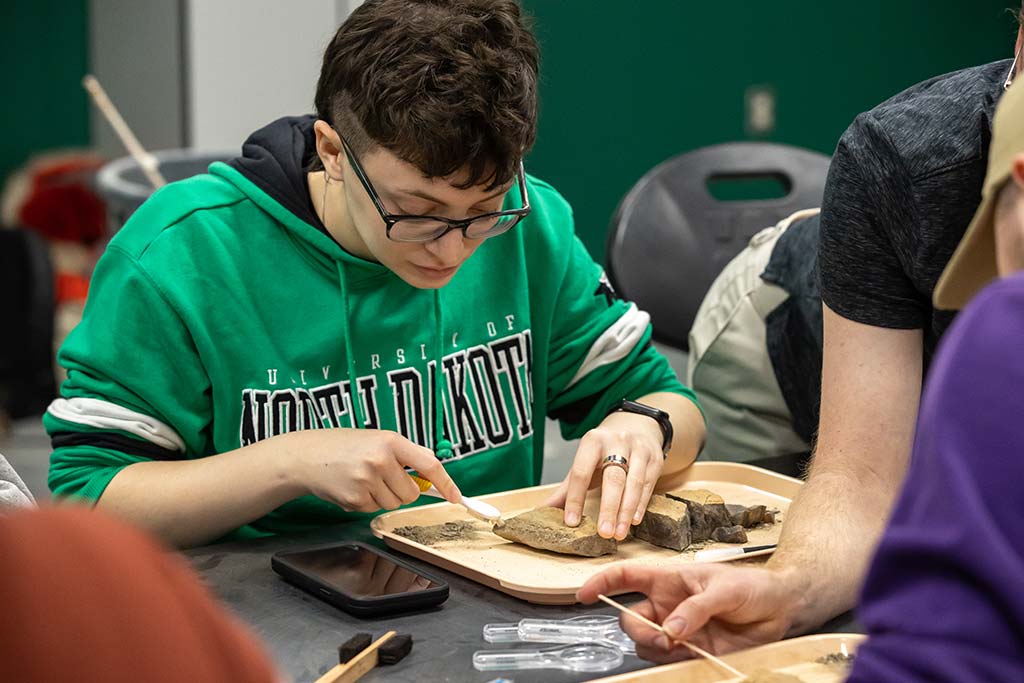
It’s like a jigsaw puzzle—except it’s three-dimensional, extracted piece by piece out of a block of rock that weighed over 4,400 pounds, is 67 million years old, … and also a dinosaur.
UND’s newest resident dino, the Edmontosaurus specimen, nicknamed Marvin, that came to campus last October, is undergoing a process akin to solving an absurdly large jigsaw puzzle.
The goal? To bring it to life through careful cleaning and assembly done by volunteers from the community—from Grand Forks and beyond.
Protectively encased in layers of plaster and burlap, the specimen holds approximately 25 bones, a substantial amount compared to most fossil discoveries.
“Anything better than two bones is a wonderful find,” says Paul Ullmann, the project’s team lead and an Assistant Professor of paleontology in the UND Harold Hamm School of Geology & Geological Engineering.
Discoveries in paleontology don’t always happen in the field. Volunteers and researchers have already uncovered at least one fossil bone inside the plaster jacket that was hidden during field excavations, meaning there is even more of the skeleton preserved. In addition, Marvin’s caudal vertebrae (tail bones) preserve pathologies. Just like in medicine, these paleopathologies are evidence of abnormal tissue from disease or injury. Researchers don’t yet know what happened to the tail of this dinosaur, but it was not something good.
“Studying the paleobiology of dinosaurs helps us better understand how they interacted with their world,” says Kristyn Voegele, who also took part in the excavation of this specimen and joined the UND Harold Hamm School of Geology and Geological Engineering in August as an Assistant Professor of paleontology this fall. Researchers will be investigating the cause of these pathologies as more of the tail is prepared.
Since February, 100+ participants from UND, Grand Forks, and the surrounding community—including community volunteers who have come from as far away as Bismarck and Bemidji—have dedicated their time to advancing the project, and through it, science.
“This is something I never thought I would ever do, but getting to actually touch real dinosaur bones was so cool,” says an anonymous volunteer and community member from Grand Forks. “Just your average Friday in Grand Forks!”
“We are now starting to 3D scan the exposed tibia [shin bone] so we can digitally capture its form before sampling for soft tissue, geochemical, and molecular research by our Master’s student, Skylor Booth,” says Ullmann. “Skylor is planning to explore how the bone has been chemically altered through fossilization and to test it for the preservation of original bone cells, blood vessels, and their component biologic molecules, such as the structural protein collagen.”
So, how long will it take to put the dino back together again? From the looks of it, probably another two years or more. There’s still plenty more to do with nine tail vertebrae and two large limb bones remaining to be finished, and more bones still waiting to be extracted from the block and prepared.
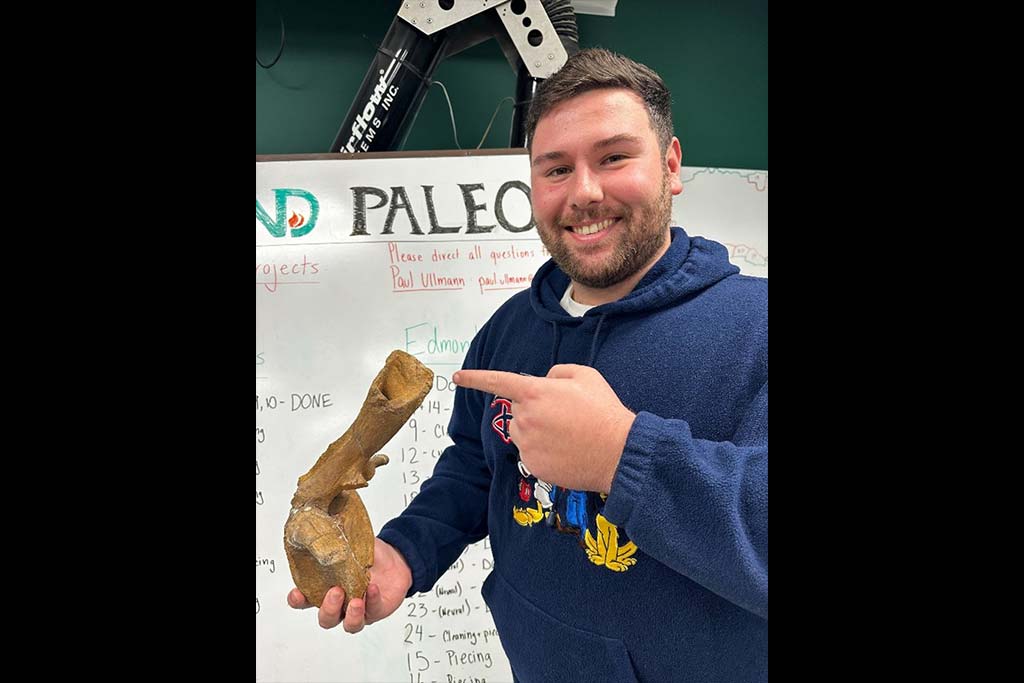
Volunteers are still needed, so if you’ve ever wondered what it’s like to get your hands on authentic dinosaur bones, now is your chance! Interested community members can register for fossil prep sessions through this link. There are periodic cancelations, so please check back often!
Written by Paige Prekker // UND College of Engineering & Mines