UND student-led cybersecurity research to protect modern energy systems earns spotlight in top-tier journal
UND cybersecurity research to safeguard modern power grids earns the spotlight in the highly selective IEEE Communications Surveys & Tutorials, a top-tier journal in engineering
Data breaches, denial of service, malware and network vulnerabilities are increasing cybersecurity threats in almost every industry. And the stakes in the energy sector are exceptionally high.
The critical and interconnected infrastructure we rely on, including the power grid, are resources that can experience devastating effects, including data breaches, loss of communication, intentional device failures and cascading outages.
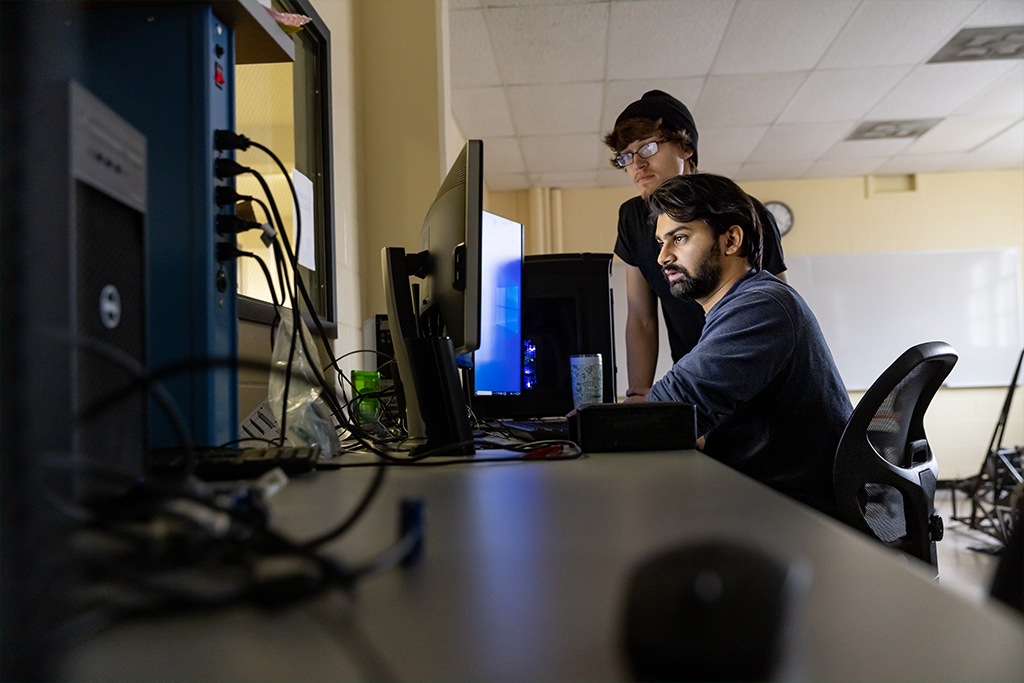
Fortunately for us, students at UND’s Center for Cyber Security Research (C2SR) are on the case for a more resilient grid.
“We propose principles such as zero-trust and intrusion diagnostic units that leverage AI and cybersecurity to enhance cyber-physical resilience,” says Niroop Sugunaraj, a doctorate student in the School of Electrical Engineering & Computer Science.
Niroop and other UND students joined forces with leading institutions and laboratories to explore AI-driven cybersecurity solutions to safeguard modern power grids. Those expert multidisciplinary partners include:
- National Renewable Energy Laboratory, USA
- Argonne National Laboratory, USA
- Texas A&M University-Kingsville, USA
- University of Missouri, USA
- Liechtenstein Business School, Liechtenstein
- Washington State University, USA
- University of Novi Sad, Serbia
- National Institute of Technology, India
- University of Maine, USA
- Suleyman Demirel University, Turkey
The resulting work, a paper titled “Distributed Energy Resource Management System (DERMS) Cybersecurity Scenarios, Trends, and Potential Technologies: A Review,” was featured in the highly selective IEEE Communications Surveys & Tutorials, a top-tier journal in engineering. Publication in this journal is highly selective, with only the most impactful and influential research being accepted.
As of this article’s release, the paper is available in Early Access on IEEE Xplore.
The student team, advised by Dr. Prakash Ranganathan (a recent recipient of the McDermott Faculty Award for Excellence in Research & Creative Activity), the team is focused on strengthening cybersecurity for Distributed Energy Resource Management Systems (DERMS)—a critical step in protecting the future of energy infrastructure. Their work aligns with national security priorities, proposing strategies based on IEEE standards to enhance grid resilience against cyber threats.
What cybersecurity research at a Carnegie R1 institution looks like
Published around the same time as the announcement of UND’s Carnegie R1 designation, the UND-led paper is an example of the high-level research happening on campus. Continually attracting international collaborations with other top universities, national labs and industry partners positions UND for major federal and industry funding to advance futuristic cybersecurity solutions.
Niroop, the leading author of the manuscript, acknowledged the expertise of Dr. Ranganathan and the paper’s co-authors, noting that the collaboration represented “a substantial and comprehensive research effort that not only aligns with national interests but also benefits stakeholders in the power and critical infrastructure sectors.
“Our work addresses a critical need within the power grid and utilities community and is poised to become a key reference for future research possibilities,” said Shree Ram Abayankar Balaji, another UND student who helped lead the paper. “It will serve as a valuable foundation for exploring new methodologies and advancing key innovations in the field.”
Written by Paige Prekker // UND College of Engineering & Mines