UND student-driven innovation takes off with the U.S. Air Force
In the U.S. Air Force’s Aerospace Propulsion Outreach Program, UND students enthusiastically embrace new challenges
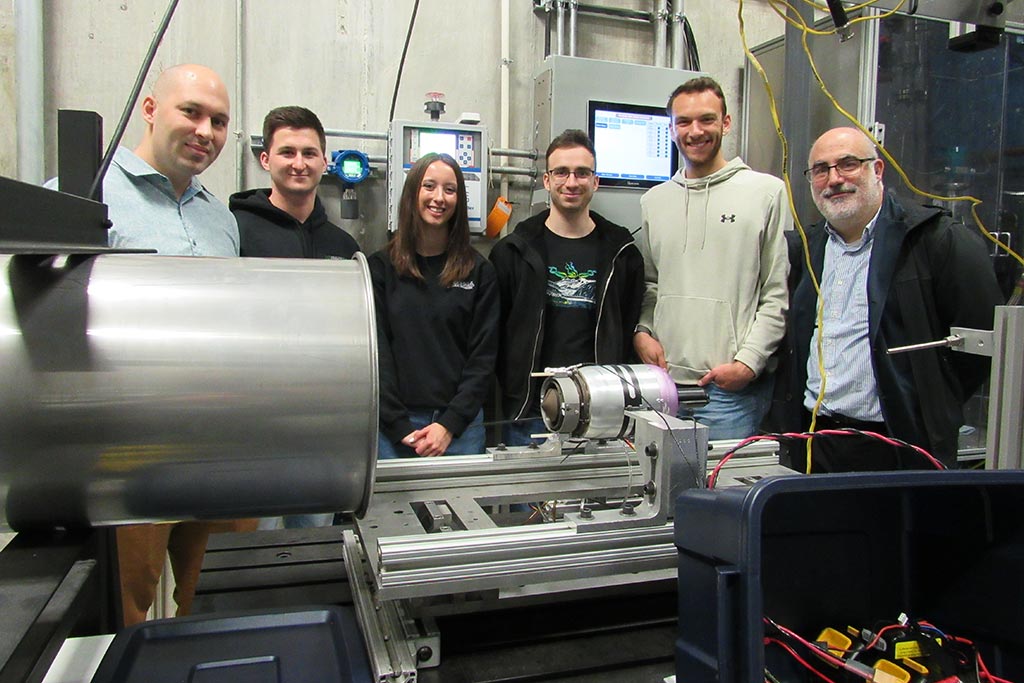
Innovation is a core skill for UND’s engineering students, but it’s not every day they get to create new technology for the U.S. Air Force.
For a team of mechanical engineering students, it was a unique and new opportunity to reimagine jet engine technology.
The University of North Dakota was recently invited to participate in the U.S. Air Force’s prestigious Aerospace Propulsion Outreach Program (APOP), joining a select group of top-tier engineering schools nationwide.
APOP is more than just a capstone project. Backed by the Air Force and facilitated by the Air Force Research Laboratory (AFRL), the program funds university student teams to explore cutting-edge engine design, giving them the chance to engineer real-world innovations and receive feedback directly from top Air Force scientists.
Small engine, big challenges
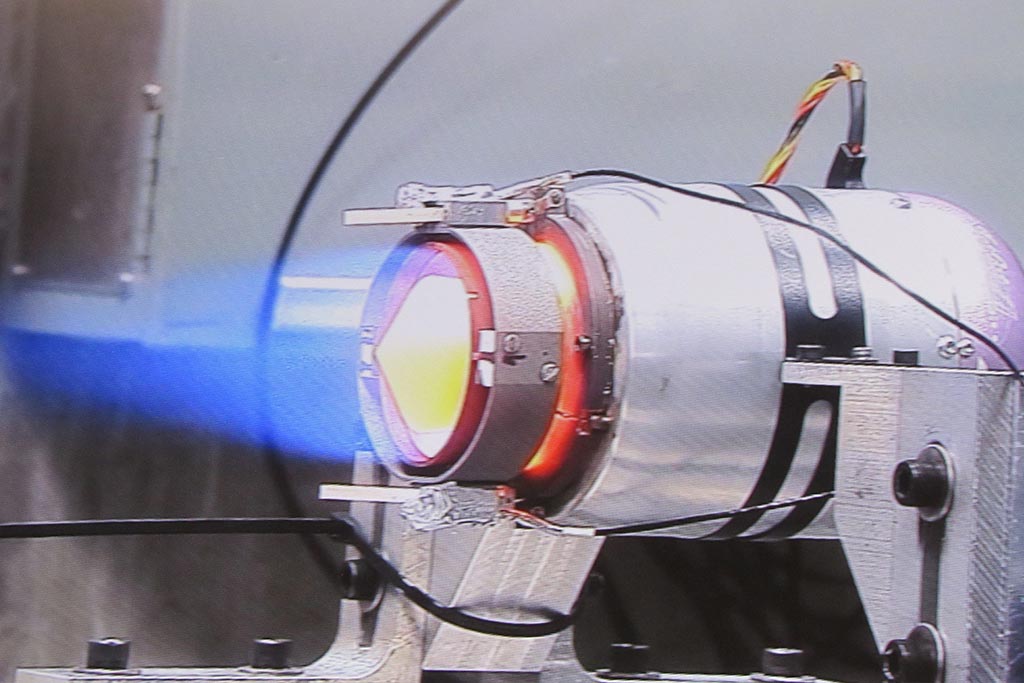
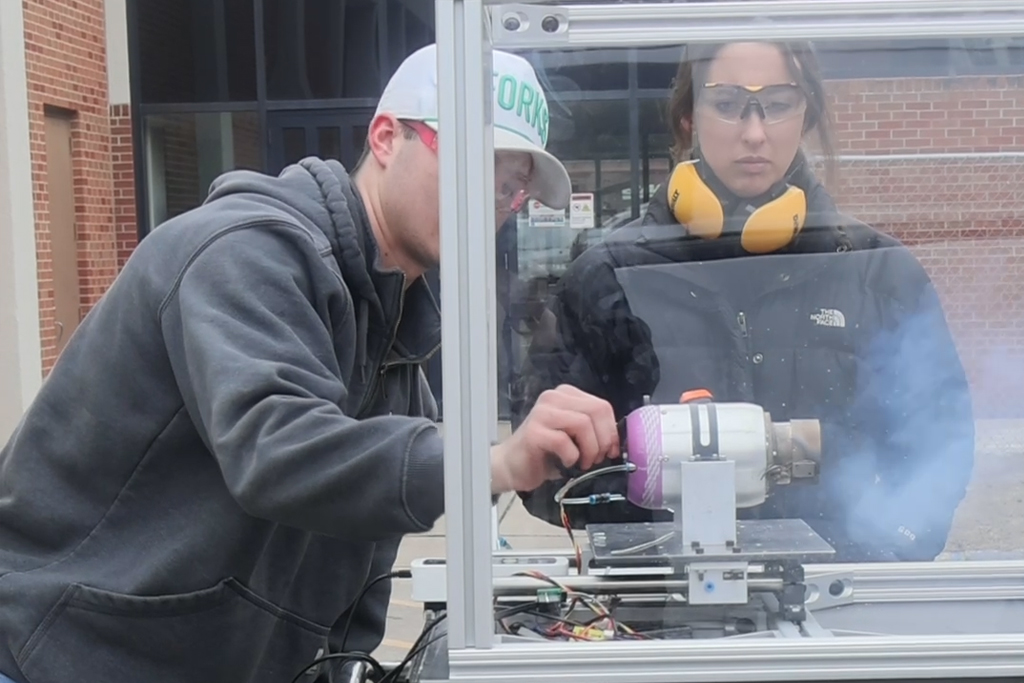
This year’s challenge? To design and build a variable thrust system for a Jetcat P100-RX —a compact turbine engine about the size of a football.
If that doesn’t sound staggering to you, consider this: variable thrust systems exist for the large engines you would see on a jet plane, but when it comes to scaling down that technology…it just doesn’t work.
“There weren’t any existing blueprints or guides—we had to invent a solution from scratch,” said senior Jaydn Affolter, one of the team members. “Scaling things down caused all kinds of problems, so we had to rethink and redesign everything.”
UND students embraced the challenge—and the opportunity.
“It was a pretty new experience. We’ve done design and manufacturing work in class before, but this was next-level.”
There was an additional challenge for the UND team: the college’s first APOP project, the team had to design and create their own workstations and testing setup before they could even begin testing and modifying their engine.
“Almost all of the other schools involved in this project have previously competed, so we started off with a disadvantage,” stated Jaydn. “Luckily, we have a great team and were able to quickly design and construct our testing setup and obtain all of the necessary equipment.”
In the fall, the team built a custom test stand to house their engine, a piece of equipment that will benefit future UND projects as well. The test stand allows them to safely run the engine while collecting key performance data like RPM, thrust, and temperature.
Like other senior design projects, they ran into other challenges along the way. “This project really exemplified the difficulties of engineering projects outside of the actual design,” said team member Rob Weakly. “Things such as lead times for parts, scheduling, meeting deadlines, project funding and more were challenging aspects to work with that gave valuable experience for the real world.”
“The biggest lesson I learned from this project was the importance of constant and clear communication when working virtually with other individuals,” said team member Katherine Kempel. “Our team was made up of both on-campus and distance students…as more and more ‘real world’ jobs transition to hybrid positions, I think that this experience will only become more relevant.”
An unmatched opportunity
“This kind of hands-on experience is invaluable,” said Dr. Carson Running, the team’s faculty advisor. “Students aren’t just learning theory—they’re building, testing, solving problems in real-time, and directly engaging with the purpose and mission of the Air Force.”
The program’s arrival at UND was no accident. Dr. Running, who previously advised an APOP team at the University of Dayton, helped bring it to Grand Forks. He made the case that UND—home to a new Aerospace Engineering degree, reputable for national security initiatives, and a prime location near an Air Force base—was the perfect fit.
The payoff? UND students found themselves at the heart of an elite program culminating in a national showcase at Wright-Patterson Air Force Base in Ohio. The team presented their engine modification to top engineers and researchers there, comparing results with those of other schools and demonstrating their accomplishments.
“This is the kind of challenge that launches careers,” Dr. Running said. “These students stand out because they’ve already done the kind of work many engineers don’t get to touch until they’re well into their profession.”
And the students were grateful for the opportunity. “The support from others was also a huge factor for our success,” said Jaydn. “Our team was awesome and we had some bright minds working on this project, but our faculty advisors helped us tremendously. We can’t thank Dr. Running, Dr. Fernandez-Tous and Mr. Steinhaur enough for their wonderful guidance and support.”
“I was immensely proud that our team was able to represent UND at the university’s first-ever year participating in the APOP competition,” said Michael Elua, a team member pursuing a concentration in Aerospace Engineering. “The team was able to take an extremely demanding set of design criteria and create a prototype that was able to function as intended.”
“I have always had a passion and interest in both aviation and spaceflight,” said Michael. “The APOP Competition seemed like an ideal way to learn more about jet propulsion while also being able to apply my creativity and the engineering knowledge I have obtained through UND.”
Written by Paige Prekker // UND College of Engineering & Mines