Launching into high altitudes and higher standards
The UND Advanced Rocketry Club doubles down on innovation at the world’s largest rocket engineering competition in Midland, Texas

The desert skies of Midland, Texas roared to life in June as collegiate rocketry teams from across the globe converged for the 2025 International Rocket Engineering Competition (IREC), drawing in 2,000 students from 143 universities in 22 countries. Among them was the University of North Dakota’s Advanced Rocketry Club (ARC).
Hosted by the Experimental Sounding Rocket Association (ESRA), IREC is the world’s largest collegiate rocketry competition. Teams design, build, and fly rockets in three altitude categories – 10,000, 30,000, and 45,000 feet – all while being evaluated on design, innovation, execution, and mission objectives.
But for UND’s ARC, the competition was more than a flight test – it was an opportunity to push boundaries, test ideas, and contribute to the future of space exploration.
Space flight and deep space exploration in mind
“Our team chose to enter the 2025 IREC to pursue a higher standard of engineering design, build, and testing,” said Club President Kristian Haugen, a double major in Aerospace and Mechanical Engineering. “This is the world’s largest rocket engineering competition, bringing over 2,000 students from all over the world together to share knowledge and experience in their rocket engineering endeavors.”
The UND rocket featured a custom-built payload focused on a complex challenge: understanding how low-viscosity liquids behave in microgravity.
“Our payload this year aimed to investigate fluid behavior of low viscosity liquid during microgravity conditions,” Haugen said. “This was spurred on by the current research into the topic for use during in-space fuel transfer missions.”
The club’s experiment tested two distinct Liquid Acquisition Device (LAD) designs during the rocket’s low-gravity flight phase.
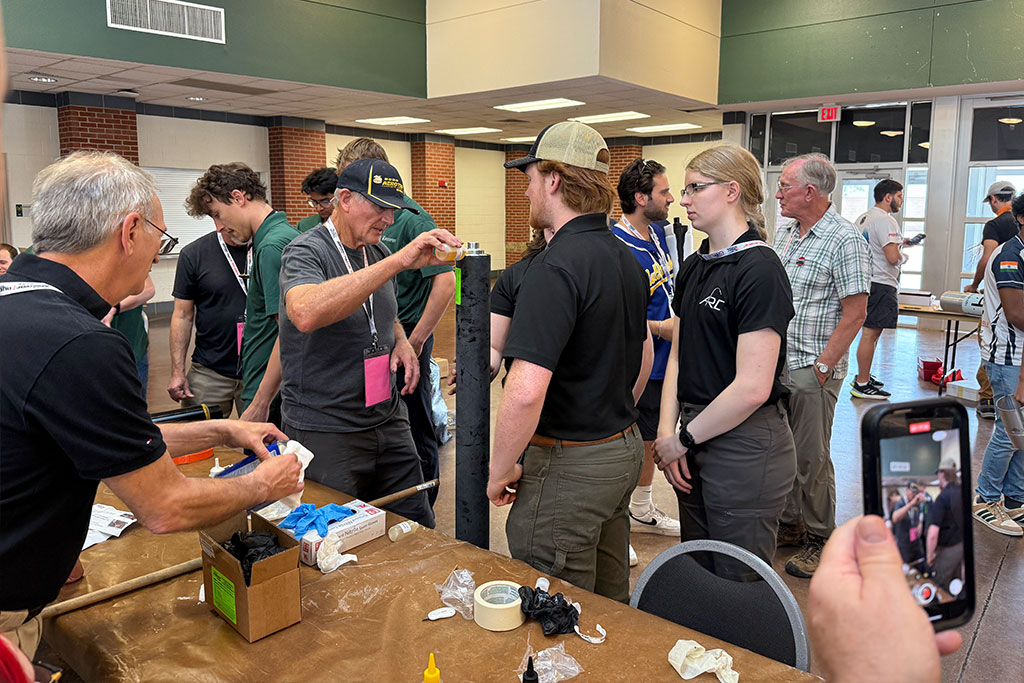
“Our project aims to provide experimental data on the behavior of low viscosity liquid during microgravity conditions,” Haugen continued. “This data is useful for the design of liquid acquisition devices and their implementation within space-based fuel and oxidizer tanks. The direction and control of liquid in a low G environment is a critical step in the path to in-space refueling missions to support deep space exploration and consistent lunar travel. Two separate designs were put to the test in our payload to characterize their effective fluid locomotion and retention during our rockets perceived low gravity phase of flight. In addition, our experiment was also able to collect data on fluid behavior in high G and tumbling scenarios, adding more depth to our experiment.”
The experiment has many direct real-world applications. The first of which being the implementation of new Liquid Acquisition Device geometries into fuel and oxidizer tanks destined for in-space operations. “The data that we have gathered from this experiment can be refined with new geometries added to the scope based on the current findings, and ultimately iterated upon until satisfactory results are obtained, and repeatable enough for large scale use,” described Haugen.
“In-space refueling being necessary for an interplanetary species, our project has direct ties to the future of space flight and deep space exploration.”
Innovation through creative teamwork
The ARC team faced a significant technical hurdle: capturing video footage mid-flight.
“I’m incredibly proud that we successfully captured in-flight video footage of our liquid acquisition devices—one of our primary goals,” said Anton Golovko, the Payload Lead and a Biology major. “Ensuring the Raspberry Pi recorded reliably during launch, flight, and descent was a major technical achievement that yielded valuable data.”
But for Golovko, it was more than the data—it was the people who made it happen.
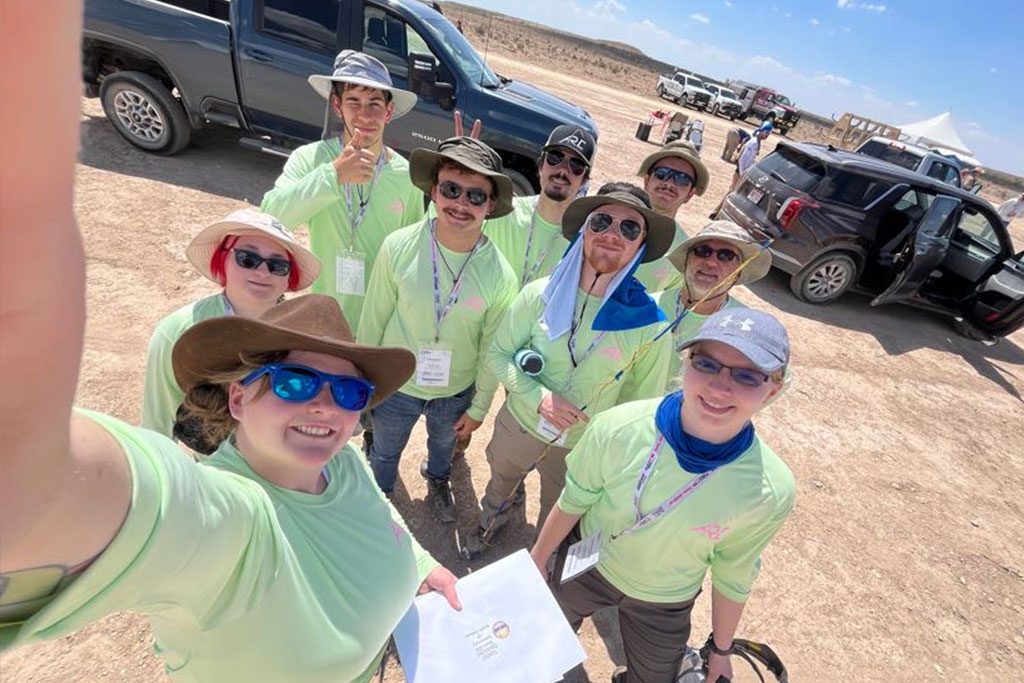
“What I’m most proud of is our team and how we came together to make this project a reality. Briana Penner contributed research and programming; Derek Reister worked on 3D modeling; Ryan Welter led programming with Spencer Johnson assisting; Jacob Schroeder handled machining and code; Travis Metzger supported calculations; and Kristian Haugen and Chase Radomski contributed to manufacturing, research, and 3D modeling. Their collaboration and dedication made this project a success.”
The experiment tackled a challenge relevant to NASA’s Artemis missions and broader space infrastructure.
“We were inspired by the growing need for better ways to manage fluids in microgravity, especially with NASA’s push for space missions like Artemis,” explained Golovko. “Handling fluids in zero-g is tricky, and we wanted to explore new designs that could help with liquid acquisition during orbital refueling or spacecraft operations.”
While NASA already uses fine mesh designs, but the team thought there was room for improvement, especially in how fluid is held and guided through a system.
“That’s what got us interested in trying different mesh sizes and different fluid management geometries,” said Golovko. “We’re also all passionate about space and hands-on engineering, so building a payload that could test these designs in flight felt like the perfect challenge. It was a way to apply what we’ve learned to make a real contribution to the field.”
The project incorporates innovation and creativity through the development of a unique multi-layered liquid acquisition device (LAD) system with varying mesh sizes, which improves fluid capture and retention under microgravity conditions, something not commonly seen in conventional designs. “Adapting these LADs to fit within the compact 4U CubeSat form factor required creative engineering and precise fabrication techniques, explained Golovko. “Using pentane as a visual and physical analog for cryogenic fluids also shows our innovative approach to safely simulating complex space environments on a suborbital platform.”
Launching more than a rocket: newfound passion
Airframe Lead Nicolette Dame entered the UND Advanced Rocketry Club as a rookie—and left as a rocketeer.
“I was brand new to rocketry when I joined the team, and on a whim decided to apply to be a team lead, said Dame. “I had zero experience, so I learned way more than I bargained for this year. I learned how to use simulation software to design and test the rocket, started learning how to use ANSYS simulation, and how to just build a rocket. I gained manufacturing and teamwork skills as well.”
Besides the new technical hurdles to overcome, there was also a time-old challenge to face: time management.
“We had many people who had no experience with rocketry (myself included) join the team, and ensuring that we get things done, and done well in time was a struggle,” Dame said. “It was also hard once people left for the summer. We were able to work on it by creating schedules and deadlines for people in shared calendars, also by going over goals in weekly team meetings.”
When asked to pitch the project in one sentence, her answer was succinct. “Liftoff: the rocket has gone upward, but there does the liquid inside go and what shape does it take?”
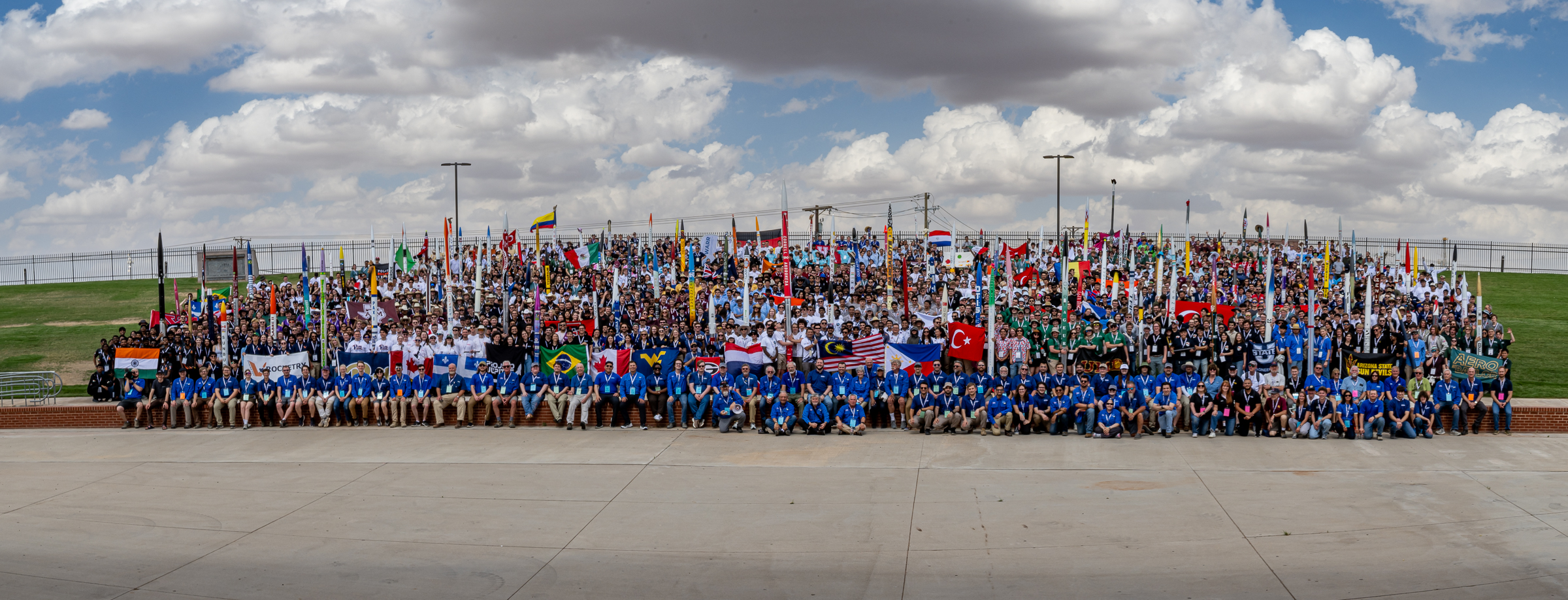
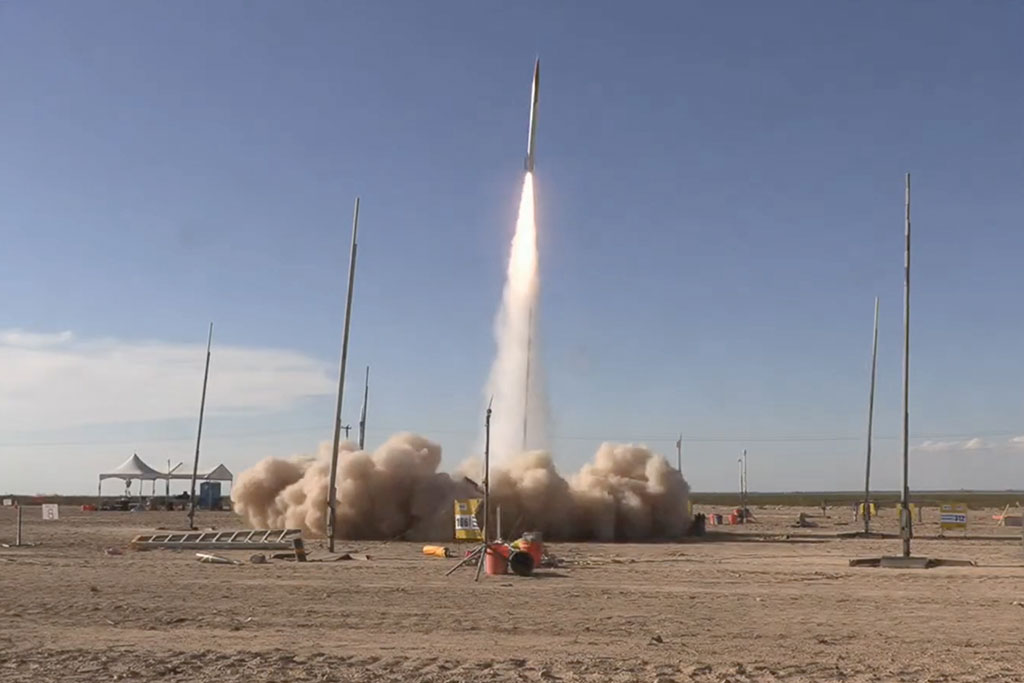
Despite challenges, setbacks, and scorching desert heat, the UND ARC team successfully launched their rocket, collected valuable data, and built something even more powerful—experience.
As they return to Grand Forks, the lessons from Midland will live on in the lab, the classroom, and in future missions. And as the next generation of rocket engineers, ARC’s members are more than ready to keep reaching higher.
Written by Paige Prekker // UND College of Engineering & Mines