Welding the language barrier between robots
Meet the cross-disciplinary student engineers who taught machines to speak the same language for a senior design project sponsored by BTD Manufacturing
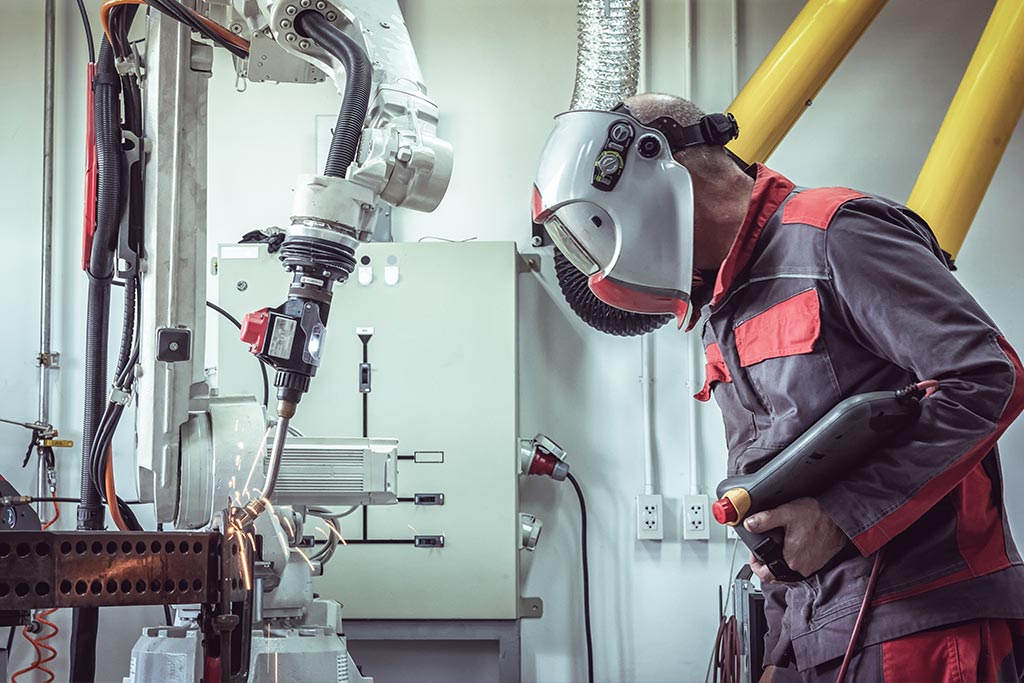
The whirring of mechatronics may be the sound of progress, but behind the scenes, these metal giants haven’t always spoken the same language. As technology continues to evolve, the barrier of communication between newer and older systems increasingly becomes more of a headache—and a costly one.
With 33 robotic welders running on two different industrial communication protocols, BTD Manufacturing faced a growing challenge: how to get their older and newer systems to talk to each other.
To weld the communication divide, BTD Manufacturing sponsored a senior design project for students at the UND College of Engineering & Mines. The “Any-Talk” Robotic Welding System, the senior design project created by mechanical and electrical engineering students, is the student-designed communication bridge between those robotic welders.
The system bridges robotic welders that speak DeviceNet and those fluent in Ethernet/IP and is housed with a touchscreen interface to make the whole thing easier for humans to use. The smart all-in-one solution is designed to not only translate machine talk but also display and manage part data for weld cell operators.
“Our project will help BTD extend the operational life of robotic welders while also allowing operators a more detailed, reliable way of counting manufactured parts,” said Lucas Wolf, an electrical engineering student on the team.
Long-distance engineering
Most of the electrical engineering students were working remotely from across the country. “The electrical engineering students all being distance — the closest being a 6+ hour drive — was a big challenge for us,” said Matthew Souder, an electrical engineering student from Edison, NJ. “But the on-campus mechanical engineering students were very supportive and helped us get over this obstacle. Their great teamwork and willingness to take on our hands-on tasks really helped make the distance a non-issue.”
Armed with webcams, virtual meetings, and a mountain of shared documents, the group stayed connected — despite being in different time zones and disciplines.
“Considering the geographic makeup of our team, we helped develop a Human Machine Interface cabinet while having a majority of our team located away from the Grand Forks area,” said Nick Andersen, a mechanical engineering student on the team. “Made possible by video calls and excellent communication, we designed, constructed, programmed and tested this prototype project, all while being largely remote from one another.”
Learning Each Other’s Languages, Too
While the robots were getting their translator, the humans were doing some learning of their own.
“This project was a team of both mechanical and electrical engineers,” said Wolf. “Each side had a different perspective and we both learned how to think a little more like each other.”
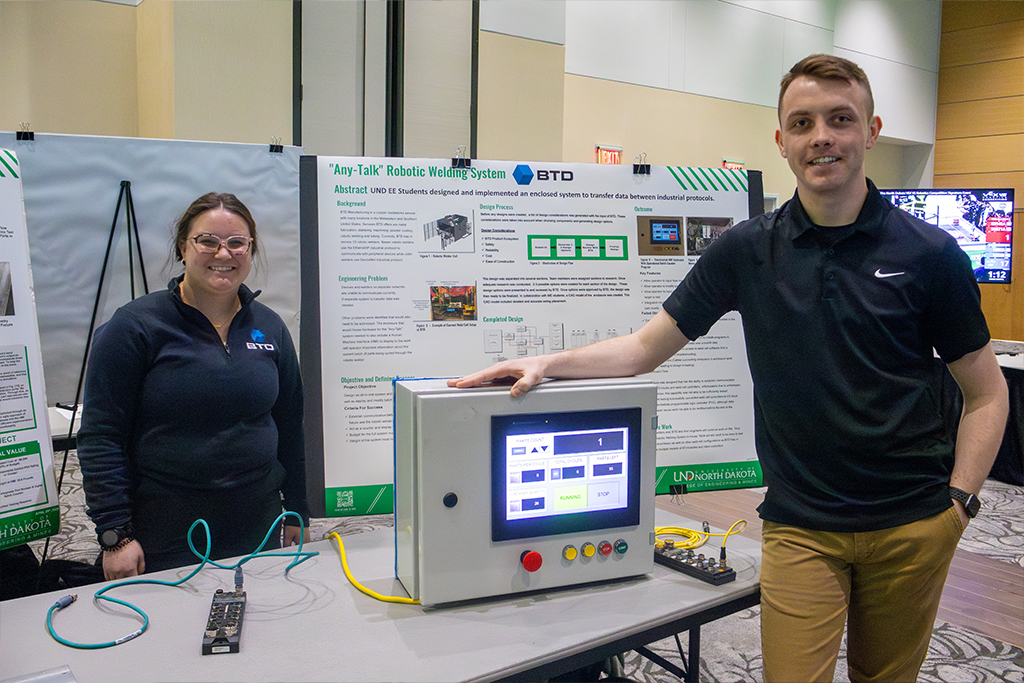
Mechanical engineers dug into electrical diagrams, while the electrical engineers started understanding the structure and build of physical enclosures. It wasn’t just about building a product — it was about building fluency in each other’s disciplines.
“As a mechanical engineering student, this project helped broaden my horizons by also requiring me to understand the prototype’s design from an electrical engineer’s perspective,” Andersen said. “To deliver the prototype on time, I had to learn how to interpret wiring schematics and educate myself on the prototype’s software program operations.”
That same spirit of teamwork kept things moving—even when the challenges were unfamiliar.
“Teamwork and collaboration were extremely important to the success of our project, especially given the very difficult and unfamiliar set of problems,” said Nicholas Larson, another mechanical engineering student. “By leveraging our diverse mechanical and electrical engineering knowledge, our team effectively tackled complex challenges through shared interests in technology and innovation.”
With no electrical engineers on campus, mechanical engineering student Thea Haaven-Farstad became the team’s boots on the ground.
“This project was a cross-disciplinary project with the School of Electrical Engineering & Computer Science and Department of Mechanical Engineering, and also a combination of distance students and on-campus students,” she said. “This unique blend of students allowed me to gain unique hands-on skills because I became the pathway from concept to creation. Because we did not have any electrical engineering students on campus, I was tasked with wiring and testing the unit.”
That experience gave her a whole new appreciation for the complexity of industrial tech. “Incompatible communication protocols are a common problem in manufacturing,” she added. “This project is a way to combat that problem, which will streamline workflow and alleviate some conflict when it comes to workflow planning.”
While the mechanical engineers were learning about wiring and programming, the electrical engineers were delving into the world of communication protocols.
“I learned a lot about communication protocols by researching what DeviceNet is and how one would go about translating between the two,” said Souder.
That deep dive into data transmission helped solve a big problem for BTD Manufacturing. “Our project tackles two problems overall,” explained Jon Misich, an electrical engineering student. “The first issue is updating the way industrial operators interact with automated industrial systems. In this project’s case, it involved an automated weld cell and how to retain functionality of those same automated industrial systems specifically while interfacing with more modern hardware.”
It’s a challenge many manufacturers face — how to modernize without tossing perfectly good machines. “This is an issue because support for these older network communication protocols are currently in the process of being phased out. And for many manufacturers, their expensive equipment is still perfectly viable in every other way,” Misich said.
Big picture thinking
For Misich, this project was a perfect match. “I opted for this project based on a number of reasons,” he said. “I felt that the skills I might gain while engaged in this project would be exceptional additions to my resume.”
Beyond the classroom, this student-built solution has serious real-world potential. Andersen is already thinking about what comes next: “By our developed prototype, the 30+ weld cells BTD operates will now run off of a single operating system, thereby aiding the workers who operate them and providing BTD greater manufacturing output.”
And their work will live on. BTD Manufacturing’s engineers plan to continue refining the Any-Talk system in-house, using the students’ documentation and prototype as a springboard.
“This problem highlights innovation because it is such a common problem in manufacturing that hasn’t been addressed due to the time and effort required to successfully bridge that communication incompatibility,” said Haaven-Farstad. “Not only were we given the opportunity to solve this common problem, but we also clearly and comprehensively documented it so that the process is able to be replicated.”
Robots united, students graduated
From Ethernet/IP to DeviceNet, CAD models to wiring diagrams, video calls to late-night troubleshooting — this team didn’t just build a piece of hardware. They built trust, understanding, and a whole new set of skills.
“I gained a profound appreciation for the sheer scope and vital importance of PLCs and sensors in both industrial applications and everyday life,” said Larson. “PLCs are instrumental in how most things are created and distributed and have a critical role in building automation and environmental control environments.”
“There were many things I learned from this project,” Wolf added. “Holding team meetings, researching, developing designs, and overcoming setbacks were all things I had ample practice at throughout this project.”
Turns out, they didn’t just teach robots how to talk to one another — they even taught each other a thing or two along the way.
Written by Paige Prekker // UND College of Engineering & Mines