Wired for determination
UND students power through Lunabotics contest with innovation and grit

Hands-on learning took center stage as a team of UND students traveled to Ames, Iowa, to compete in a Lunabotics contest hosted by Iowa State University.
NASA’s Lunabotics Challenge tasks students with designing and building a functional robot capable of off-world construction operations, the contest simulates the type of problem-solving and systems engineering required for future space exploration—including lunar and Martian missions.
The experience gave students a real-world opportunity to apply their classroom knowledge to complex engineering challenges—collaborating across disciplines, troubleshooting hardware issues, and managing a full-scale design and build project.
At Iowa State, teams from across the Midwest came together to test their engineering mettle. UND’s team rose to the occasion, placing 5th overall—even with an unexpected technical issue cutting their robot’s run short.
“The team was given 30 minutes for our robot to run during the match, but stopped at 12 minutes due to a mechanical failure. The motor mount for our shaker motor tore apart due to cyclic fatigue,” explained team lead Cole Graner. “We are still proud that we placed as high as we did with only about a third of our allotted time!”
Immersed in the full systems engineering process—from design and fabrication to live problem-solving under pressure—students embraced the challenge.
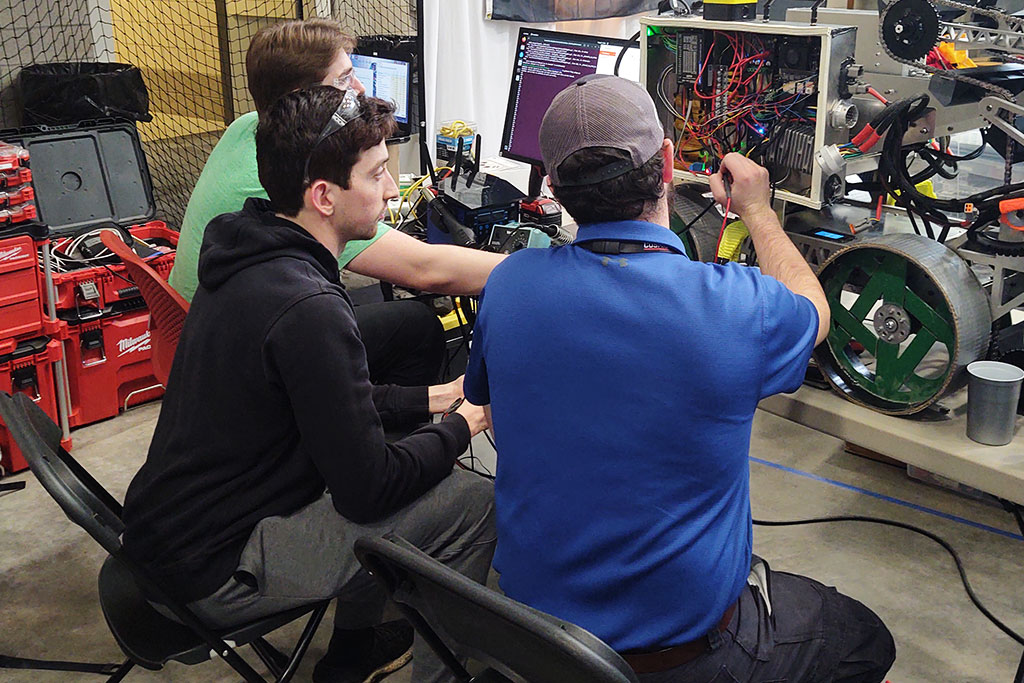
“The team’s largest challenge was overcoming faulty GPIO (General purpose input/output) pins in the robot’s jetson computer. This means two motors were not receiving signals and could not operate. To fix this problem, the team rerouted the motors to a constant 5-volt output pin and inserted a mechanical switch that would be pressed when the robot was fully extended,” Graner described.
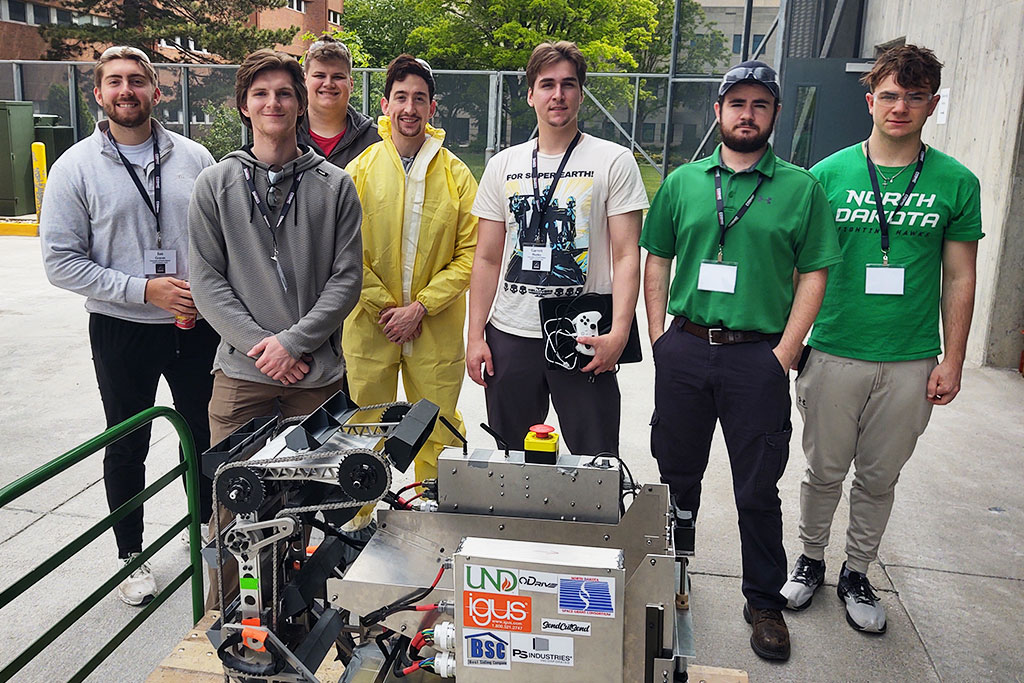
For many team members, the experience was an opportunity to apply their discipline-specific skills in a collaborative environment that mimicked real-world engineering work. Graner was especially proud of what the electrical team accomplished.
“I’m most proud of the electrical system of the robot. The electrical engineers on the team poured hundreds of hours into the robot making sure the cables were organized and protected. Additionally, the electrical team decided to incorporate two control boxes instead of the typical one control box. This ensures the robot would be balanced and create a lower center of gravity.”
The project also served as a valuable introduction to project management and leadership.
“The most impactful lessons and skills I have learned throughout the project are systems engineering and team management. Being able to coordinate a large team of multidisciplinary engineers and plan a budget and timeline are essential for any real-world project. I plan to take these skills with me when I enter the workforce,” Graner shared.
In true UND fashion, the project showcased the importance of cross-discipline collaboration. Advised by Jeremiah Neubert and John Nordlie, students from the School of Electrical Engineering & Computer Science and the Department of Mechanical Engineering worked alongside computer scientists to bring each subsystem of the robot to life.
“I’m very proud of the team and what they accomplished, overcoming some serious technical problems with a clever solution,” said John Nordlie. “They never gave up, and made things work in the end.”
“Teamwork and collaboration were essential to the completion of the project,” said Graner. “The robot requires a mechanical frame paired with electrical systems that require large amounts of programming. We were fortunate to have a team comprised of mechanical and electrical engineers as well as computer scientists that could each handle the different subsystems of the robot.”
Reflecting on the experience, Graner emphasized the value of diverse perspectives and peer learning.
“The most surprising thing I learned along the way is that everyone has a different background and carry their own experiences and ideas with them. Collaborating with one another can help bring these ideas to light and inspire new and creative designs to solve problems!”
From multi-disciplinary collaboration to problem-solving under pressure, the Lunabotics Challenge provided UND students with an authentic glimpse into what it takes to be an engineer—preparing them to tackle tomorrow’s challenges with creativity, resilience, and teamwork.
Written by Paige Prekker // UND College of Engineering & Mines