From Badlands to the classroom via virtual field trip
A virtual field trip aims to inspire future geologists by bringing Jurassic discoveries to the classroom

When do most geoscientists first fall in love with rocks, fossils, and the Earth’s story? Statistics indicate that it often begins with an introductory geology course in college.
But what if that spark could be ignited even earlier?
Thanks to a National Science Foundation (NSF)-funded project led by Dr. Kristyn Voegele, that spark may soon be striking much sooner — during high school biology, math, geography or even physics classes.
Dr. Voegele, who joined the faculty of the UND Harold Hamm School of Geology & Geological Engineering in August 2024, brought the innovative initiative with her: a multi-year effort to develop a dynamic, online Virtual Field Trip that uses dinosaur paleontology as both a gateway and a “hook” into the world of geoscience.
Fossils, fieldwork and future geoscientists
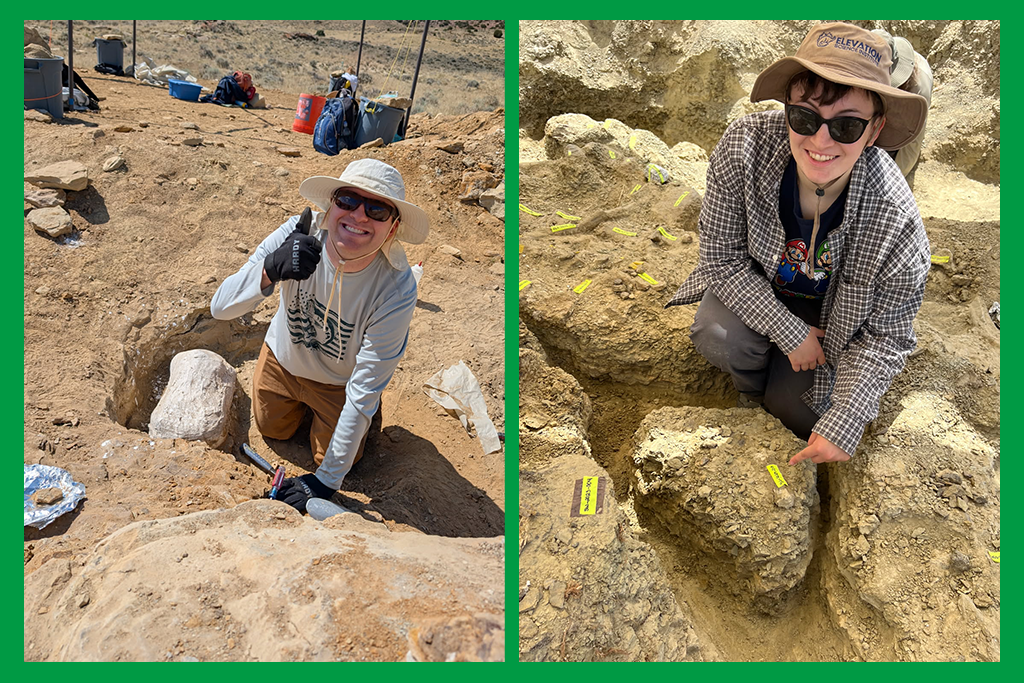
The heart of the project lies in real paleontological fieldwork in the famed Morrison Formation of Montana, a fossil-rich Jurassic deposit teeming with dinosaur bones. For three summers, the NSF grant has funded UND Harold Hamm School of Geology & Geological Engineering faculty and students to collaborate with the Elevation Science Institute and researchers from Arizona State University and Villanova University, excavating and documenting remarkable fossil finds.
In the summer of 2025, Drs. Voegele and Paul Ullmann (a co-Principal Investigator) led Year 2 of this expedition, joined by three UND students: geology major Julia Baisch, geology master’s student Brian Skillman and geology minor Adam Shea. Together, the crew unearthed partial skeletons of Jurassic titans — including the fearsome Allosaurus and several long-necked sauropods — in a two-week dig through the Montana badlands.
But bones weren’t the only treasures uncovered. The students also gained invaluable skills in fossil identification, wilderness navigation and field research methods.
Capturing the experience, sharing the excitement
Every moment of the expedition was captured by a professional science media specialist, whose photographs and videos will be transformed into immersive online lessons for the virtual field trip. Later this fall, those raw visuals are being edited and adapted by UND Communication students, who are helping shape the experience for a high school audience.
The final product will enable students anywhere in the world to virtually “step into the field” alongside real scientists, explore fossil sites, and apply geoscience concepts to what they observe. Lessons will align with high school curricula across disciplines — making Earth science not only relevant but also thrilling.
Measurable impact
The team’s academic collaborators are also developing a survey tool that will measure how students perceive themselves as geoscientists before and after engaging with the virtual field trip. That tool, along with the project itself, will be made available to the global geoscience education community to support STEM outreach well beyond UND.
Next summer, Drs. Voegele and Ullmann will return to the field for the final season of this project, bringing with them another cohort of passionate UND students eager to dig into the Earth’s ancient past — and maybe change a few futures while they’re at it.
Because loving rocks? That’s not just for college kids. It’s a passion that can start young — with a dinosaur bone, a virtual field trip and a little help from the Badlands of Montana.
Written by Paige Prekker // UND College of Engineering & Mines