Celebrating Native American Heritage Month
This post was made with the help of the American Indian Studies Department, who recommended several of the titles listed. We’ve featured authors belonging to the Native Tribes of North and South Dakota to honor their histories and legacies for Indigenous Peoples’ Month. Louise Erdrich, Lise Erdrich, Heid E. Erdrich, and Angela Erdrich belong to the Turtle Mountain Band of Chippewa Indians of the Ojibwe people. Louise Erdrich has won the National Book Award for Fiction (2012) as well as the Pulitzer Prize (2021). Layli Long Soldier is a member of the Oglala tribe of the Lakota People, and winner of the National Book Award for Poetry (2017). Diane Wilson, is a Mdewakanton descendant and an enrolled member of the Sicangu Oyate, won the Minnesota Book Award for Fiction (2022). Gwen Westerman is a member of the Sisseton Wahpeton Oyate of the Lake Traverse Reservation, and is currently the Poet Laureate for the state of Minnesota.
Land Acknowledgement
Today, the University of North Dakota rests on the ancestral lands of the Pembina and Red Lake Bands of Ojibwe and the Dakota Oyate – presently existing as composite parts of the Red Lake, Turtle Mountain, White Earth Bands, and the Dakota Tribes of Minnesota and North Dakota.
We acknowledge the people who resided here for generations and recognize that the spirit of the Ojibwe and Oyate people permeates this land. As a university community, we will continue to build upon our relations with the First Nations of the State of North Dakota – the Mandan, Hidatsa, and Arikara Nation, Sisseton-Wahpeton Oyate Nation, Spirit Lake Nation, Standing Rock Sioux Tribe, and Turtle Mountain Band of Chippewa Indians.
Fiction

The Antelope Wife by Louise Erdrich
Past and present combine in a contemporary tale of love and betrayal influenced by Chippewa tradition, myth and legend. Rozin and Richard, living in Minneapolis with their two young daughters, seem a long way from the traditions of their Native American ancestors. But when one of their acquaintances kidnaps a strange and silent young woman from a Native American camp and brings her back to live with him as his wife, the connections they all hold to the past rear up to confront them. Soon the patterns of their ancestors begin to repeat themselves with truly tragic consequences.

The Night Watchman by Louise Erdrich
Based on the extraordinary life of National Book Award-winning author Louise Erdrich’s grandfather who worked as a night watchman and carried the fight against Native dispossession from rural North Dakota all the way to Washington, D.C., this powerful novel explores themes of love and death with lightness and gravity and unfolds with the elegant prose, sly humor, and depth of feeling of a master craftsman.

The Red Convertible and Other Stories
In Louise Erdrich’s fictional world, the mystical can emerge from the everyday, the comic can turn suddenly tragic, and violence and splendor inhabit a single emotional landscape. The fantastic twists and leaps of her imagination are made all the more meaningful by the deeper truth of human feeling that underlies them. These thirty-six short works selected by the author herself—including five previously unpublished stories—are ordered chronologically as well as by theme and voice, each tale spellbinding in its boldness and beauty. The Red Convertible is a stunning literary achievement, the collected brilliance of a fearless and inventive writer.

In Night Train, Lise Erdrich offers a sharp-humored and powerful primer. Set in the small towns and reservations of northwestern Minnesota and western North Dakota, her literary snapshots capture lives playing out against backdrops of emergency rooms, supermarket aisles, backwoods parties, family breakfast tables, booze-soaked taverns, and sterile but emotionally fraught offices. As the pressures of daily life collide with the insidiousness of history, these stories reveal the personal struggles and small triumphs of people facing the absurdities of bureaucracy, cycles of poverty and addiction, and out-sized notions of Indian legends and culture.

Josie Dances by Denise Lajimodiere, with Illustrations by Angela Erdrich
Josie dreams of dancing at next summer’s powwow. But first she needs many special things: a dress, a shawl, a cape, leggings, moccasins, and, perhaps most important of all, her spirit name. To gather all these essential pieces, she calls on her mom, her aunty, her Kookum, and Grandma Greatwalker. They have the skills to prepare Josie for her powwow debut. As the months go by, Josie practices her dance steps while Mom stitches, Aunty and Kookum bead, and Grandma Greatwalker dreams Josie’s spirit name. Josie is nervous about her performance in the arena and about all the pieces falling into place, but she knows her family is there to support her.
Poetry
Little Big Bully by Heid E. Erdrich
Little Big Bully begins with a question asked of a collective and troubled we – how did we come to this? In answer, this book offers personal myth, American and Native American contexts, and allegories driven by women’s resistance to narcissists, stalkers, and harassers. These poems are immediate, personal, political, cultural, even futuristic object lessons. What is truth now? Who are we now? How do we find answers through the smoke of human destructiveness? The past for Indigenous people, ecosystem collapse from near-extinction of bison, and the present epidemic of missing and murdered Indigenous women underlie these poems. Here, survivors shout back at useless cautionary tales with their own courage and visions of future worlds made well.

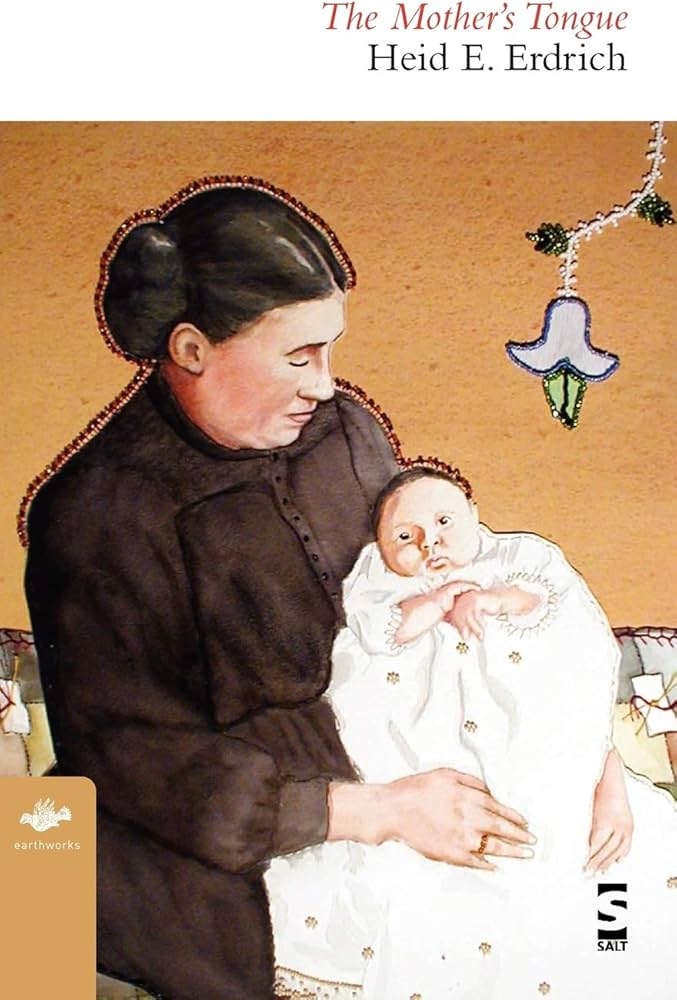
The Mother’s Tongue by Heid E. Erdrich
Shortlisted for the Minnesota Book Awards 2006. Poems that consider and figure women’s experiences of work, sex, pregnancy, childbirth, and mothering within the particular contexts of the prairie landscape, American Indian cultures and Ojibwe language recovery.
WHEREAS confronts the coercive language of the United States government in its responses, treaties, and apologies to Native American peoples and tribes, and reflects that language in its officiousness and duplicity back on its perpetrators. Through a virtuosic array of short lyrics, prose poems, longer narrative sequences, resolutions, and disclaimers, Layli Long Soldier has created a brilliantly innovative text to examine histories, landscapes, her own writing, and her predicament inside national affiliations. “I am,” she writes, “a citizen of the United States and an enrolled member of the Oglala Sioux Tribe, meaning I am a citizen of the Oglala Lakota Nation—and in this dual citizenship I must work, I must eat, I must art, I must mother, I must friend, I must listen, I must observe, constantly I must live.” This strident, plaintive book introduces a major new voice in contemporary literature.

Non-Fiction

Beloved Child: A Dakota Way of Life by Diane Wilson
Among the Dakota, the Beloved Child ceremony marked the special, tender affection that parents felt toward a child whose life had been threatened. In this moving book, author Diane Wilson explores the work of several modern Dakota people who are continuing to raise beloved children: Gabrielle Tateyuskanskan, an artist and poet; Clifford Canku, a spiritual leader and language teacher; Alameda Rocha, a boarding school survivor; Harley and Sue Eagle, Canadian activists; and Delores Brunelle, an Ojibwe counselor. Each of these humble but powerful people teaches children to believe in the “genius and brilliance” of Dakota culture as a way of surviving historical trauma.

Spirit Car: Journey to a Dakota Past by Diane Wilson
Diane Wilson has a family like everybody else’s. Her Swedish American father was a salesman at Sears and her mother drove her brothers to baseball practice and went to parent-teacher conferences. But in her thirties, Diane began to wonder why her mother didn’t speak of her past. So she traveled to South Dakota and Nebraska, searching out records of her relatives through six generations, hungering to know their stories. She began to write a haunting account of the lives of her Dakota Indian family, based on research, to recreate their oral history that was lost, or repressed, or simply set aside as gritty issues of survival demanded attention.

Mni Sota Makoke: The Land of the Dakota by Gwen Westerman & Bruce White
Much of the focus on the Dakota people in Minnesota rests on the tragic events of the 1862 U.S.–Dakota War and the resulting exile that sent the majority of the Dakota to prisons and reservations beyond the state’s boundaries. But the true depth of the devastation of removal cannot be understood without a closer examination of the history of the Dakota people and their deep cultural connection to the land that is Minnesota. Drawing on oral history interviews, archival work, and painstaking comparisons of Dakota, French, and English sources, Mni Sota Makoce tells the detailed history of the Dakota people in their traditional homelands for at least hundreds of years prior to exile.

Skull Wars: Kennewick Man, Archaeology, and the Battle for Native American Identity
The 1996 discovery, near Kennewick, Washington, of a 9,000-year-old Caucasoid skeleton brought more to the surface than bones. The explosive controversy and resulting lawsuit also raised a far more fundamental question: Who owns history? In this new work, Thomas charts the riveting story of this lawsuit, the archeologists’ deteriorating relations with American Indians, and the rise of scientific archeology. His telling of the tale gains extra credence from his own reputation as a leader in building cooperation between the two sides.