Saving Earth one person, one act at a time
Dietetics students, GRO.UND leaders demonstrate hands-on sustainability tips at Earth Day Fair
Earth Day may come around just once every April 22, but dozens of visitors to UND’s Education Building last week learned hands-on how they can make a meaningful impact on our planet all 365 days a year.
The interactive “Earth Day Fair 2025: Grow, Eat, Repeat — A Cycle of Sustainability” was hosted by the Department of Nutrition & Dietetics within the College of Nursing & Professional Disciplines, as well as the GRO.UND Learning Gardens within the College of Education & Human Development.

“It’s important for people to learn about sustainable food practices because our resources are finite,” said Erin Lauckner, clinical assistant professor in Nutrition & Dietetics. “Food waste is a big part of greenhouse gas emissions, so we need to ask ourselves what we can do to reduce that impact.
“Sometimes when we talk about sustainability, the issue can seem so big that people think, ‘Oh, I can never make a difference,’ but that’s not true. Many things are within our control.”
And those are exactly the kind of best practices that juniors in UND’s Accelerated Dietetics master’s degree program set out to demonstrate as they filled the corridors with exhibits and lively conversation.

How you can help save the Earth
The goal for the day? Teach others practical ways to reduce food waste, eat more sustainably and make environmentally conscious food choices.
“These students have come up with some great ideas,” Lauckner said. “They’re making the sustainability-nutrition link and showing their peers that ‘Yeah, this is doable. I personally can make a difference — even as an individual student at UND.’”
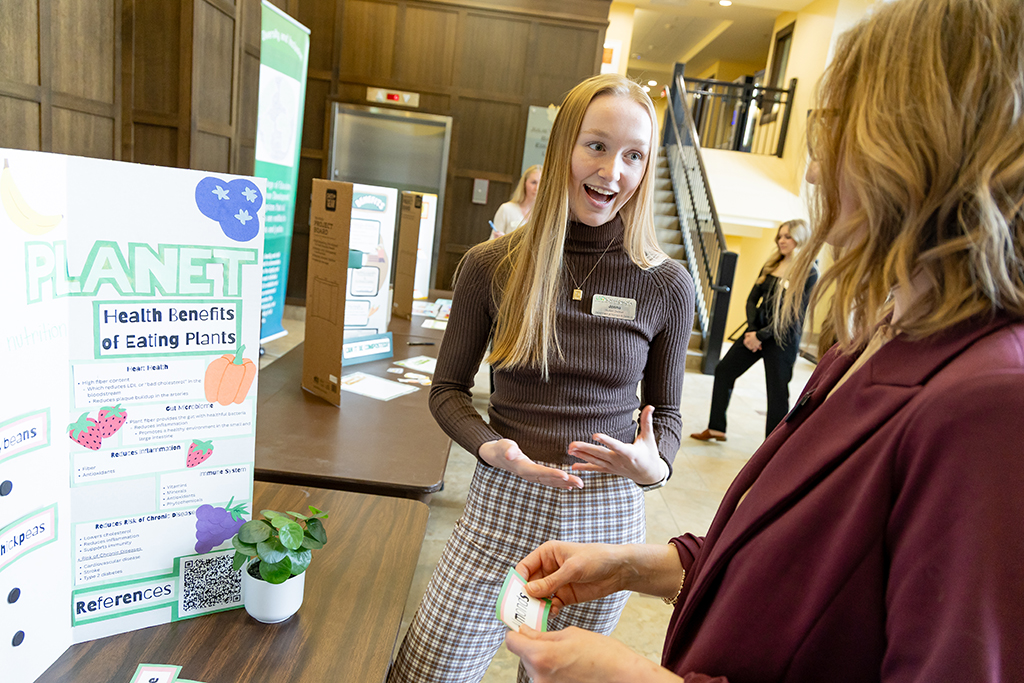
Jenna Torborg’s interactive exhibit “Green Plate, Green Planet” showed visitors the “power of plant-based nutrition.”
“Something as simple as going to the grocery store and purchasing those plant-based foods — fruits and vegetables, greens and legumes — can help your health and our planet,” Torborg said.
“I’m hoping people learn today how they can become more sustainable and make life changes that will help the Earth for future generations to come.”
Torborg explained how plant-based foods can improve heart and gut health as well as reduce inflammation and the risk of chronic disease, not to mention the many ways they boost the immune system with their high vitamin, mineral and antioxidant content.
Speaking on sustainability for the planet, she explained how plant-based foods create oxygen and regulate climate, as well as how they stabilize the ecosystem and generate healthy soil.
To amp up the fun, Torborg asked participants to exercise their brain power by matching plant-based foods with their sources. Did you know tofu comes from soybeans? (Yep.)
The lesson of waste not, want not
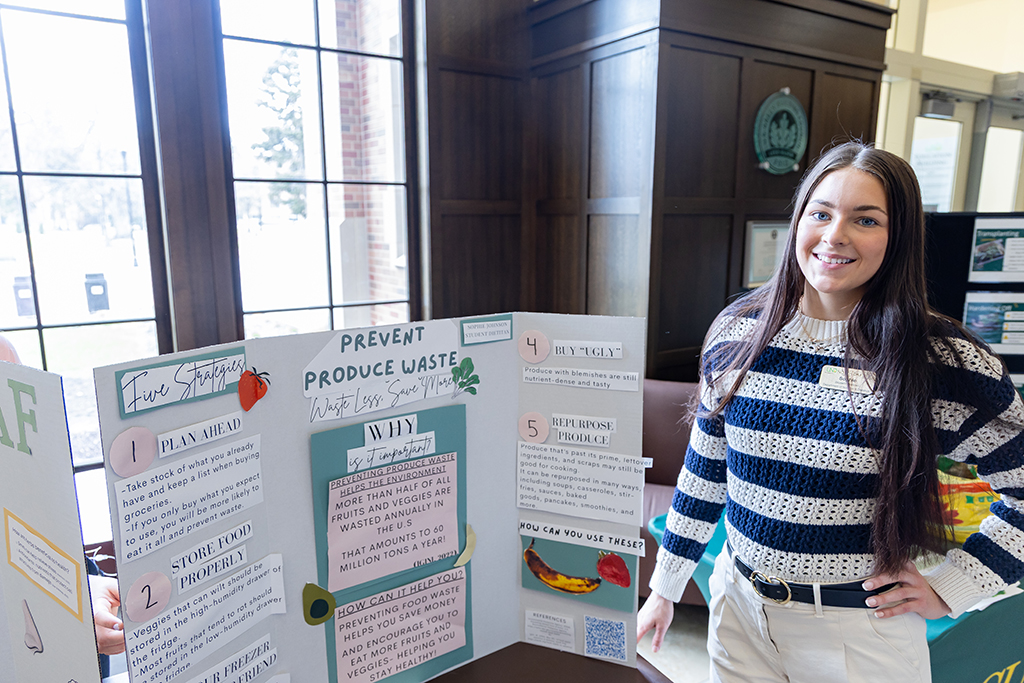
Sophie Johnson presented “Five Strategies to Reduce Food Waste at Home.”
“There are so many small ways people can help prevent food waste while helping the environment and their own health,” Johnson said.
For instance, “Take stock of what you have at home before you go grocery shopping,” she said. “And make a list so you don’t buy more than what you need.”
Johnson also suggested people take care to store their produce properly — the veggies in the high-humidity drawer and the fruits in the low-humidity drawer. Don’t cut them until you’re ready to use them, she said. You also can extend the shelf life of some fruits and vegetables by putting them in the freezer.
After all, nobody wants to be part of the shocking statistic that Johnson shared from sustainability author Martina Igini. Believe it or not, Igini said that more than half of all fruits and vegetables in the U.S. are wasted each year. That amounts to a whopping 60 million tons.

The plants that keep on giving
Anna Biby presented yet another way to practice sustainable habits with her “Un-Bay-LEAF-able Herbs” exhibit.
Why buy them when you can grow them, right?
“Tasty herbs are one of the easiest plants to grow,” Biby said. “All it takes is three easy steps: You plant them. You water them. You put them in a sunny window and watch them grow.”
Biby pointed out that many herbs can be purchased in the grocery store produce section once and then be repotted in soil at home for forever use.
“Using fresh herbs from your home is more sustainable and less expensive (than buying them every time you want them for a dish.)”
Further, fragrant herbs such as lavender and rosemary are known to reduce stress, Biby said, and they are filled with nutrients “that help protect your cell structures from damage.”
Still more students offered helpful advice on how to “Learn to Love a Local Lunch” and how to cut down on those “Cabinet Castaways.”
Kendall Herman explained that the so-called cabinet castaways — the food that gets pushed to the back of the shelf and eventually gets thrown — usually “comes from products meant for a specific use or recipes or events that just never happened.”
She suggested people swap out those specific-use products for ingredients they use more frequently.
“People should buy in bulk only when they know they’ll use everything,” Herman added. “And then they can rotate their stock using the first-in, first-out method.”
Save Earth and support your local growers
Tristan Bisbee shared that the benefits of buying food grown close to home are threefold.
Not only do consumers support the local economy and decrease the carbon footprint by cutting down on transportation, they also reap the benefit of eating foods at their peak ripeness and nutritional value.
Local foods also can help fight food insecurity by increasing the supply of high-quality foods at affordable prices, he said. In addition, community gardens sometimes provide opportunities for free food.
“While supporting local food sources, your money is not going to be spread out across a bunch of big organizations,” Bisbee said. “Instead, it’s going to be pumped right back into your local and regional economy, where you live.”
UND gardeners give everyone a green thumb
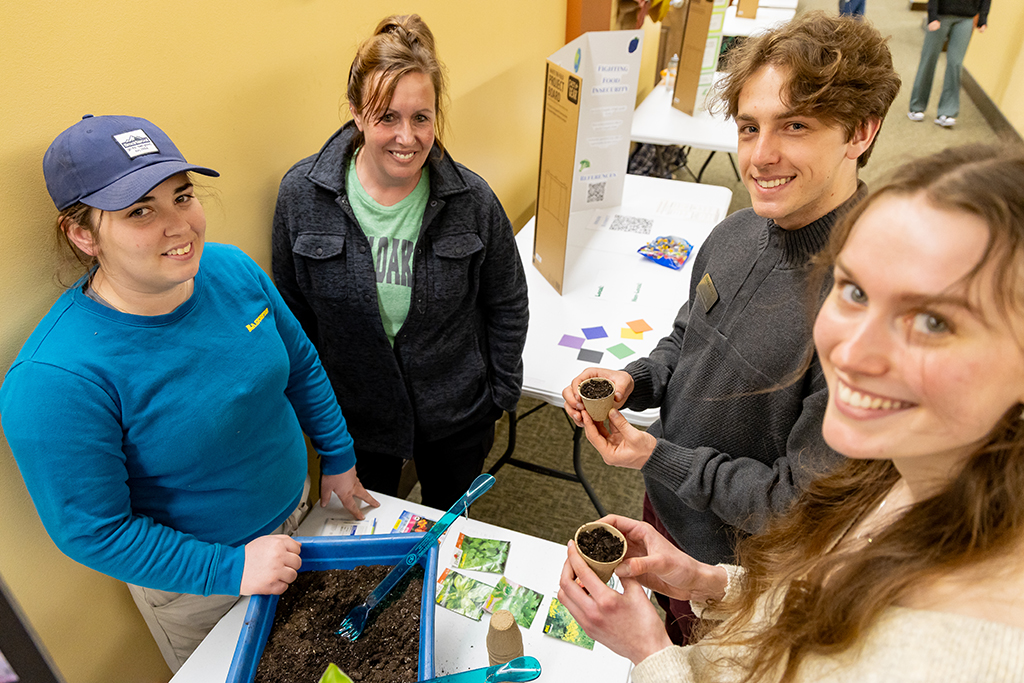
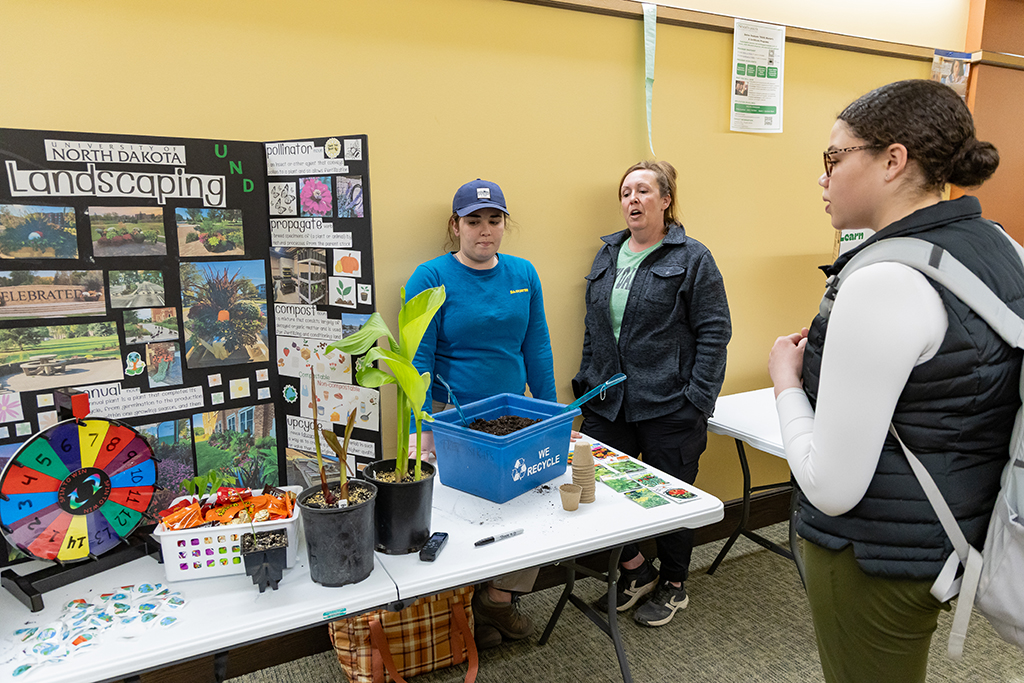
More hands-on action could be found at the booth tended by UND horticulturalist Melissa Grafenauer and landscape assistant Emily Orr.
Participants dug in the dirt to plant their own seed-pots-to-go while also spinning the wheel for a quiz question and a chance to win a sweet treat.
Meanwhile, of course, they learned how the landscape artists of UND Facilities Management are doing their part in sustainability efforts. (You can read a profile on Grafenauer in a past UND Today story.)
For starters, did you know that UND plants 15,000 annual flowers each year or that a single landscape worker collects a 5-gallon bucket of trash across campus each day? Or, that for every tree the University must cut down, about 10 new trees are planted?
“I don’t think everybody knows quite what we do in an effort to reuse and recycle,” Grafenauer said. “We use all of the plants that we pull out in the spring and the fall, plus all of the weeds we pull and the leaves we collect — it all gets put into a compost pile.
“Then, by turning that compost pile with a big payloader, watering it and heating it up in the middle to break it all down, we can feed it to the flowerbeds again about two years later.”
Woody stalks are kept separate and are put through a wood chipper to be used for mulch.
Orr added that the department works hard to stay fiscally responsible, too. Recycled pallets are used to make temporary plant shelving in the shop.

And those gorgeous 7-foot red, orange and hot-pink canna lily flowers you see across campus all summer? Those giant root bulbs can cost up to $30 a pop, but UND doesn’t pay that.
Instead, Grafenauer says her small gardening crew digs every one of them up, shakes the dirt off and overwinters them at just the right temperature so they can be replanted in the spring.
“That saves UND about $7,000 every year,” she said. Plus, the gardeners have a secret spot to grow their own pumpkins for the fall planters.
Orr has been dreaming up something new to plant in The Quad this year, too. It will be a planter with all edible plants, including a special vining spinach.
How does your garden grow?
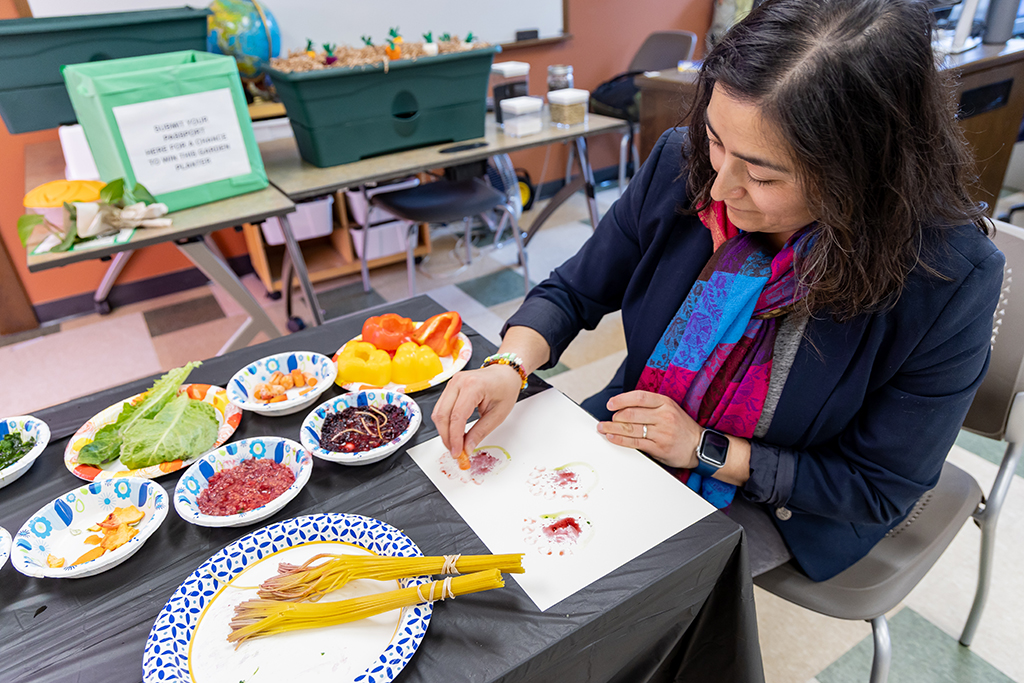
Inside the GRO.UND greenhouse classroom, there was another flurry of activity. That’s where Meg Livers, health promotion specialist with UND Wellness & Health Promotion, was guiding guests in mindful expression through art.
But this wasn’t any ordinary art — it was art created with fruits and vegetables. That’s right, fruits and vegetables. Participants used sliced limes to stamp and a handful of half-cooked spaghetti noodles to “paint” with smooshed spinach, raspberries and blackberries, among other things.
“Sometimes you look into your refrigerator and things have gone bad, but you don’t want to necessarily just throw or compost them,” Livers said. “That’s when you think of fun, creative activities that also can be stress-relieving.”
It was a point taken by Assistant Professor Elizabeth Suazo-Flores of the College of Education & Human Development.
“I love this event. I came last year, too. It just reminds me of how we can do beautiful things with simple materials that are not plastic or pollution for our Earth,” Suazo-Flores said. “I love doing that because it makes me feel so good. It’s very much like a mindfulness experience for me.”
Participants also measured their personal carbon footprints by taking a special online quiz and learned how to easily propagate plants by taking clippings from other plants and adding a sprinkle of cinnamon as an antifungal agent.
And probably most exciting of all — at least to one guest — people learned how to make their own nutrient-rich potting soil with a plastic tote, kitchen food scraps, shredded paper and worms (plus, a little sand, vermiculite and coconut coir).
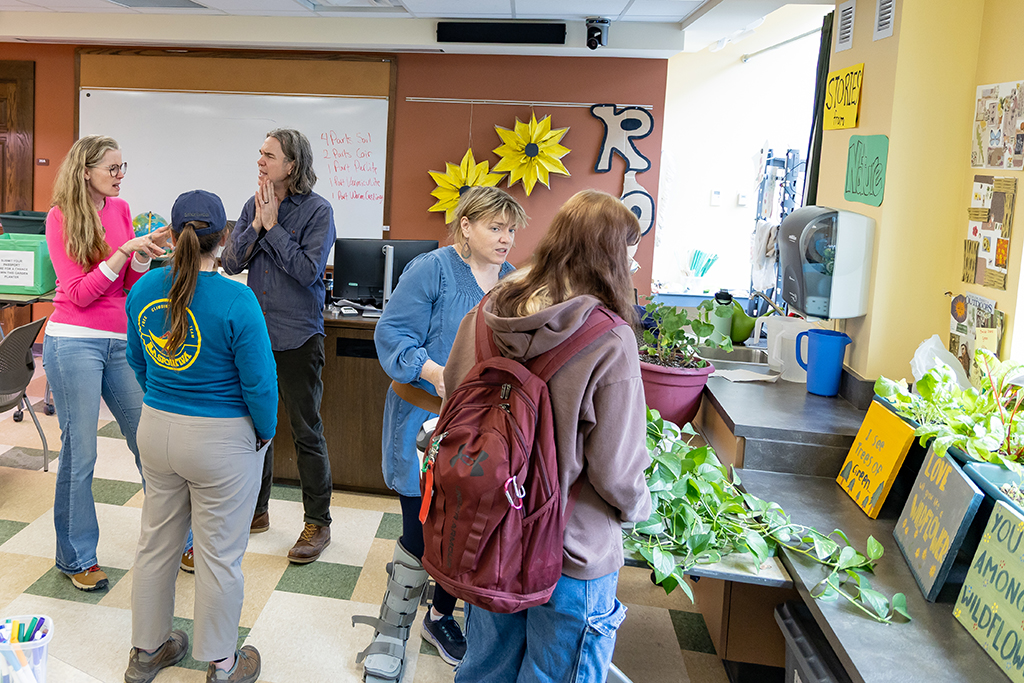
Professor Cheryl Hunter and Associate Professor Joshua Hunter of the College of Education & Human Development stressed that taking care of our world happens one person and one step at a time.
“We don’t want to be all doom and gloom because it’s really easy to get bogged down by all the news,” Joshua Hunter said. “We can get lost in sort of the bigness of problems. If we do, we end up not doing anything. We get incapacitated.”
It’s better to start small and think of what you can control, he said. Walk or bike when you don’t need to drive far. Find a community garden.
“Sometimes it’s just finding the right information or the right community of people to help you along the way,” he said.
Added Cheryl Hunter: “Don’t get overwhelmed. Take 15 minutes a day and choose to do one thing. If every day everyone were to choose one small thing, the impact would be huge.
“A lot of this is about kindness and thinking to be kind — kind to one another and kind to the planet.”
>> Do you want to read more UND Today stories? Just hit the link or go to our home page to subscribe to our twice-weekly newsletter.