At UND, former U.S. Rep. Earl Pomeroy assesses state of American democracy
UND alum, nine-term Democratic congressman calls for engaged citizenry, as 250th anniversary of nation’s founding approaches
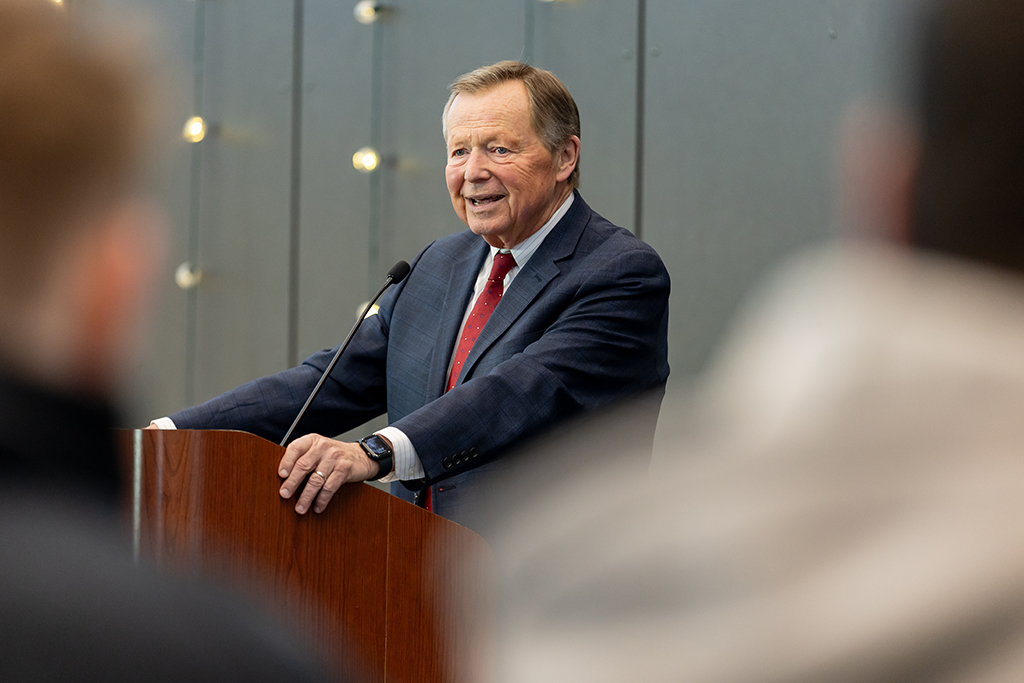
Thursday, February 26, 2026 UND welcomed a distinguished alumnus back to campus – one who served nearly two decades as the state’s at-large member of the U.S. House of Representatives.
The Hon. Earl Pomeroy – a member of Congress from 1993-2011 — delivered the latest address in the University’s Wenstrom Lecture Series. The series is named in honor of the late Frank Wenstrom, a UND benefactor and prominent public figure who served a combined 22 years in the North Dakota Legislature as well as lieutenant governor from 1963-65.
Pomeroy’s address, titled “America at 250 — ‘A Republic, if You Can Keep It,’” alludes to a quote by Benjamin Franklin at the conclusion of the 1787 Constitutional Convention – where the founding father asserted that the success of the newly minted nation is contingent on an engaged and educated citizenry.
Patrick O’Neill, interim dean of the Nistler College of Business & Public Administration, introduced Pomeroy to attendees gathered at the Gorecki Alumni Center. A hallmark of Pomeroy’s Congressional tenure, O’Neil said, was his commitment to serving his state, particularly its next generation of public servants.
O’Neill cited Pomeroy’s enthusiasm toward engaging with students participating in the Nistler College’s spring break field trips to Washington as evidence of this commitment.
“I recall on one of those trips, Earl raced out in between votes so as not to miss an opportunity to speak with our students,” O’Neill said. “He showed us his voting card and told us what a privilege it was to be entrusted with it to cast a vote on behalf of the entire state of North Dakota. Honorable indeed.”
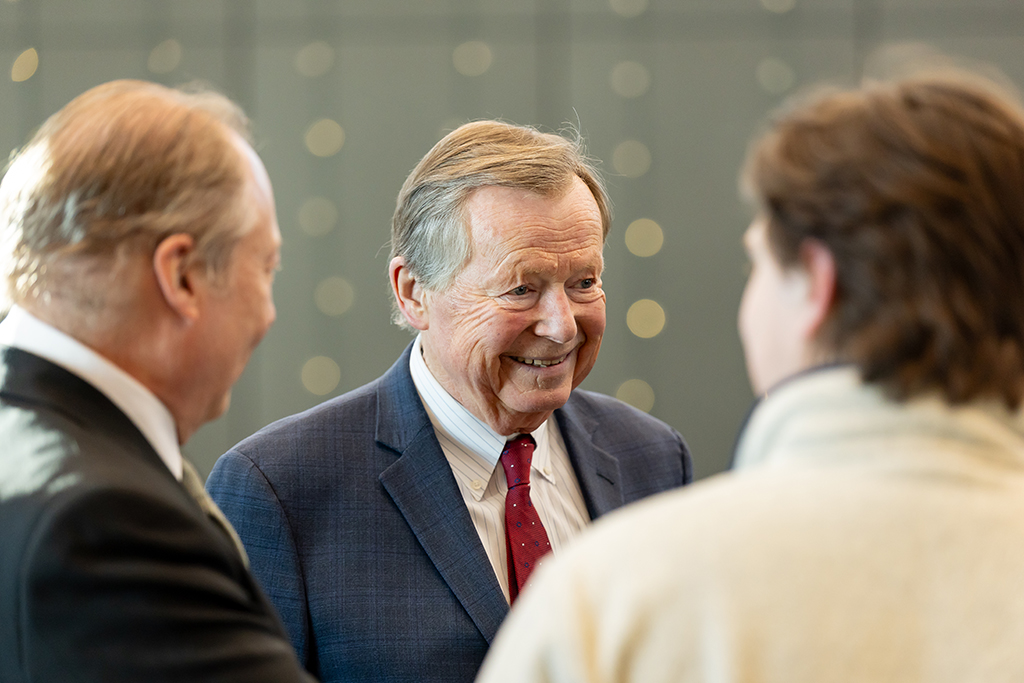
Pomeroy, who earned both a bachelor’s degree in Political Science and a law degree from UND, said the University developed his passion for public service.
“Grand Forks and UND have always been extremely important – it evolved my sense of self and what I wanted to do with my career,” he said. “In the course of my political science classes, I became more interested in public policy.”
Among his former UND professors, Pomeroy cited the late Lloyd Omdahl – who taught at UND from 1967-87 and then served as lieutenant governor under former Gov. George Sinner – as his “mentor for over 50 years.”
“He was a wonderful man,” Pomeroy said. “He was quite the guy to teach us about state government.”
In his lecture, Pomeroy outlined what he perceives to be an erosion of the U.S. Constitution’s system of checks and balances – particularly an unchecked executive branch. A powerful executive, he added, was an acute concern shared by the Constitution’s framers.
“King George III was very fresh in their memory,” Pomeroy said. “They did not want to empower a new source of governance that had the ability to threaten either the colonies or individuals within them.”
Additionally, Pomeroy said the legislative and judicial branches have undermined each other’s independence in tandem. The legislative branch has powers explicitly delegated in Article I of the Constitution, along with checks on the executive branch outlined in Article II.
Among these is the U.S. Senate’s “advice and consent” power outlined in Article II, Section II, which tasks the upper chamber of Congress is with ratifying treaties, and confirming ambassadors and Supreme Court nominees.
It is this latter function of the Senate, Pomeroy opined, that has been compromised by ideologically driven judicial interest groups.
“The process wasn’t intended to be based on partisan alignment, or even ideology,” he said. “Now we have an entire well-funded nonprofit called the Federalist Society, that has outsourced screening of would-be justices based on whether this nonprofit deems them to be sufficiently rigorous in their ideology.”
The strongest evidence of the Federalist Society’s influence, Pomeroy said, is how the confirmation process for Supreme Court nominees has played out over the past decade.
After the death of Justice Antonin Scalia in February of 2016, the Republican-controlled Senate did not hold a hearing for President Barack Obama’s nominee Merrick Garland – arguing that voters in the upcoming presidential election should decide the court’s future composition. As a contrast, following the death of Justice Ruth Bader Ginsburg in September 2020, the Senate confirmed her replacement, Justice Amy Coney Barrett, a mere week before the 2020 Election – the shortest window between a confirmation and presidential election in the court’s history.
“We’ve changed the process from advice and consent, to needing a Senate majority to confirm someone to the Supreme Court,” Pomeroy said. “There is tremendous substantive policy change that moves from the concept of a Supreme Court justice being a jurist to a partisan.”
The legislature’s independence, Pomeroy added, has also been undermined by the judiciary – namely in the form of rulings regarding campaign finance and gerrymandering. Pomeroy cited the 2010 Supreme Court decision of Citizens United vs. the Federal Election Commission, which ruled that laws restricting corporate political spending violate the First Amendment’s free speech clause.
“Political power has flowed directly with the ability to influence elections – and money influences elections,” he said. “This whole spending deal is a genie that is out of the bottle, and I’m not sure how you get it back in.”
Gerrymandering, or the redrawing of electoral districts to favor party lines, favors incumbents and creates a hyper-partisan Congress, Pomeroy added.
“Instead of voters selecting the politicians, the politicians – based on maps that are more accurate than ever with computer technology – select the voters,” he said. “That’s why we have over 90 percent of the House in dead-safe seats.”
“As a Democrat who represented a republican state, you had to run hard,” Pomeroy added. “I developed a belief that there’s virtue about having to tough out every election. I couldn’t just listen to Democrats; I had to understand both sides – figure out ways to compromise.”
Pomeroy’s greatest concern outlined in his lecture, however, is “a very ascendant, aggressively assertive executive branch.” Among the executive’s overreach, Pomeroy said, is unilaterally levying tariffs, and withholding appropriated funds – both powers delegated to Congress in Article I.
Pomeroy said the executive branch’s current actions are guided by “unitary executive theory,” a legal theory which posits that the president’s actions are not subject to congressional restrictions.
“It holds this extraordinary notion that the person who is the executive controls everything about the implementation of our laws,” he said. “In my opinion, it’s a very radical and dangerous theory that has never been asserted like it is now.”
Additionally, Pomeroy expressed concern about the executive branch’s combative response toward higher court rulings – including the recent Learning Resources Inc v. Trump decision. On Feb. 20, the Supreme Court ruled 6-3 that the President’s use of the International Emergency Economic Powers Act to justify tariffs was unconstitutional.
In his conclusion, Pomeroy said an engaged citizenry – much like Franklin advocated for at the nation’s founding – is vital to the health of democracy.
“There may be times where substantial protest and just showing up is just as important as any of these constitutional tools in the face of a runaway executive branch,” he said.