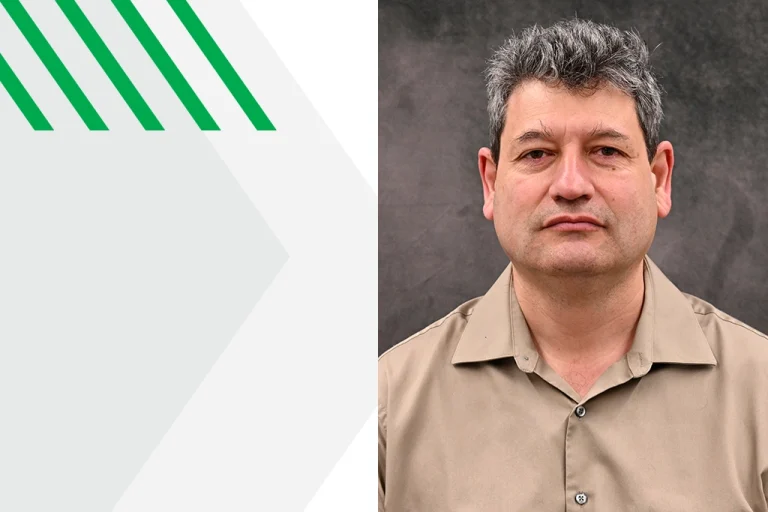
‘The department’s in good hands’: Longtime MLS faculty Mary Coleman and Linda Ray to hang up their lab coats
“Well, I stayed because I believe in lifelong learning,” smiled Mary Coleman from a conference room in UND’s School of Medicine & Health Sciences (SMHS). “Like one of my students once said, ‘Mary, you’re just a paid student!’”
But even professional students have to graduate sometime.
So it is that after 51 years, Coleman, the lifelong learner and assistant professor in UND’s Department of Medical Laboratory Science (MLS), is hanging up her lab coat. “It’s certainly going to be a transition,” Coleman said. “I’ll miss the great learning and great friends I’ve made here at UND.”
Seated beside her colleague-friend, Linda Ray nodded. An assistant professor of MLS who is also retiring from UND, Ray added that she stayed at UND for nearly three decades because, quite simply, she loved working with young learners. “I am really going to miss the students,” Ray said. “The MLS personality likes to be in the background, but whenever we get a student who really enjoys the work, we’re happy because it’s clear they have so much knowledge they want to share and their personalities really come out.”
Team training
The figure – 80 combined years of service to UND – is lost on neither Coleman nor Ray, both of whom end their careers on June 30.
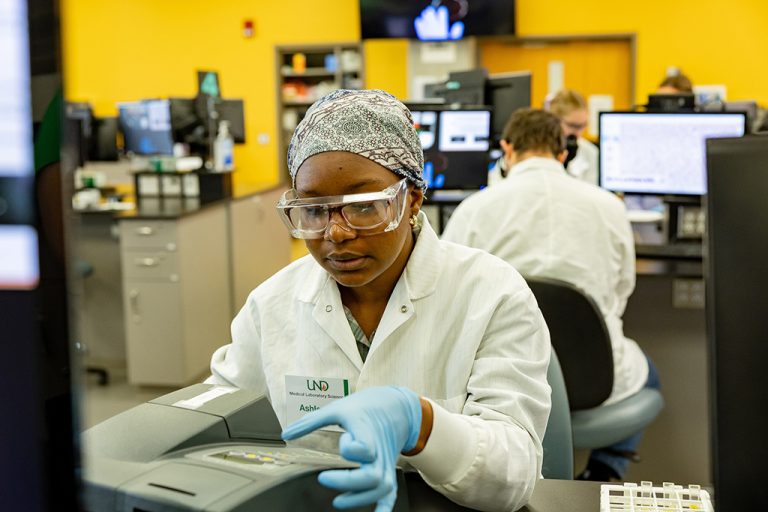
Over that span of years, they said, both the MLS profession and teaching have evolved considerably. In the lab, for example, new technologies have made analyses of all types significantly faster, which has affected how the pair teach in the classroom. “Everything was manual” thirty years ago, said Ray, using a complete metabolic panel blood test as an example. “Tests like that would take us all day long – and we would just do one test at a time instead of a complete panel. Those chemistry panels come out in minutes now.”
This acceleration of testing means that students are learning how to manage more procedures earlier in their education, added Coleman. The result is that medical laboratory science, in both the educational space and the clinic, is increasingly being folded into the interprofessional training models medical schools across the country are adopting.
“A lot of our students probably feel a little bit intimidated being around so many med students,” said Coleman, thinking of the School’s annual Interprofessional Healthcare Day and of her students’ intermingling with medical students, NDSU pharmacy students, and nursing students during the programs’ many team-based simulation exercises. “But it’s been great. We’ve had so many positive comments from faculty in other departments about what MLS adds to simulation, really appreciating what our students bring to the training.”
What even is MLS?
Because such team training was not how either Coleman, who began in the Department of Pathology in 1975, or Ray, who hopped over to UND from the former Grand Forks Clinic after the Red River Valley Flood of 1997, learned their profession.
Learning her craft primarily in laboratories with other “medical technology” students, as MLS was known at the time, Coleman started in the pathology department’s former Hematology and Cytogenetics Laboratory. She was teaching for the Medical Technology program a year later.
For her part, Ray took her UND degree in what by the early-1990s was known as “clinical laboratory science” to the Grand Forks Clinic. Tasked with training staff on new technologies, Ray learned that she “loved training and orientating new employees. That’s kind of where I figured out I love to teach.” At UND by late 1997, then, Ray was originally teaching graduate and medical students in what is now UND’s Department of Biomedical Sciences.
Taking this interest in interprofessional teaching with her to the Department of Medical Laboratory Science, Ray helped embed MLS into the revised patient-centered learning curriculum at SMHS in the early 2000s.
“That was wonderful experience because I was working with all the med students that came through,” said Ray, explaining how teaching diagnostic biochemistry to graduate and medical students helped her prep her own MLS students.
This growth in interprofessionalism at North Dakota’s only school of medicine and health sciences has gone a long way to helping bring a traditionally behind-the-scenes profession out into the open, said Ray. After all, she still occasionally fields questions about what MLS, as a discipline, even is.
Her answer is to get people thinking about how UND approaches aerospace education in its John D. Odegard College of Aerospace Sciences. “UND trains pilots, right?” she asks rhetorically. “You have your twin engine propeller plane and then you have your great big commercial airliner. Flying these planes requires different skills, and it takes hundreds of hours of training to be able to go from being a private pilot to being able to fly a jet. Same for medical laboratory science.”
In other words, even if airplanes can engage in “autopilot,” the process of taking off, landing, and managing atmospheric nuances in-flight requires years of training. So does laboratory science.
“Delivering accurate and timely lab results – which affect diagnoses and treatment plans – isn’t just pushing a button,” she said. “Blood chemistry, parasitology, histotechnology. That’s one of the main aspects of our profession that people don’t quite understand. We have to know how to interpret results and know that what we’re sending out is correct.”
New beginnings
That’s something about laboratory work that has not changed: the emphasis on collecting samples safely and as comfortably as possible for patients before analyzing them both quickly and accurately.
Passing such values on to the next generation is what she will miss the most, said Ray. “My love is being in the classroom, and I’m going to miss that terribly,” she said, adding that it feels appropriate that she’s ending her career by teaching a classroom full of wide-eyed second-year students. “Sophomores, of all people! And it’s been great. I just love seeing the lightbulb turn on for them. They’re very eager to learn.”
Claiming an unconditional love for the university, Coleman, who taught everything from human parasitology and laboratory mathematics to hematology, clinical chemistry, and a graduate capstone course, said she’ll miss the students, yes, but also the opportunity to learn something new every day. “I’ll probably still take classes at UND,” she said, adding that she expects to keep busy via the nonpartisan League of Women Voters, books clubs, and other organizations. “And I plan to stay active in the American Society for Clinical Laboratory Science and travel to meetings.”
And she’ll work hard not to bother her soon-to-be former UND colleagues.
With a laugh, Ray agreed.
“I think the faculty here have a good future,” she said, explaining how the profession’s work-life balance has improved in recent years. “The department’s in good hands, and it’s easy to leave when it’s in good hands.”
Such hands include those of department Chair Brooke Solberg, who remains in awe of her colleagues’ 80 combined years.
“There just aren’t words that capture what Mary and Linda have meant to our programs, faculty and staff, and students,” said Solberg. “That kind of dedication is virtually unheard of these days, and says so much about their character and passion. It is almost impossible to imagine UND MLS without Linda and Mary, but what they’ve given runs so deep that I know their impact will carry-on well past their physical presence at UND.”