‘Science is part of me’: Dr. Jonathan Geiger reflects on 20-plus years of problem solving at UND’s School of Medicine & Health Sciences
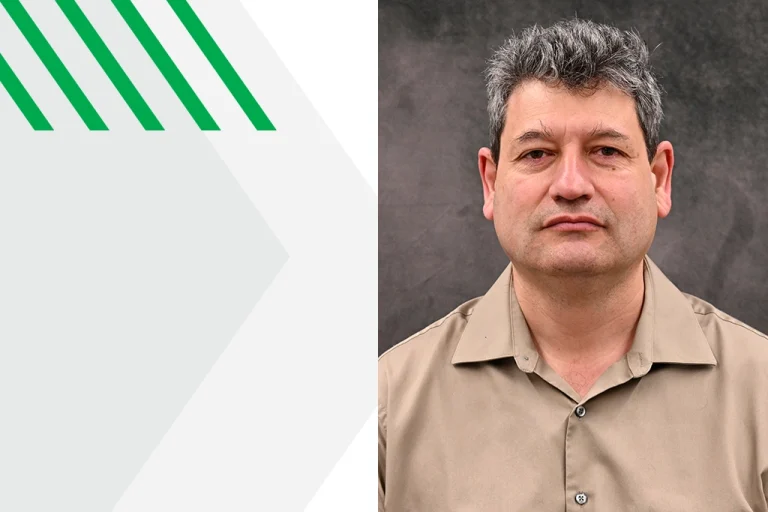
“Look, I never wanted to lead a boring life,” explains Dr. Jonathan Geiger from his office in the UND Neuroscience Research Center. “And I think that I’ve done pretty well in that regard.”
Reflecting on his 23 years at the UND School of Medicine & Health Sciences – and 50+ years as a scientist – the New York native describes how his not-boring life went from living, studying and practicing science in Syracuse, Switzerland, and Vermont to Winnipeg and, of course, North Dakota.
That’s to say nothing of his years in France in the middle 1970s.
“I was a little disenchanted and maybe a little confused as to what I wanted to do,” admits Geiger of the months immediately after he completed his master’s degree in pharmacology and physiology at UND. “I finished my master’s degree in 1975 and decided to go to Paris to study with the founder of corporeal mime, Étienne Decroux.”
Wait, what?
“Yeah. He taught in his basement – hardly ever left his house,” Geiger smiles of the master of physical theatre whose life was screened in the 1945 Marcel Carné film Les Enfants du Paradis. “He would sit in his darkened library, reading Victor Hugo all day, smoking his pipe, and didn’t do much else. He had this amazing following, including Marcel Marceau, and all these mime artists trace their provenance to him.”
Including, it seems, an award-winning professor of biomedical sciences in North Dakota.
‘Best you can’
Fifty years later, and on the cusp of retirement, Geiger regrets nothing. Or almost nothing.
Such a full life, confesses the Chester Fritz Distinguished Professor, is both something he couldn’t have dreamt of as child even as it was exactly what wanted.
He was the child of a dentist and an occupational therapist. His grandfather and uncle were also dentists. Geiger says that the original expectation was that he, too, would pursue dentistry.
But he wasn’t interested. “I just didn’t think that was for me,” he says. “I wanted to be a university professor. My father was pretty critical of that, but he encouraged me to strive for excellence in whatever I do. He was very critical of people who only strove for mediocrity.”
Ultimately, adds Geiger, his father was fine with his son blazing his own trail, as long as he did whatever he ended up doing well.
“He’d say, ‘If you want to be a professor, be the best you can. If you want to be a shoe repair person, that’s fine too – you just have to strive to be the best shoe repair person.’ He just found it intolerable for people to strive to be only mediocre.”
So the younger Geiger went first into chemistry via Windham College in Vermont, and this led him to study pharmacology at UND.
“I started looking around for graduate schools and I bumped into the University of North Dakota, which had this ‘Man-in-the-Sea’ project,” Geiger says of Sen. Quentin Burdick’s U.S. Office of Naval Research funded program designed to study “the effects of high pressure on the reproduction, nutritional needs and general health of test animals,” as the Dec. 1973 edition of Naval Research Reviews puts it.
“The only other facility of its kind in the world was in the then-Soviet Union,” says Geiger, who helped build UND’s former high-pressure chamber with his fellow grad students. “We were torquing bolts and putting together these things, and of course we ran our experiments. So that was it. That’s what got me interested in pharmacology.”
At UND, Geiger met Chester Fritz Distinguished Professor Surendra S. Parmar, with whom he explored the effects of hyperbaric pressure on drug metabolizing enzymes. After a gap of 4 years when he practiced and taught physical theatre, running a home renovation company, and conducting clinical outcomes research at the University of Minnesota – Geiger came to realize that science is just who he is.
“I called up Parmar, and said, ‘I’d like to come back,’” he recalls.
Getting it done
So he did, earning a doctoral degree in 1982 and building a research lab at the University of Manitoba, where he remained for about 20 years. Nearly 50 years after earning his Ph.D., and 23 years after returning to UND, Geiger has brought at least $60 million in extramural research funds to North Dakota for his many studies into brain energy metabolism and neurodegenerative disease. He has also produced well over 200 publications and given more than 100 invited lectures around the world.
What he’s most proud of, however, is that he became known as a go-to problem solver – a “fixer” – for multiple SMHS deans.
“I’m proud of the fact that when both Dean Wynne and Dean Wilson needed something done, they turned to me,” Geiger says. “The federal government gave money for this neuroscience building, but Dean Wilson was just constantly bombarded with attacks from other people who said the grant shouldn’t be for neuroscience – it should be something else. In my first year as department chair Dean Wilson literally threw this pile of architectural drawings across his desk at me and said ‘you fix it.’”
Which Geiger did, managing construction of the building he works in to this day. A similar scenario emerged under Wilson’s successor, Dr. Joshua Wynne, when the current SMHS building in Grand Forks was being built.
When be the chair of what was by now the Department of Biomedical Sciences had to take a leave of absence around 2014, and the building’s architects “were banging on Josh Wynne’s door,” Geiger was again asked to help get the building project across the finish line.
“He turned to me, said, ‘Jonathan, I need you to get it done.’ So we did.”
Then there was the time UND’s School of Graduate Studies needed updated promotion and tenure guidelines for SMHS faculty, and the time UND’s Indigenous Trauma and Resilience Research Center needed an interim principal investigator, and….
Stopping himself from saying too much, Geiger just shrugs and smiles.
“What am I most proud of?” he repeats. “I guess it’s continuing to be successful and, at the same time, being accessible to help fix things when they need fixing. That’s my natural tendency: when I see things that are not working so well, I want to get in and fix them.”
The science life
The Syracuse native offers this statement in the full knowledge that such an orientation is what made him a successful scientist-administrator.
“Look, I view myself very clearly,” Geiger concludes soberly. “I can be out and about doing whatever – at a baseball game – and the conversation always comes around to science.”
Because science, he says, is fundamental to human life. And despite a lifetime’s worth of challenges – wrangling with federal agencies, managing conflicting personalities, running into dead ends in the lab – Geiger remains committed to the practice of scientific inquiry.
“That’s not going to change,” he insists. “Science is part of me. It’s always going to be part of me.”
Even in retirement.