SMHS student research draws global audience
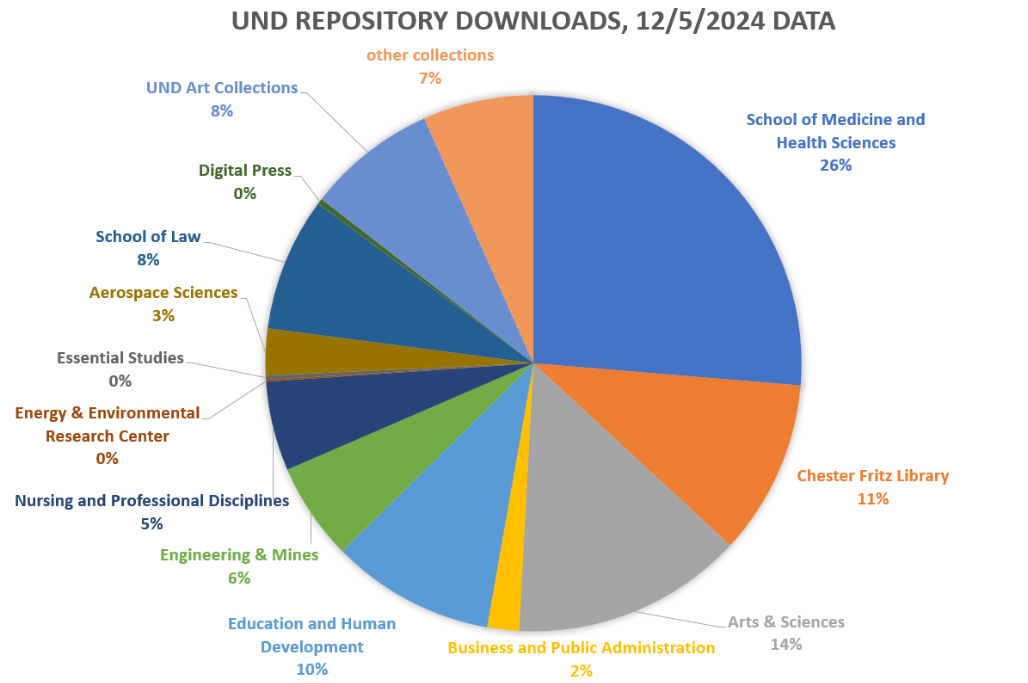 At the close of 2024, works by SMHS faculty, statff, and students accounted for 26% of all downloads on the UND Scholarly Commons (since it was established in 2017). This is especially impressive considering that SMHS accounts for 9% of the enrolled student body at UND.
And SMHS also boasts two items in the top most popular works across all of UND’s collections, with PT and OT projects as the 3rd and 4th most popular works in the entire repository.
What is the UND Scholarly Commons?
Institutional repositories (IRs) are open access databases of an institution’s research and scholarly outputs, and include anything from student theses, to faculty articles and presentations, to special collections papers. Most universities internationally have an IR now, and the UND Scholarly Commons is a particularly heavy-hitter, with SMHS’s collections alone ranking 7th most popular among all health sciences IRs administered by BePress, an international IR software company.
IRs are a crucial tool for educational institutions, research organizations, and libraries internationally to preserve, showcase, and disseminate their scholarly work.
Advantages of IRs
Increased visibility, usage, and impact; compliance with open access mandates
IRs are by design open access repositories of research, meaning that anyone can access this research and read and download each work. There are no paywalls or limits to access for readers. For SMHS researchers, this means that any healthcare worker or professional can access our research, and use it to practice evidence-based practice, regardless of their institutional affiliation or location.
Global, paywall-free readership of research allows our researchers to reach a wider audience, and in turn generate more citations to illustrate the impact of their work, a particular benefit to innovative or under-resourced areas of practice such as Indigenous health, rural health, or women’s health.
Additionally, IRs help researchers comply with mandates that their research be made openly accessible by providing a central, stable location to share outputs with the public.
Real scholarly communications experience for students
A large portion of the works on SMHS’s collection on the Commons are student works, mostly theses and dissertations, but we also accept and post conference presentations and brief reports. Writing and posting these works provides students with real experience in creating and disseminating scholarly works with global reach. We frequently field requests from individual researchers across the world who read our students’ works and want to collaborate, work with their research products, or meet up to discuss shared research foci. Particularly for healthcare practitioners in rural areas, this expanded, global community is an incredible benefit in an under-resourced area of practice, especially as our students grow into practitioners and researchers.
Showcasing institutional research
IRs serve as a platform to showcase an institution’s research excellence. They help promote the university’s academic and research accomplishments, which can be especially attractive to prospective students and faculty members. Additionally, IRs help communicate and make transparent the story and impact of the institution’s research to invested parties such as community-members, legislators, and policy makers.
Create a stable, accessible archive
Not only are IRs stable, safe archives to store research outputs and datasets, they enable authors to self-archive without requiring a transfer of intellectual property ownership. Works may be deposited on the Commons without the author signing over their copyright to their work, so they remain the owner while allowing anyone to read their work.
Who benefits from IRs?
Researchers, students, and even the general public all benefit from IRs. IRs democratize access to knowledge, allowing the general public to benefit from the university’s educational and research resources. As such, IRs are powerful tools that support the open access movement, facilitate knowledge dissemination, and promote research excellence. As the scholarly communications ecosystem continues to evolve, IRs will remain integral to preserving and sharing the knowledge of our time.
Contact us or your education librarian to learn about accessing the Scholarly Commons, using its collections in your class, or contributing your own work to our collections!
Sources
- Asadi, S., Abdullah, R., Yah, Y., & Nazir, S. (2019). Understanding Institutional Repository in Higher Learning Institutions: A Systematic Literature Review and Directions for Future Research. IEEE Access, 7, 35242–35263.
- Eysenbach, G. (2006). Citation Advantage of Open Access Articles. PLOS Biology, 4(5), e157.
- Langham-Putrow, A., Bakker, C., & Riegelman, A. (2021). Is the open access citation advantage real? A systematic review of the citation of open access and subscription-based articles. PLOS ONE, 16(6), e0253129.
- Piwowar, H., Priem, J., Larivière, V., Alperin, J. P., Matthias, L., Norlander, B., Farley, A., West, J., & Haustein, S. (2018). The state of OA: a large-scale analysis of the prevalence and impact of Open Access articles. PeerJ, 6, e4375.
- Sandler, B. (2023, October 25). Unlocking the Potential of IRs: A Comprehensive Guide. Becker Medical Library.
- Santos-Hermosa, G. (2023). The Role of IRs in Higher Education: Purpose and Level of Openness. In D. Otto, G. Scharnberg, M. Kerres, & O. Zawacki-Richter (Eds.), Distributed Learning Ecosystems : Concepts, Resources, and Repositories (pp. 47–70). Springer Fachmedien.
- US National Institutes of Health. (2020). NIH Policy for Data Management and Sharing (Publication NOT-OD-21-013).
Featured image from UND SMHS Collections Dashboard BePress 2025; via TomTom 2024; Microsoft 2025