Does Slip-Resistant Footwear Reduce Slips, Trips, and Falls in Food Service?
Slips, trips, and falls are the second most common type of fatal work-related injuries and the third most common type of non-fatal work-related injuries in the United States. Although falls from heights are more likely to result in a fatality, falls on the same level (which often start as a slip or trip) occur more frequently and can cause injury. Recent US Bureau of Labor Statistics data show that 50% of all same-level falls resulted in more than 10 days away from work. Sprains, strains, dislocations, and tears to the lower extremities are the most common injuries after a same-level slip, trip, or fall. These injuries are estimated to cost nearly $13 billion in direct workers’ compensation-related costs each year and are the most expensive category of injuries.
Laboratory studies of slip-resistant footwear to reduce slips, trips, and falls have shown promise in reducing slips, but limited field research made it difficult to demonstrate if slip-resistant footwear actually reduced injuries. NIOSH researchers evaluated the effectiveness of a no-cost-to-workers, highly rated slip-resistant shoe program in preventing workers’ compensation injury claims caused by slipping on wet or greasy floors among food services workers. The study, Effectiveness of a no-cost-to-workers, slip-resistant footwear program for reducing slipping-related injuries in food service workers: a cluster randomized trial, was published in the Scandinavian Journal of Work, Environment and Health.
Approximately 17,000 food services workers from 226 school districts, serving students in kindergarten through 12th grade participated in the study. Workers were clustered by school district and the districts were randomly assigned either to a group that received no-cost, 5-star rated slip-resistant shoes or to a group that generally bought their own slip-resistant shoes.
Investigators looked specifically at workers’ compensation injury claims caused by slipping on wet or greasy surfaces, the type of incident that the shoes were designed to prevent. The school districts provided with highly rated slip-resistant shoes saw a 67% reduction in claims for slip injuries; whereas there was no decline seen in the group who did not receive the highly rated slip-resistant shoes. The findings revealed a baseline measure of 3.54 slipping injuries per 10,000 hours worked among the intervention group, which was reduced to 1.18 slipping injuries per 10,000 hours worked in the follow-up period when slip-resistant shoes were provided.
Another finding from this research was that prior to the no-cost slip-resistant footwear intervention, workers over 55 years old had a higher probability of a slip-related workers’ compensation injury claim (4.2 injuries per 10,000 worker hours) than workers under age 55 (2.3 injuries per 10,000 worker hours). This is of public health significance because more workers over age 55 continue to remain active in the US workforce. Without intervention, slipping injuries may be an increasing injury problem for older workers.
This was the first randomized controlled trial evaluating the effectiveness of a no-cost –to-workers slip-resistant footwear program for reducing slipping-related workers’ compensation injury claims in food service workers in the field. This research helps to bridge the gap between understanding the performance of slip-resistant footwear in laboratory settings to understanding the effectiveness of slip-resistant footwear at preventing injuries in a functional work environment. Additionally, this study attempted to isolate the effect of a single intervention as much as possible through the study design.
The findings from this study provide evidence of the effectiveness of slip-resistant footwear and may assist employers, managers, and workers in their decision on whether to invest time and resources in a slip-resistant footwear program.
This study examined the effectiveness of slip-resistant footwear among food service workers. What other industries or workers could benefit from the use of slip-resistant footwear? 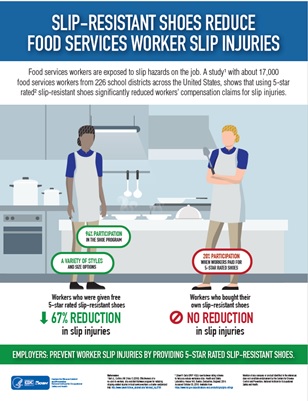
Comments