UND astronomers help uncover mysteries of Miranda
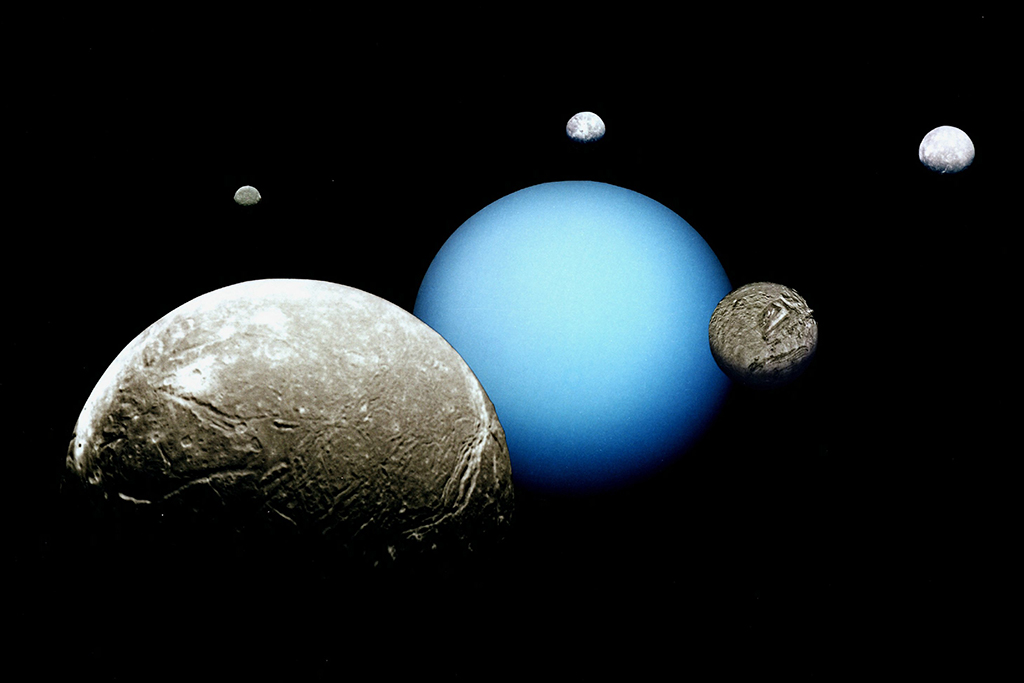
A new study suggests Uranus’ moon, Miranda, may harbor a water ocean beneath its surface, a finding that would challenge many assumptions about the moon’s history and composition and could put it in the company of the few select worlds in our solar system with potentially life-sustaining environments.
“To find evidence of an ocean inside a small object like Miranda is incredibly surprising,” said Tom Nordheim, a planetary scientist at the Johns Hopkins Applied Physics Laboratory, a study co-author and the principal investigator on the project that funded the study. “It helps build on the story that some of these moons at Uranus may be really interesting — that there may be several ocean worlds around one of the most distant planets in our solar system, which is both exciting and bizarre.”
Also involved in the research project and co-author of the The Planetary Science Journal article is Sherry Fieber-Beyer, associate professor of Space Studies, who said the project is significant because it helps planetary scientists better frame the context of the solar system’s formation and evolution.
“Evolutionary models of the solar system invoke giant planet migrations scattering objects from the inner solar system to the outer system—and vice versa,” said Fieber-Beyer. “These migrations resulted in the creation of Jupiter’s asteroids, irregular satellites, and other astronomical phenomena. We must consider whether these moons formed at their location or whether they were captured during planetary migration.”
Among the moons in the solar system, Miranda stands out. The few images Voyager 2 captured in 1986 show Miranda’s southern hemisphere (the only part we’ve seen) is a Frankenstein-like hodgepodge of grooved terrain quartered off by rough scarps and cratered areas, like squares on a quilt. Most researchers suspect these bizarre structures are the result of tidal forces and heating within the moon.
Caleb Strom, a graduate student at UND who worked with Nordheim and Alex Patthoff of the Planetary Science Institute in Arizona, revisited the Voyager 2 images. The team set out to explain Miranda’s enigmatic geology by reverse engineering the surface features, working backwards to uncover what the moon’s interior structure must have been to shape the moon’s geology in response to tidal forcing.
“This research helps us understand what the requirements are for an icy moon to be an ocean world, which is relevant to assessing the habitability of icy outer solar system satellites,” Strom said. “We do not know enough about the Uranian satellites to say whether there could be life on them, but understanding what factors would result in the in them having subsurface oceans is an important step towards addressing that question.”