Chemical Engineering professor publishes second academic textbook
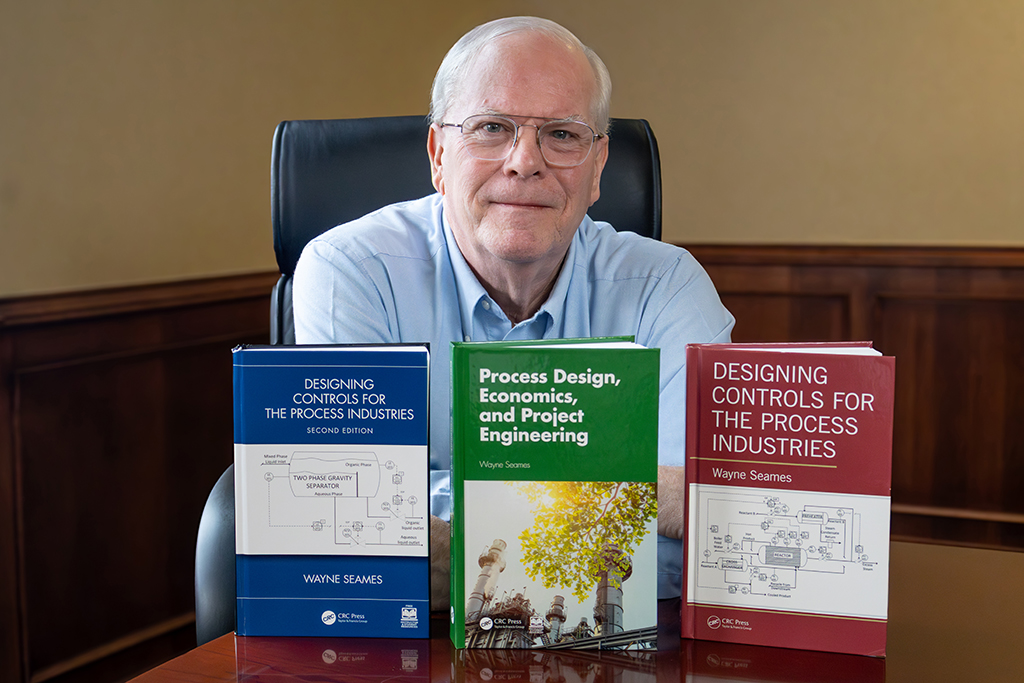
Wayne Seames, Chester Fritz Distinguished Professor of Chemical Engineering, has published his second academic textbook for undergraduate chemical engineering students.
Published by Routledge Books, CRC Press and Taylor & Francis, “Process Design, Economics and Project Engineering” is based on material that Seames has used in teaching his capstone design courses since 2002.
The textbook aims to prepare process and chemical engineers for careers in a wide variety of process-related jobs. It also serves as a reference resource for engineers working in the process and process design industries.
From the author:
“When I was first given the opportunity to teach design while a graduate student in 1997, I sat down and figured out what I wished I had learned to support my Industrial Career, which involved projects of all sizes and types.
“Some of this information was covered well in existing textbooks, but there were significant gaps. Most significantly, none of the textbooks covered retrofit projects (a modification to an existing plant), which are much more common than grassroots projects (an entirely new plant).
“In addition, other design books do not differentiate between the different levels and types of design or explain what level of detail for design and economics are needed at each phase of the project.
“Most of the rest of the information is available in other textbooks, but you’d need at least three to cover all of the other topics that are included in this new book.
“Senior chemical engineers have been using the draft textbook for the past couple of years. They haven’t had to struggle quite as much as previous students who were working just off my slides and notes, plus other textbooks. I’m only sorry I didn’t get the book finished sooner.”
The book assumes prerequisite knowledge of material and energy balances, heat transfer, fluid flow and mass transfer but does not require any prerequisite knowledge of economics, process control, process safety or material selection.
It’s uniquely organized to follow the project life cycle most commonly used by engineering contractors and the companies they serve in the process industries.
The textbook covers both retrofit and new process projects, includes a set of easy-to-use, step-by-step preliminary equipment sizing methods, and offers realistic rules of thumb for equipment sizing and pressure profiles.
In addition to professional development topics, it addresses safety and sustainability considerations for process design, includes a unified suite of cost estimating methods and covers process/project economics and how to evaluate process opportunities.
Conceptual design topics are also included such as information on plant layout, auxiliary systems and process automation. The automation section is a summary of Seames’ other textbook, “Designing Controls for the Process Industries,” which is now in its second edition from CRC Press.
“Process Design, Economics and Project Engineering” is available now (ISBN 9781032833613).