From brainwaves to clinical trials: Exploring human experience with Dmitri Poltavski

A key question sits where human behavior meets biology: how can we really understand what someone is experiencing? Dmitri Poltavski, professor of Psychology at UND, believes that combining subjective, objective and physiological evidence gives us the most reliable answers.
Poltavski provides students with unique research experiences by encouraging them to collect and study physiological data in a field that often uses subjective data based on personal opinions. In a lab outfitted with a suite of instruments capable of measuring physiological responses such as electroencephalography, eye movements, respiration, electrodermal activity, heart rate or muscle tension, students become experts in human response monitoring. Poltavski and his students are also exploring applications of non-invasive brain stimulation such as transcranial direct current stimulation and photobiomodulation.
Historically, physiological recording and brain stimulation were labor-intensive and time-consuming processes requiring a considerable amount of knowledge and technical expertise. Now it is more accessible than ever before as user-friendly software has opened the door for the next generation of scientists.
When asked how research impacts students, Poltavski noted that, “It is not just the type of research, it’s about the mindset.” Through academic research, students cultivate discipline, attention to detail and strong critical-thinking skills. More importantly, they learn to approach information, often received via social media, with curiosity and analytical rigor—an outlook that influences how they understand and engage with the world around them.
Collaboration is foundational to Poltavski’s research and can be beneficial to an array of disciplines. His projects extend to monitoring the cognitive load of drone pilots or military personnel, where human factor assessments are used to determine the performance breakdown during intensive multitasking. Software engineers can play a major role in building multitasking simulations to control experimental variables.
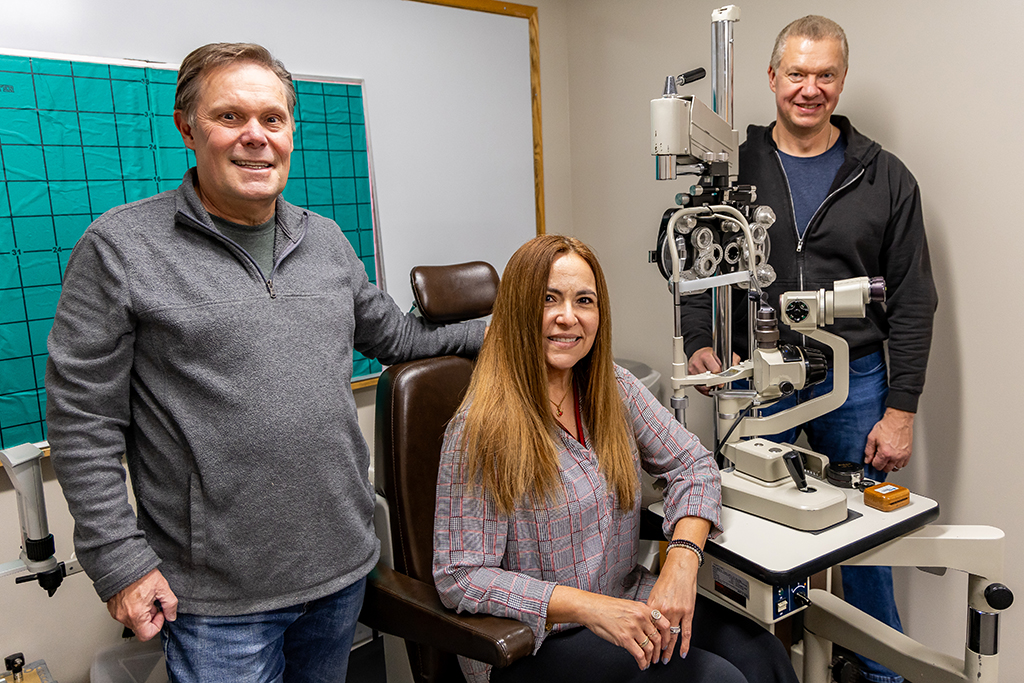
Beyond the lab, Poltavski participates in a Pediatric Eye Disease Investigative Group initiative funded by the National Institutes of Health. Partnering with a local optometrist, David Biberdorf, and an optometric vision therapist, Carolina Praus Poltavski, his team has been approved by Brad Rundquist, dean of the College of Arts & Sciences, and licensed by PEDIG to conduct clinical trials in pediatric eye disease on the premises of UND’s Department of Psychology. Poltavski’s team is currently the first and only PEDIG site in North Dakota to conduct clinical trials of cutting-edge treatments of pediatric amblyopia, or lazy eye. The traditional treatment methods of eye patching and spectacle correction are being compared to new virtual reality headsets. VR allows subtle manipulations of a patient’s binocular vision to encourage the development of visual-motor skills within the weaker eye. This study is providing kids in North Dakota and Minnesota with modern treatments that originally may not have been available to them.
Poltavski’s students become clinically trained as visual acuity and binocular acuity technicians through PEDIG certifications. The double-blind clinical trials allow his students to examine rehabilitation progress as an unbiased party without knowledge of the patient’s treatment method. This is an unparalleled hands-on, clinical and technical experience for each student.
Poltavski is passionate about his work, saying: “Discovery! The kid’s curiosity keeps on growing as you do research. You never lose it in our job.”