Reaffirmation of accreditation: An update from Shane Schellpfeffer
All systems are ‘Go’ for Higher Learning Commission’s site visit in April, UND’s director of institutional effectiveness and accreditation says

UND Today: Tell us about where you’re from and how got into this particular field.
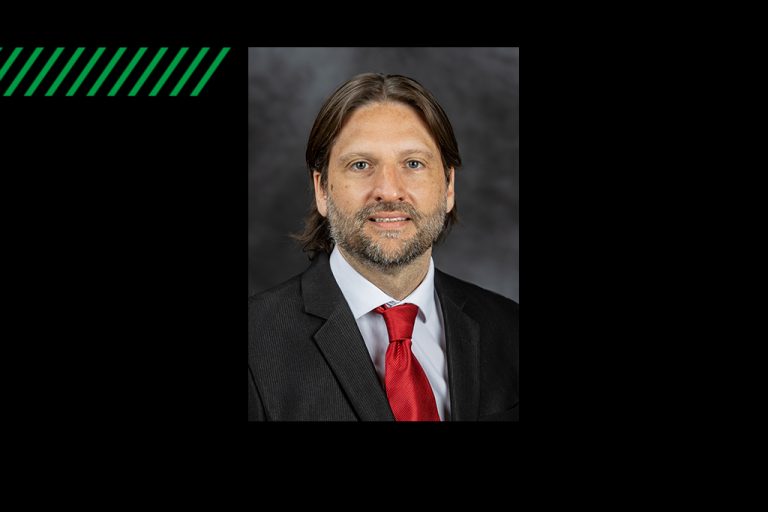
Shane Schellpfeffer: I grew up in Sioux Falls, S.D. I did my undergraduate work at Augustana University there. I then earned a master’s degree at Texas Christian University in Fort Worth, Texas, and a doctoral degree at the University of South Dakota.
After that, I moved all around the country for different jobs; North Dakota actually is the seventh state that I’ve lived in. Before I moved here, I was down at Kansas State University; and before that, I was working for the USD medical school in Sioux Falls.
As for my background, which is in assessment, I was a math major. So I always liked analytical things – working with numbers, that sort of thing. And so, in the process of just working my way through various jobs in higher education, I found my way to doing assessment.
That has really changed a lot in the past decade, especially in the area of data analytics, which has become much more important to the field. The result is that today, we have the software – the technology – to really start to do a lot more in the assessment realm.
Which brings me to UND. I’ve been here since July 3, and I’m really happy here. It’s been a great experience so far. I can’t say enough good things about UND; it’s just been a really good job. There are so many good people who have such a great sense of community here.
UND Today: You’re the director of director of institutional effectiveness and accreditation at UND, so assessment is a big part of your work. What’s involved with assessment at the university level?
Shane Schellpfeffer: There are a variety of definitions, but for our purposes, we’re concerned with something like “outcomes based assessment.” That means programs should have outcomes developed that will address particular skills that all students should have when they finish the program.
And with this in mind, academic programs figure out how to gather data to measure those outcomes. That might be an exam, or a portfolio, or a group project – that kind of thing.
In that way, assessment is pretty closely tied to the overall accreditation process. In the last 30 years or so, a lot of the accreditors started to ask for that assessment data; they wanted to know, “What is your program doing to offer that assurance of learning?”
I was just working with the Nistler College of Business recently about a new program, and that was the term their accreditor was using: assurance of learning.
In short, in our world these days, assessment is related to measuring student achievement on outcomes, particularly at the end of the student’s degree program.
UND Today: At UND, the big thing going on these days is reaffirmation of accreditation through the Higher Learning Commission or HLC. Could you bring us up to date on where we are in that process?
Shane Schellpfeffer: Sure. So, the hard deadline is April 22-23; that’s when the site visit will occur in 2024. That’s when a team of peer reviewers will come to UND from other institutions.
They will be here for a full day on Monday, April 22, and at least for the morning on Tuesday, April 23. They will be conducting interviews, they’ll have panels, there will be all sorts of things they’ll be involved with during their brief time on campus.
A lot of it will be behind the scenes, but there definitely will be an out-front component – probably several Open House-type forums that will be advertised to the UND community and will be open to the public. One likely will be dedicated to students, one will be dedicated to faculty and one to staff.
But if we go back to the beginning of the process, which would be about 18 months ago or before my arrival here, that’s when the Assurance Argument writing teams started meeting, and they’ve been working very hard ever since on getting our Assurance Argument put together.
Role of the Assurance Argument
The Assurance Argument is a document of no more than 35,000 words that provides a narrative that addresses the HLC’s five criteria for accreditation. Those criteria address mission; ethical and responsible conduct; quality, resources and support for teaching and learning; evaluation and improvement of teaching and learning; and institutional effectiveness, resources and planning.
And part of UND’s responsibility is to provide evidence files as a kind of proof or documentation of what we’re saying throughout the argument.
So, the drafting process has gone on for the past 18 months or so. Now, we’re in essentially the final phases, in that we are starting a multi-pronged editing process. That will involve such things as reducing the word count, to make sure we stay under the HLC’s limit; identifying areas that could be strengthened or need more attention; and so on.
We’re working on that, and our goal is to finish this by the end of the calendar year. Once that happens – once the copy editors and the reviewers have gone through the document – then both the substance and the style of the Assurance Argument should be pretty close to its final version.
After that, we come to January, when we’ll have a chance for the public to weigh in again. That’s when the UND community will be invited to look at the Assurance Argument and provide feedback.
So, we’re planning on having an Open House or Open Forum, or maybe that’s not the right description; we’ve referred to it as something like a poster session. That means there won’t be a formal presentation, but people will be able to come in, talk with others, look at the draft, ask questions and offer suggestions.
And we’ll also have a way for our online students and employees working remotely to provide feedback as well.
We’ll incorporate the feedback that we’ll get into the final draft, and then that draft will be sent to the president and provost for their final review.
Then it has to be submitted; I believe that deadline is 30 days prior to the site visit, but we will probably submit it earlier – more like 45 days before.
So my goal is early to mid-March to have the document officially submitted.
UND Today: So the HLC team will be able to see the report before they get here?
Shane Schellpfeffer: Yes, they will have read it and reviewed it before they arrive. That means when they are here and they are asking questions, the questions will be based on that document or, more likely, what’s missing from that document!
One other thing I should mention is that in late January or early February, the HLC will providing a “Student’s Survey” – a survey that they develop and they administer. I think the only thing we’ll have to do is just advertise it and send it out to our students.
So that’s another thing, and we very much hope to have good participation or a good response rate from our students for that HLC survey.
Importance of accreditation
UND Today: Why is this important to UND? Why does the University need to complete this multi-year process?
Shane Schellpfeffer: There are a few reasons. First, accreditation is a process of verifying standards that have been set forth by our peers in higher education. In other words, it’s getting feedback or an assessment of how well is UND is performing, in relation to these standards.
Then in the later stages, the HLC board essentially votes on whether to continue the accreditation of the institution. By the way, that’s officially referred these days as reaffirmation of accreditation, not re-accreditation, the way it used to be.
So some of the language has changed, but it very much remains a peer review process.
And by assessing UND and other institutions according to uniform standards, the HLC provides various governing bodies with assurance that the University is meeting their guidelines, too. Those governing bodies include the State Board of Higher Education, the state of North Dakota and the federal government.
Last but not least, the process also is our way of telling the citizens of North Dakota that we are meeting the standards – the standards that were established through peer review.
In short, it’s really a process for ensuring that we’re offering quality education and quality services – in other words, that we are a high-quality institution, which UND without a doubt is.
One last point, and it’s a very practical one where accreditation is concerned. Often when you’re applying for graduate school or a job, there’ll be a requirement that says, “You have to have a bachelor’s degree from an accredited institution.”
Of course, that means that by being accredited, UND is helping its students advance in their graduate training or their careers.
UND Today: Why did the language change from reaccreditation to reaffirmation of accreditation?
Shane Schellpfeffer: As you probably know, UND has been continuously accredited since 1913. I believe the thinking behind the language change was that “reaccredited” seemed to suggest the institution had lost its accreditation, and now was getting reaccredited. Instead, of course, the situation at UND is that the HLC is reaffirming that we are accredited and have been for more than 100 years.
UND Today: How about the accreditation of different schools and colleges, programs and departments: How is that different, and is your office involved?
Shane Schellpfeffer: Well, we can be involved if those programs reach out to us for assistance; and if that happens, we’re certainly willing to help. For example, I’ve been asked to review an application for one program on campus that’s seeking accreditation for the first time, and for others that are also going through their own reaffirmation process.
But to answer the question a little more directly, the accreditation of particular programs and colleges is a process that is driven by those individual schools, departments, and/or programs.
One item that I’m hoping we can help with is essentially creating a central repository for all of the program accreditation documentation. That way, we can easily access that information if we’re ever asked for it by, say, the HLC or the State Board of Higher Education.
UND Today: You know, we were looking back and recalling that it was about three years ago when we wrote our first story about the reaccreditation process getting underway. That story went through the timeline, and noted that the Assurance Argument would be the big thing.
Now, that day is almost here.
Shane Schellpfeffer: Yes, and a lot of good people have been involved all along the way. I really appreciate all the help from everyone, and I can say with 100 percent confidence that the hard work that started back then and continues through today has really positioned us well for the site visit and our reaffirmation process.