Brig. Gen. Jackie Huber on ROTC: ‘Never close the door on yourself’
UND graduate, North Dakota National Guard brigadier general talks about ROTC, college life and her career
What does it take to succeed in a military career? What does it take to succeed as a cadet in UND’s Reserve Officer Training Corps program? How about in a career beyond the military?
According to Brig. Gen. Jackie Huber, deputy adjutant general of the North Dakota National Guard, all three tasks take “grit” and confidence. They also demand the willingness to seize on opportunities for oneself, to keep the proverbial door open and investigate the opportunities behind it.
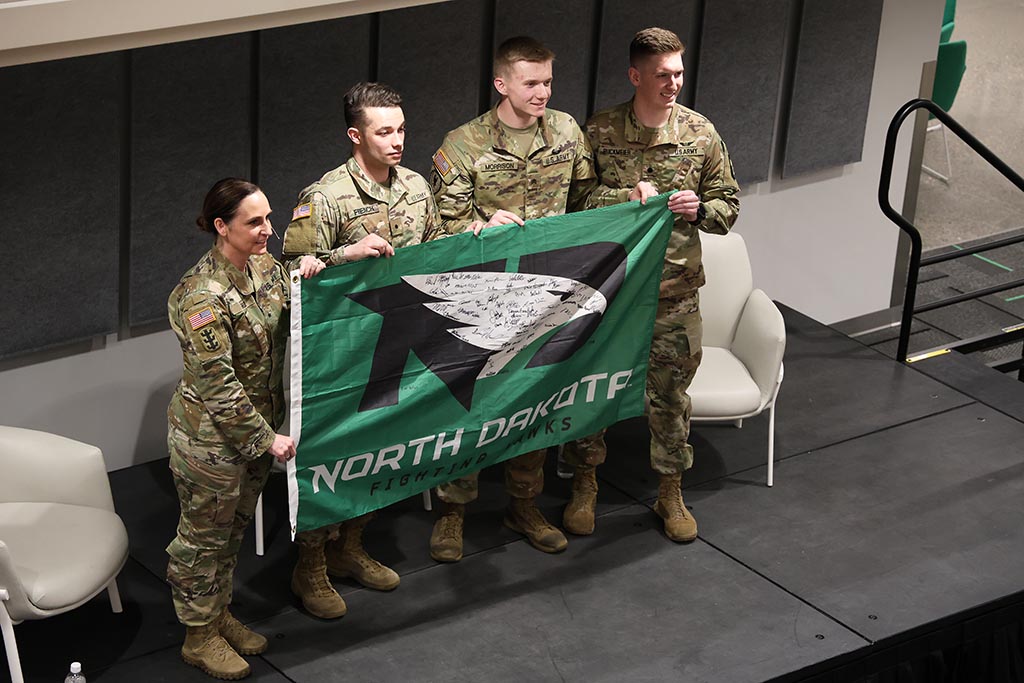
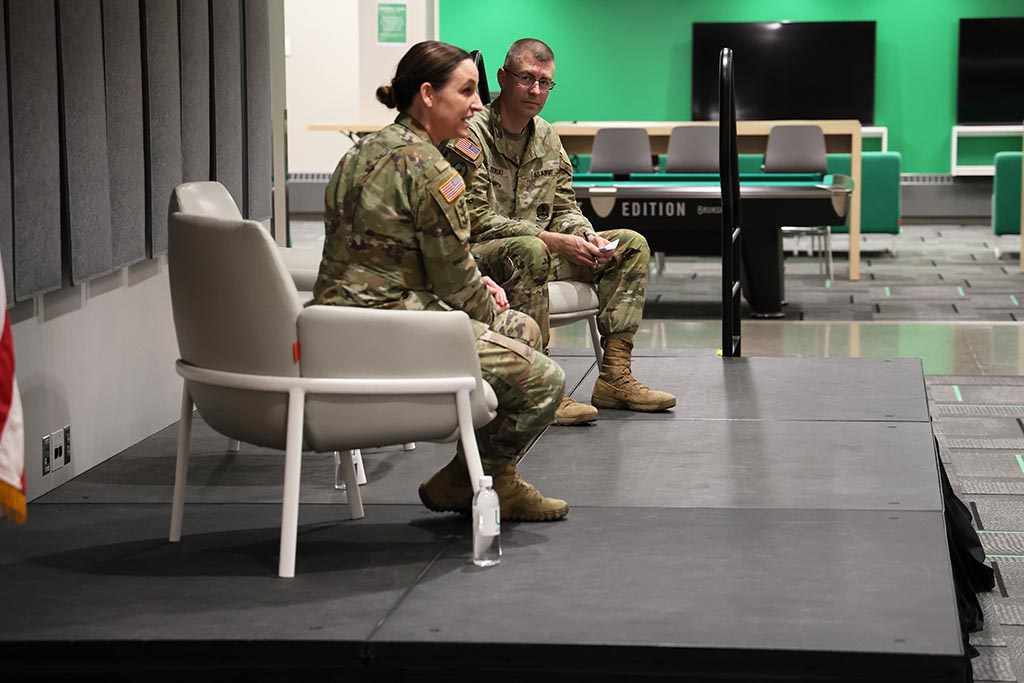
Huber delivered that message to UND ROTC cadets and civilians alike when she appeared on the Social Stairs in the Memorial Union on April 11 to discuss her insights and her career. Her talk, “From Cadet to General,” was the focal point of a recruiting event organized by UND student and ROTC Cadet Casin Buckmeier, as part of the responsibilities in his Military Science course.
For Huber, a foundational principle of the ROTC program is to expose a person to challenges that help show the strength of their inner character — challenges that get them to say, “I didn’t know I could do that.”
“It is so inspiring how ROTC can open doors for an individual, to take a peek and see what opportunities are available,” she said.
A UND Criminal Justice major and ROTC graduate, Huber is the first woman to hold the position of deputy adjutant general of the North Dakota National Guard. She has earned master’s degrees from the University of Mary and the U.S. Army War College. A decorated officer, she has received the Legion of Merit, the Bronze Star Medal and the Meritorious Service Medal with four Bronze Oak Leaf Clusters.
She also has cultivated lifelong friendships from her days in the UND ROTC program; one of the many benefits she said it confers.
When asked by Maj. Jared Budinski, the professor of Military Science who moderated the event, Huber joked that she was drawn to UND because of its hockey team but also for its reputation of excellence and professionalism. Like other young University students, she wasn’t sure what career she wanted to pursue, but found that the strong support systems at UND — both inside and outside the ROTC program — helped guide her to be the officer she was to become.
‘Open that door’
Huber advised new cadets, and the potentially future cadets in the audience, that people can be their own worst critics — that they can convince themselves they can’t do something. In a sense, they close the doors of opportunity on themselves.
“Don’t do that,” she said. “Don’t put those ideas in your head. Open that door.”
In addition, people should realize that they’re usually stronger than they think.
She advised cadets who may be unsure of their future in the program and in the military to not be shy in discussing their feelings either with their ROTC or degree professors, or a trusted friend or family member. Everyone has doubts, she said, but persisting through those doubts can make one stronger.
And when it comes to feeling stronger, Huber said the idea of physical fitness has been something she has carried with her in her military career from her days as a cadet to her present position. The benefits of physical training transcend the body and extend to the mind, and lead to less stress and overall improved mental health, she said.
These were sentiments largely echoed by a pair of UND ROTC cadets who also took the stage.
Mitchell Morrison, a second-year cadet, is the recipient of a ROTC flight training scholarship. The Pequot Lakes, Minn., native said he chose UND because he still wanted to be active outdoors and go fishing and hunting.
For Morrison, becoming part of the ROTC program was like “taking a leap of faith.” He said prospective cadets should not feel intimidated when considering joining. Instead, they should reexamine their own preconceived notions of what ROTC may mean; in a sense, they shouldn’t “close the door” on themselves.
Morrison attended Air Assault School at Fort Campbell, Ky., an opportunity he said he never would have been exposed to without his time at UND ROTC. There, he learned several different skills, including rappelling — a skill that UND ROTC cadets have employed at hockey and football games, by descending from the roof of the Ralph Engelstad Arena and the Alerus Center, to deliver the puck and the game coin to officials.
Taking the stage after Morrison was Alex French, who is pursuing a master’s degree in Forensic Psychology and a graduate certificate in Quantitative Research Methods.
French, who served previously in the Army National Guard, said he was thankful for being able to receive his undergraduate degree largely debt-free. He was even more grateful to be surrounded by different people at different points in their lives, all functioning together as a team and working to develop their careers through military service.
Like Huber, French said he has experienced periods of doubt about his future. He said introspection is important for him to remain committed to his service. It’s about goals — understanding where you want to be and knowing where you are. He said he found help in plotting his career course through people in the ROTC program.
“I think ROTC is a fantastic way to bridge that gap between where you are and where you want to be, especially if you’re running into roadblocks,” he said.
>> TWO ROTC PATHS: UND offers two ROTC programs — Army ROTC and Air Force ROTC.
>> MORE INFO: You can learn more about these programs and how to apply on the UND website.