Water goes in. Engineers come out.
With water-filtration project, fourth-graders show power of UND’s new Center for Engineering Education Research
Editor’s note: In the UND LEADS Strategic Plan, the Discovery core value calls on the University to “foster and sustain cross-disciplinary
teams dedicated to identifying solutions to pressing challenges,” especially concerning Grand Challenge areas such as human and rural health.
The new Center for Engineering Education Research — described below in a story originally published on June 18 — is a cross-disciplinary collaboration between UND’s colleges of Education & Human Development and Engineering & Mines, the long-term outcome of which is sure to touch the Grand Challenges of human and rural health and more.
****
What’s a beach bum to do when it’s the dog days of summer, the wind is still, the skin is sticky and the giant lake just a paddleboard away looks as thick as pea soup?
We don’t know, but there’s a bunch of fourth-graders in Devils Lake who might just have an answer.
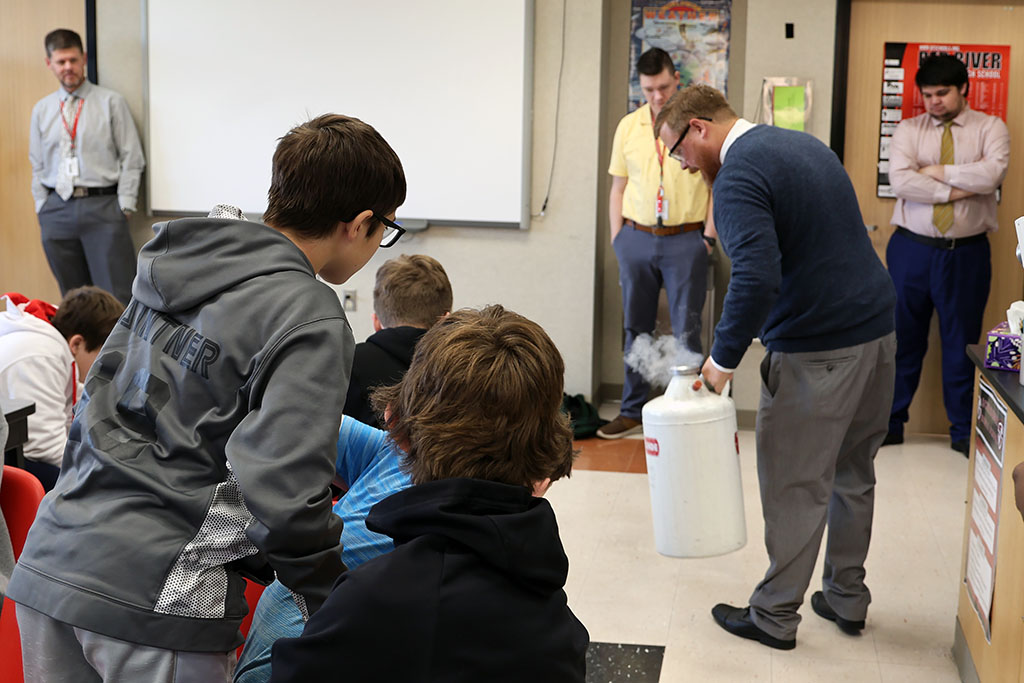
Julie Robinson, director of UND’s new Center for Engineering Education Research, says teachers there, and elsewhere in North Dakota, are learning how to incorporate standard engineering practices into the classroom to engage young learners in finding solutions to issues or problems that are relevant to them and their communities.

It’s a model lesson that represents a big part of CEER’s mission, Robinson said.
The formal collaboration between UND’s colleges of Education & Human Development and Engineering & Mines — made possible by a three-year strategic investment — aims to transform PreK-20 engineering education and broaden pathways to engineering through research partnerships and outreach.
“Before the CEER was created, a few of us between the colleges already were collaborating on some projects,” Robinson said. “We had this intent to create STEM education, particularly engineering education, that is more inclusive of diverse communities both in education and in the workforce.
“We’re talking about this deep need to really understand how we can support teachers at all levels so that we’re providing education that affords student learners regular opportunities to see engineering as something that can provide solutions to community interests — something all students can see themselves doing by identifying with it and engaging with it in very relevant, personal and authentic ways.”
Back to the pea soup
Teachers in Devils Lake used what’s called a “culturally relevant engineering design framework” to help guide instruction that began with students identifying a community-based need or problem — in this case, improving the water quality at a nationally known recreation area popular for fishing, swimming and other water sports.
But before the “problem” even was identified, Robinson said, the teacher would prompt an open group discussion.
What do you like to do at the lake? What have you noticed about the lake? What’s the special history behind it? Have you heard any stories about how it’s changed over the years?
Once the youngsters determined that the lake isn’t always the most squeaky-clean for swimming, they were ready to take the next step.
“They do some investigation and exploring to learn more about the issue,” Robinson said. “The teacher might bring in an elder from the Native community to talk about the importance of the natural resource within that culture. They take a tour or bring in an expert from the water treatment plant to talk about what that process looks like.”
Later, with the teacher’s guidance, they do a little more research and get the chance to build their own water filtration systems. In small groups, they experiment with different filtration materials — sand, gravel, activated charcoal — to see what works best to capture the “yuck.” They test, redesign and improve their filtration systems until they’re satisfied with the results.
“Then, there’s some sort of final stage where they’re justifying their design solution to a broader audience,” Robinson explained. “When you’re an engineer, there’s a reason you’re doing all those tests, right? Now you have to bring it back to the context of community and present your findings to the stakeholders, the City Council — or maybe the school principal.
“Fourth-graders likely aren’t designing a functioning solution that’s going to work in the long term, but the project is helping them to see, ‘Oh, I can do this engineering thing. I can come up with some innovative ideas to address a problem that can impact my community.’”
The big picture
That’s the win, and that’s how engineering can be introduced at a very young age, Robinson said. Students easily can build on that core knowledge from year to year so that engineering becomes real rather than just an abstract concept in a textbook.
Engineering instruction that’s thoughtfully designed is equity-centered and very inclusive, she added.
“It’s giving all students a voice and a sense of ownership over their learning because they can approach it in so many different ways that build on their individual strengths,” Robinson said. “When we allow students to solve problems and connect what they learn back to themselves, we can reach some of the most underrepresented students because we’re making it about their own lived experiences. They’re applying these pieces of science, math, technology, design, writing and even art to do something that’s very real.”
The learning becomes fun, and it disproves one of the biggest misconceptions about engineering: that it’s just for people who are good at the hard sciences and math.
Robinson says the teachers who have used the culturally relevant engineering design framework in their instruction have reported that students who ordinarily have been some of the most disengaged in the classroom have become passionate leaders.
“It never gets old,” one excited teacher recently told her. “I never tire of seeing that.”
Building breadth of perspective
And that’s exactly one of the underrepresented demographics educators want to ensure they reach. Another one is Native American students.
Robinson says Native Americans are overwhelmingly the most disproportionately underrepresented group in all engineering fields. Only 0.3% of the overall engineering workforce is Native American, with only 0.07% being Native American women.
These trends can be traced back to educational pathways, she says. While 5% of North Dakota’s overall population is Native American, they make up only 1.5% of the University’s total number of enrolled students across all programs and colleges. Further, only 0.4% of the students enrolled in UND’s College of Engineering & Mines are Native American or Alaska Native.
These are statistics CEER hopes to change not only by embedding engineering concepts in the education of UND’s future teachers but also by networking to increase personal development opportunities for practicing teachers and acting as a ready resource for dozens of school districts.
A quick peek at the CEER webpage shows multiple grant opportunities through the College of Education & Human Development and College of Engineering & Mines, as well as a long list of funding opportunities for engineering education research through the National Science Foundation.
Robinson said CEER also wants to create more industry partnerships that, in turn, could lead to even more pathways for engineering.
“We need many different kinds of people with different backgrounds, voices and perspectives if we truly want to be innovative and make life better for people,” she said. “That’s not going to happen if we have only one type of person going into engineering. Building that breadth of perspective and strong diversity in our workforce begins with our education.”
So, what about those Devils Lake fourth-graders, you wonder. What would they tell the overheated beach bum? Well, probably something like …
The water’s fine. Go jump in the lake!
>> THE CEER LEADERSHIP TEAM includes Ryan Summers, associate professor and Rose Isabella Kelly Fischer professor, Teaching & Leadership, College of Education & Human Development; Rachel Navarro, training director and professor of Counseling Psychology, College of Education & Human Development; Frank Bowman, Chemical Engineering Department chair and Thomas C. Owens Endowed Chair of Chemical Engineering, College of Engineering & Mines; and Beth Klemetsrud, assistant professor, Chemical Engineering, College of Engineering & Mines.
>> WANT TO LEARN MORE ABOUT CEER OR BECOME AN AFFILIATE? Contact Julie Robinson at julie.robinson@UND.edu.
>> SEE THE WORK IN ACTION by attending the one-day PreK-12 STEM Conference on Aug. 1. The conference is part of UND’s “Pages & Pathways: The Science of Learning” series.
****
>> QUESTIONS OR COMMENTS about the UND LEADS Strategic Plan? Your thoughts are welcome! Please contact Angie Carpenter, UND’s director of Special Student Populations, and/or Ryan Zerr, associate vice president for Strategy & Implementation, the co-chairs of the UND LEADS Implementation Committee.
You also may offer your thoughts by visiting the UND LEADS Strategic Plan home page and clicking on the “Provide your feedback” link that you’ll find there.
Thank you for your support of the UND LEADS Strategic Plan!