UND rooftop radar sets sights on space security
Backed by the state of North Dakota, the system will support student research, space domain awareness and UND’s growing national security role
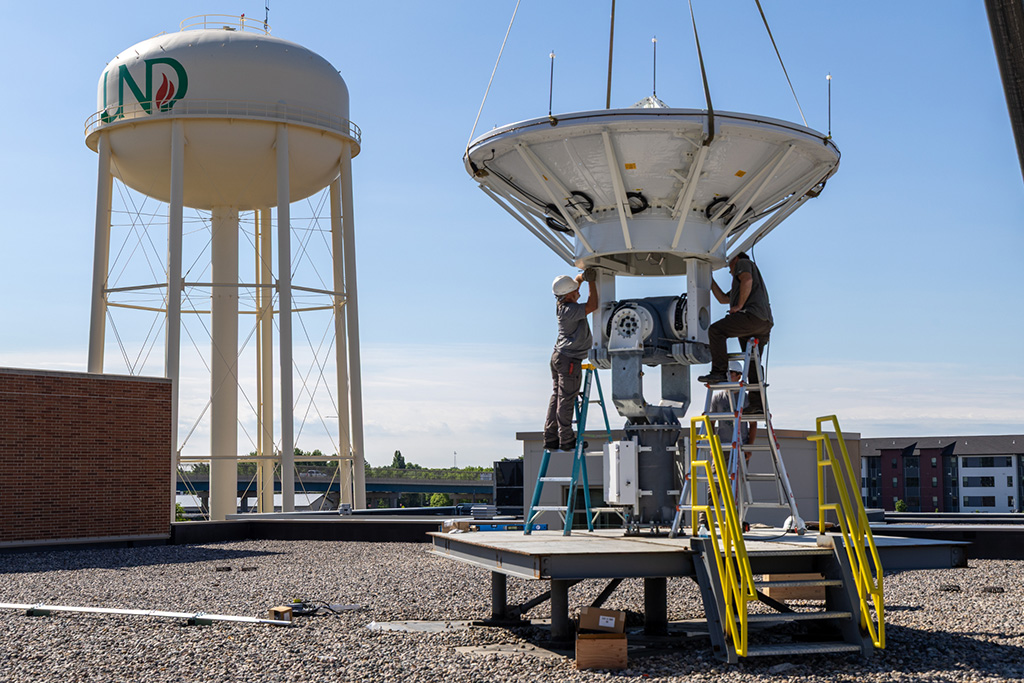
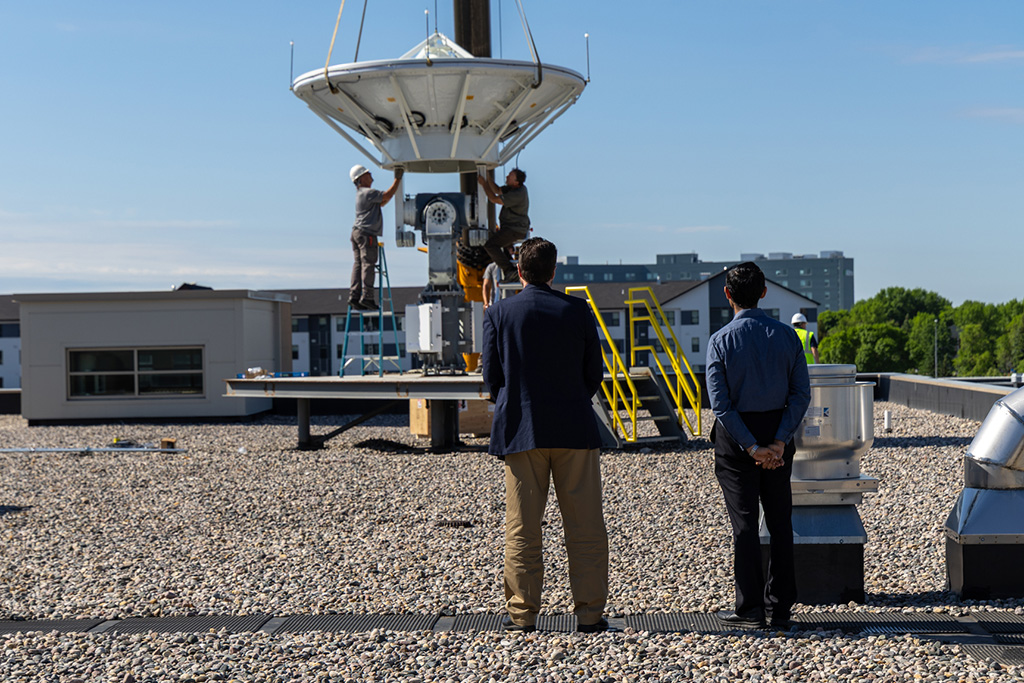
On June 4, UND’s newest space-research project rose into view above campus as cranes lifted two antennas onto the rooftops of the Collaborative Energy Complex and Odegard Hall.
That morning, workers installed the most visible pieces yet of UND’s new bistatic radar system, with “bistatic” referring to the physical separation between the radar’s transmitter and receiver. The system will be North Dakota’s first for academic space applications and will help researchers study and track the objects moving above Earth.
In addition, the system will give students hands-on experience with technology tied to national security and space studies.
For Ryan Adams, dean of the College of Engineering & Mines, the project begins with a clear mission: “The primary purpose of this radar system is to teach students and to do research on radar detection methods. The goal is to see everything that’s in low Earth orbit.”
How bistatic radars help researchers study low Earth orbit
Most monostatic radar systems send and receive signals from the same antenna. At UND, the antenna on the Collaborative Energy Complex will send signals into the sky and the other, about a mile away on Odegard Hall, will listen for the signals that bounce back.
Adams compared the transmitting antenna to a flashlight shining into the sky. The receiving antenna looks for the “glimmer” that comes back when that signal reflects off an object in orbit.
That separation gives a bistatic radar an advantage. When a monostatic radar has to switch back and forth between sending and receiving signals, objects can be missed in the time it takes to switch. With one antenna dedicated to transmitting and the other dedicated to receiving, UND’s bistatic radar can stay online continuously and watch for objects as they pass over the horizon.
But the ultimate goal is to detect objects in low Earth orbit, the region closest to Earth where many satellites, spacecraft and pieces of debris circle the planet. Many of those objects help support things such as communications, navigation and national security, which makes knowing where they are increasingly important.
And because so much depends on that crowded part of space, researchers need better ways to track even small objects moving through it. UND’s two-antenna setup offers a new way to do that, though it also makes the system more complicated than a traditional radar.
This work will extend beyond campus, especially in a state with a growing role in space and defense.
Supporting North Dakota’s growing role in space security
North Dakota is already home to Cavalier Space Force Station, where a monostatic radar system performs space domain awareness and missile warning missions. Adams said that connection makes the state a strong place to build a university-scale radar test bed.
UND’s radar will operate at a higher frequency than the system at Cavalier, Adams said. That could help researchers detect smaller objects and better understand what those objects are made of.
UND has had conversations with Cavalier about receiving sanitized datasets that could help researchers calibrate the campus system. By comparing what each radar sees, researchers can better understand how UND’s system is performing.
The project also connects to the Space Development Agency’s growing presence at Grand Forks Air Force Base and to broader national needs in satellite tracking, missile defense and homeland security. The lessons learned from UND’s radar could eventually help systems beyond campus, Adams said.
“The hope is that the work we’re doing is a test bed that we can use to benefit the work that’s already being done in North Dakota,” he said.
Additionally, the project ties into the College of Engineering & Mines’ growing national security research work, as internal components and programs for the system have been developed in the Mark & Claudia Thompson National Security Corridor in Harrington Hall.
For Adams, that broader national security mission is closely tied to what students will gain by working with the system directly.
One of the biggest benefits of having a bistatic radar on campus is the hands-on experience it will give students. These students include Sajib Kapali and Vigneshwar “Vig” Parameshwar, doctoral students who are helping develop internal components and software for the system.
“It is a privilege to be a part of UND’s bistatic radar project as I get to see firsthand how my research is contributing to solving a real-world problem,” Parameshwar said.
What’s next for UND’s bistatic radar
While the June 4 installation marked a milestone for the project, the work is not yet done.
Over the summer, the project team will bring the radar’s parabolic reflector system online and begin calibrating the antennas. From there, they will study how to improve the radar for space domain awareness and space debris tracking.
For now, Adams and others are glad to see years of planning take shape on campus rooftops.
“It’s just incredible to see this idea that we put forward actually happening,” Adams said. “It’s thrilling, it really is.”