Eager beavers, eager learners
In Project CuRRENT’s second summer workshop, teachers take to the river to build place-based lessons for more engaged students
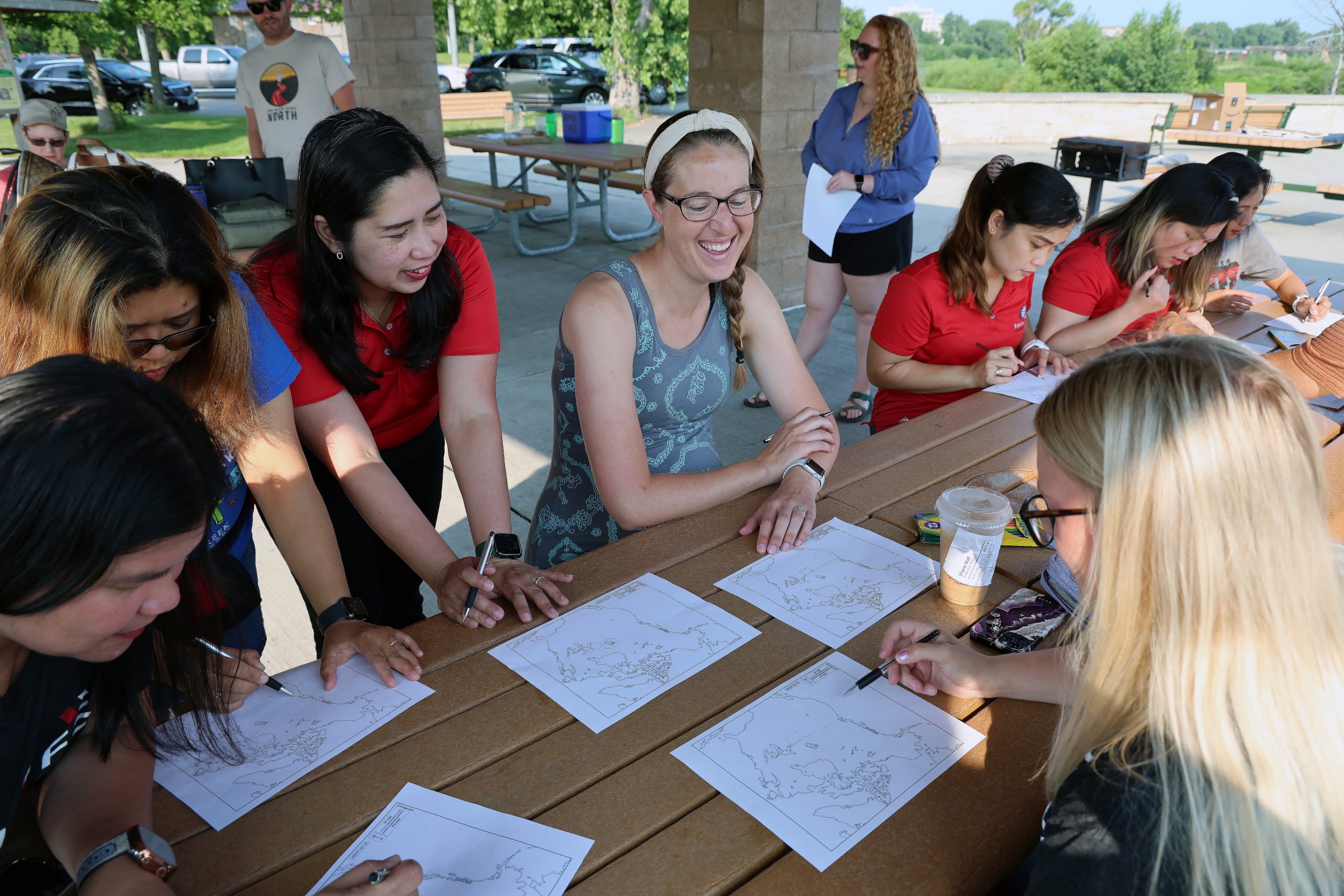
There’s probably nothing like a good old-fashioned geography quiz to wake up a group of teachers on a hot summer day.
And that’s just what was in store for nearly 20 educators who took part in the second chapter of UND’s three-year Project CuRRENT — that is, Culturally Relevant River Education for Nature-Based Teaching.
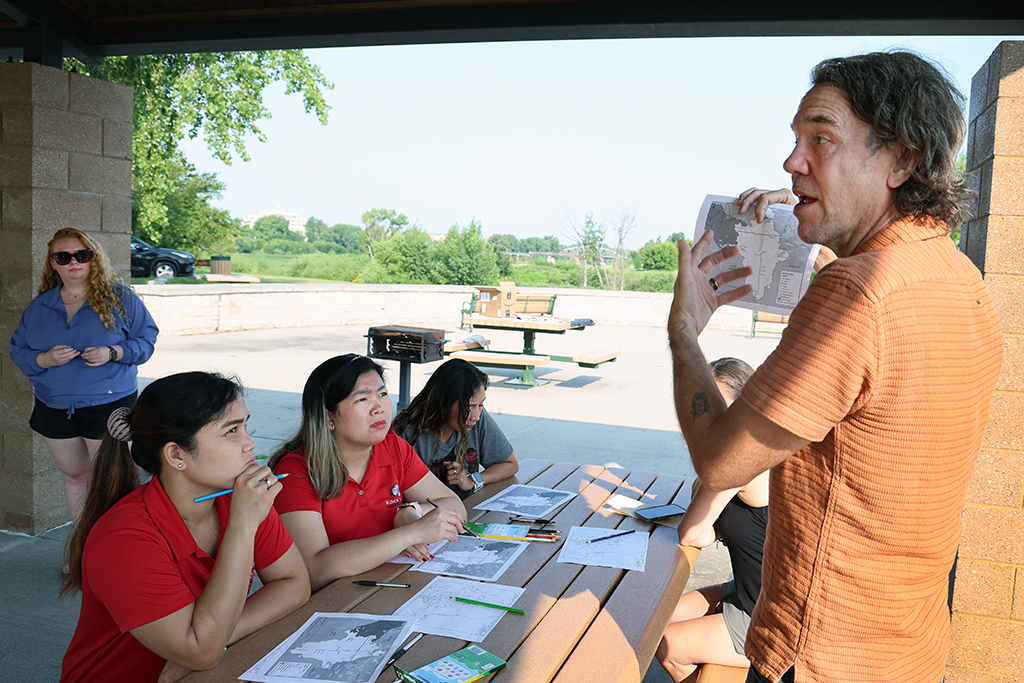
While gathered at the Eagle Point Trailhead near the confluence of the Red and Red Lake rivers in East Grand Forks, the teachers would begin this year’s two-day workshop with crayons and a one-page handout showing a sparse outline of North America.
Eventually — and with a little help from their cellphones, their neighbors and the presenters from the International Water Institute — they would name and plot on another map more than a dozen watersheds that feed into the Red River Basin.
Going straight to the source
“We don’t have to go all the way to the rainforest to experience really fundamental ecological processes,” explained Joshua Hunter, project partner and UND associate professor of Education, Health & Behavior Studies. “By using a place-based approach to learning, we can dig into that one specific spot on the map and explore all the many ways we can understand it.”
Hunter, along with project lead and Assistant Professor Julie Robinson of UND’s Teaching, Leadership & Professional Practice, were leading the second summer workshop designed to help teachers embed place-based education within their own curriculums. The program is funded by the National Science Foundation and is a collaboration with Turtle Mountain Community College in Belcourt, N.D. Other partners in the project include UND faculty members Bonni Gourneau, Kathy Smart, Jared Schlenker and Frank Bowman, along with UND doctoral student Sydney Raboin and math instructor Danny Luecke of Turtle Mountain Community College.
“Here, we’re talking about watersheds, but there are multiple ways we can think about them,” Hunter said. “We can look at them from cultural and historical points of view. We can think about the politics and land use practices. We can look at how people have engaged with the water over the years and also how animals are a part of that web, too.
“Place-based education allows us to take a deep dive into something that’s right here in front of us. We can see it. We can feel it. We can experience it directly.”
Canoes and connected waterways
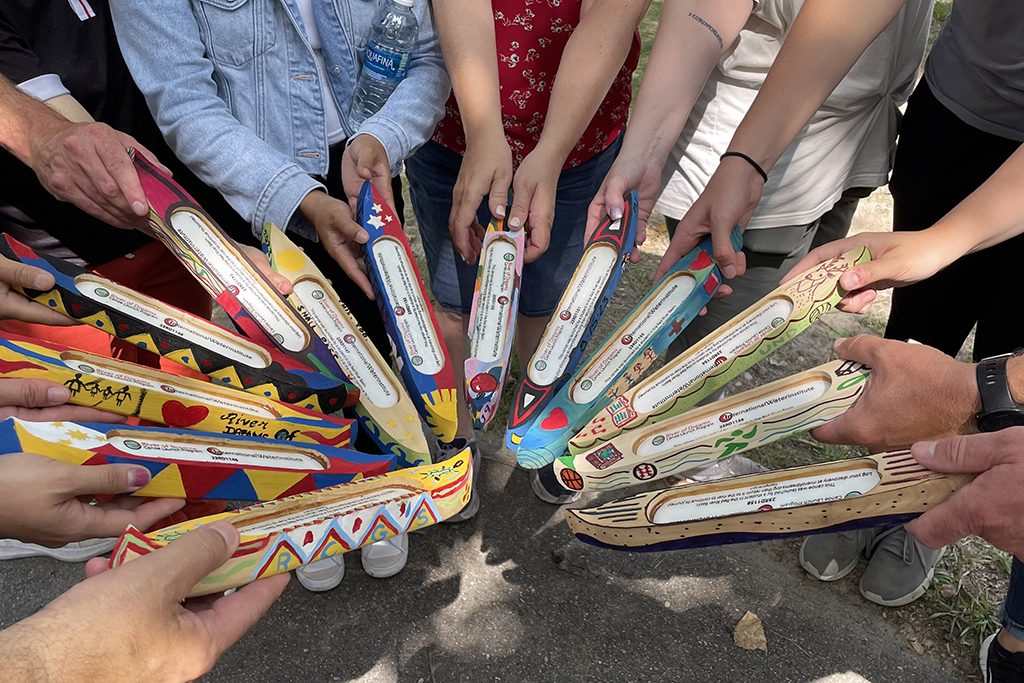
Last summer, the teachers and administrators from Thompson (N.D.) Elementary School, Rock Creek Grant School in Bullhead, S.D., and Circle of Nations Indian School in Wahpeton, N.D., were able to experience it directly by decorating their own miniature canoes and pitching them off the Sorlie Bridge into the Red River. (Click the link to see that story.)
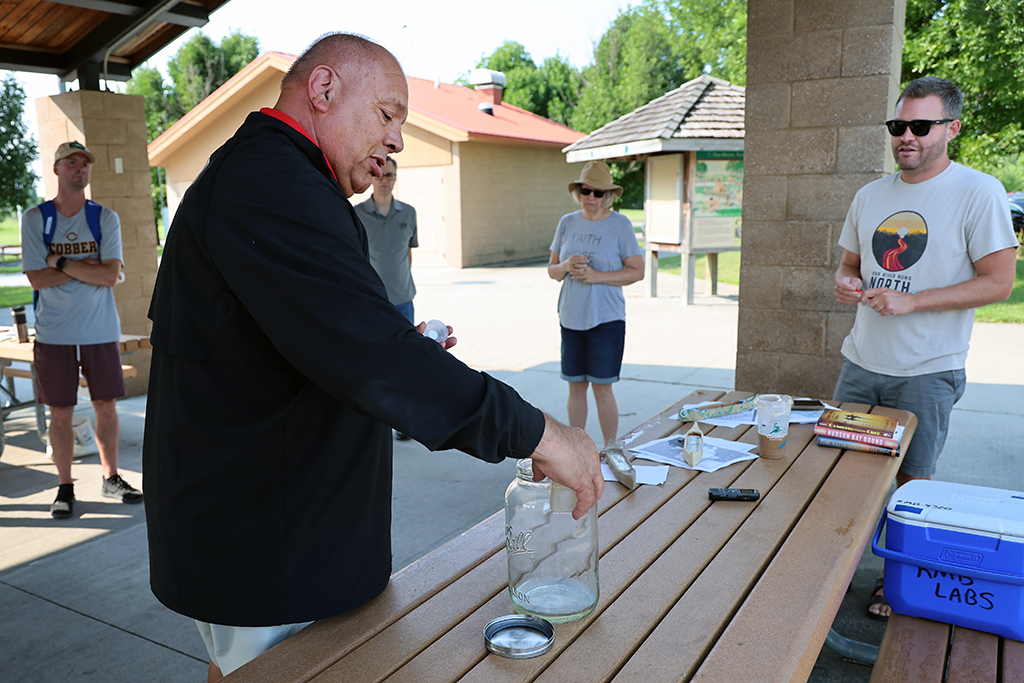
That exercise was a mini version of the International Water Institute’s River of Dreams program, which teaches schoolchildren about the connectivity of the planet’s water supply and watersheds. (The tiny watercraft, which include a phone number, often are found hundreds of miles from where they were launched.)
The Water Institute’s Project Specialist Asher Kingery and Monitoring & Education Specialist Taylor Lemieux returned this year to lead more hands-on watershed activities. After the mapping activity and discussion, the teachers poured little jars of water — each sample collected from a different watershed area — into one large jar to represent all the waters coming together as they do naturally.
Making new connections
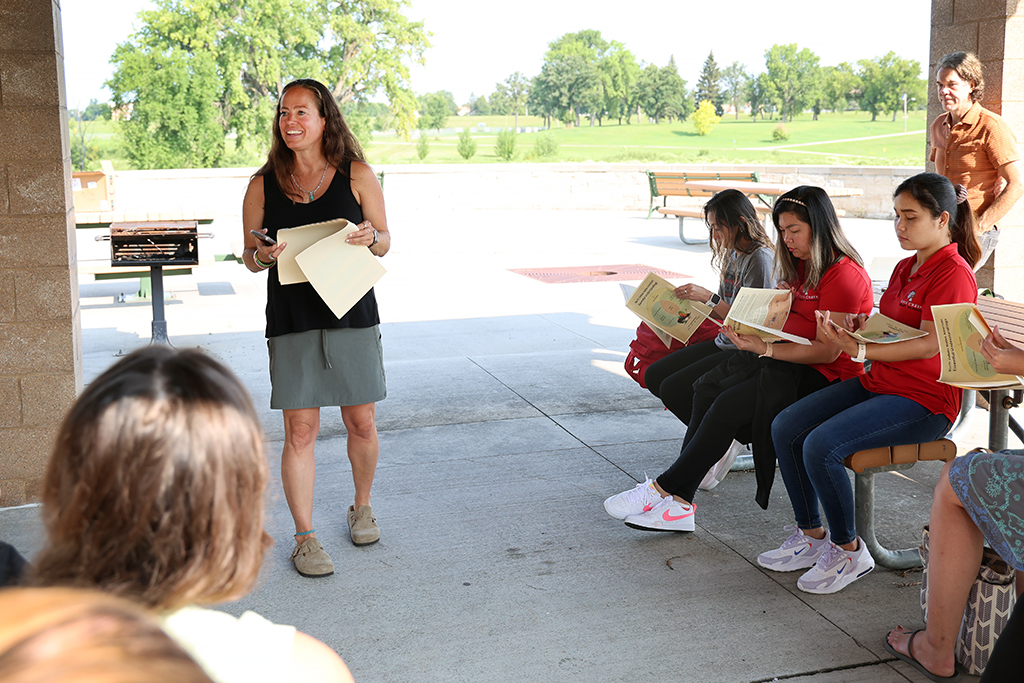
Next, Robinson handed out journals and a copy of “North Dakota Native American Essential Understandings” before inviting the participants to take a Wondering Walk along the riverbank.
“As you find a sit spot or wander while you wonder, I’d like to ask you to take a look at the interconnectedness of all things that are in our context and space,” Robinson said. “Think about how all of those elements within an area are connected, integrated and beneficial to each other.”
Robinson also encouraged the educators to think about “sacred relatives” — one of seven “understandings” about Native culture, history and lifestyle that tribal elders in 2015 determined to be “essential” for all North Dakota schoolchildren to learn. (You can learn more about those essential understandings on the Department of Public Instruction website.)
“Enjoy your time toward forging your own connection here,” Robinson told the teachers. “And think about where you can see evidence of that essential understanding of ‘sacred relatives’ around you.”
A time for sharing
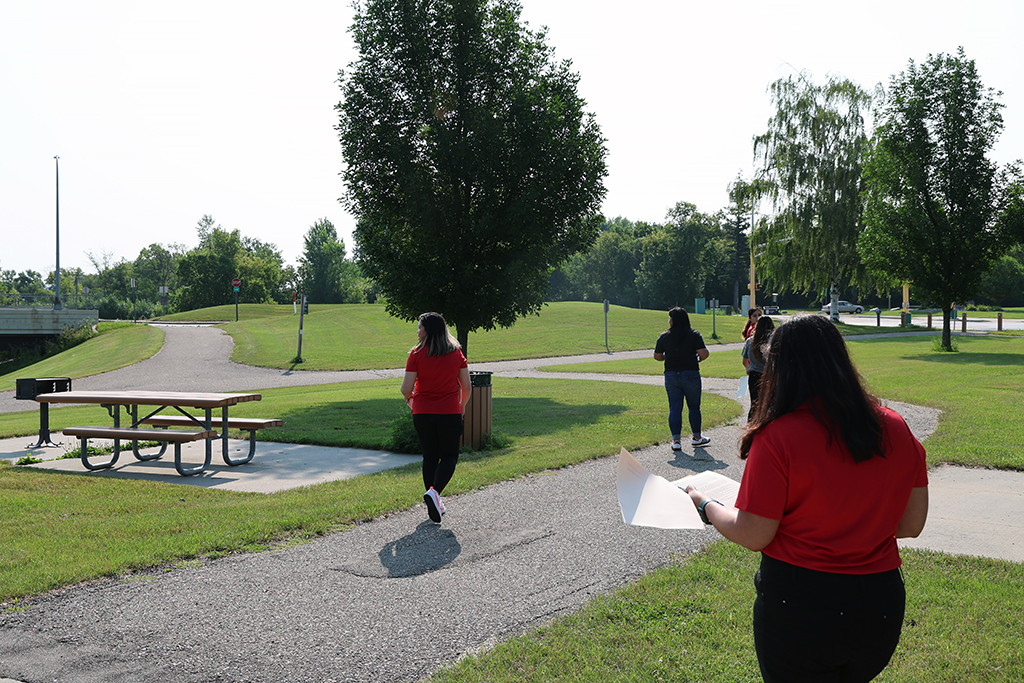
As the teachers filtered back to the shelter after their individual Wonder Walks, they began to share their thoughts and observations.
“As I was walking toward the river, I was thinking about how Native people value and respect nature,” said Juvy Vacunador, who teaches fourth-, fifth- and sixth-graders at Rock Creek Grant School. “I saw plants and that big tree right there and thought of how the river supports that big tree to help it survive and also how the Native people survived because of the things around them — how they nurtured and protected nature.”
Rock Creek special education teacher Faith Isidto spoke of respect.
“As I was doing my reflection, I thought of how I always let my kids know to let nature live,” Isidto said. “Every time you see bugs or whatever, I just say, ‘Let the nature live.’ I want my students to recognize and value respect. And it’s not just a superficial respect. As I read the ‘sacred relatives,’ I was thinking of how there really is a deeper meaning to respect. There’s so much more beyond that.”
How to ‘build a beaver’
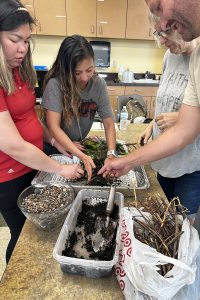
As the first morning of the two-day workshop wrapped up, the teachers got a hint of what was to come. They would head back to a more traditional classroom on campus, where they would explore the industrious beaver.
“Endemic to this part of the world, the beaver is a strange and wonderfully unique and adaptive creature that gives us a host of different topical areas to explore,” Hunter said.
Besides playing a very significant role in the history and culture of Indigenous people, the semi-aquatic mammal offers potential for interactive and interdisciplinary lessons on the environment, ecology, engineering (building dams) — and even anatomy.

Quietly, he shared with UND Today just one surprise activity planned for that afternoon.
“We’re going to do this thing we call ‘Build a Beaver,’” he said with a smile. “It’s kind of silly, but it really gets at the uniqueness of this creature and how well-suited it is for being successful in its environment.”
The exercise involves dressing a willing participant with all sorts of beaver-wear. For example, swimming nose plugs would stand in for the beaver’s natural nose flaps that close for diving. Goggles would represent the special eye lenses that allow a beaver to keep its eyes open underwater. There’s fake fur for the body, earmuffs for the ears, and so on.
Before the two days were out, the teachers also would get the chance to take a kayak for a spin on the Red, and they’d create art masterpieces by using objects found in nature.
Feedback from the educators
The two-day workshop barely had begun, but the teachers already were enthusiastic. Here’s some of what they had to say …
>> Andrew DeCoteau, superintendent and principal, Rock Creek Grant School: “Native Americans are hands-on learners to start with, so when our Filipino teachers do a lot of these sorts of hands-on activities, the students are more engaged in it. And when they see they know some of the cultural aspect of it, they really take to it. It has made the classroom a lot more exciting. And we don’t stop there. The teachers also bring their culture into it. So, the learning doubles.”
>> Deena Monson, fourth-grade teacher, Thompson, N.D.: “I think the place-based education really has inspired us all. We want to get our students outside and take them to some of these places so they actually can have a connection to what we’re teaching. You can lose them if you’re not getting their minds really engaged. This kind of learning can make everything more exciting and fun.”
>> Malou Jubay, special education, Rock Creek Grant School: “Learning is a continuous process, so we’re learning as teachers at the same time our students are learning. We need more exploration, not just in the classroom, but outside in nature, too.”
>> Lorelie Rojas, physical education and music, K-8, Rock Creek Grant School: “This allows us to give them opportunities to share their stories and their lives, so it’s more meaningful that way. They’re more open to us, and it builds trust.”
>> Maria Chabel Yongco, second- and third-grade teacher, Rock Creek Grant School: “As a foreign teacher, I come from a different country and a different culture. In the Philippines, we’re surrounded by water; here, it’s huge, massive land. But once you get involved and connected, you learn there are many similarities in our cultures. In the Philippines, we have tribes, and we respect their rules and their governance. It’s the same thing here. These field trips allow the teachers and students to learn together, and that’s been a great experience. The students say, ‘Oh, my teacher is Filipino, but she also wants to learn our culture.’ It might be overwhelming to us because it’s different, but it’s a good, overwhelming process for us.”