Pomp, circumstance and gratitude
Health and happiness for you and those around you starts with saying thanks, UND’s Dan Lewerenz tells graduates at Summer Commencement
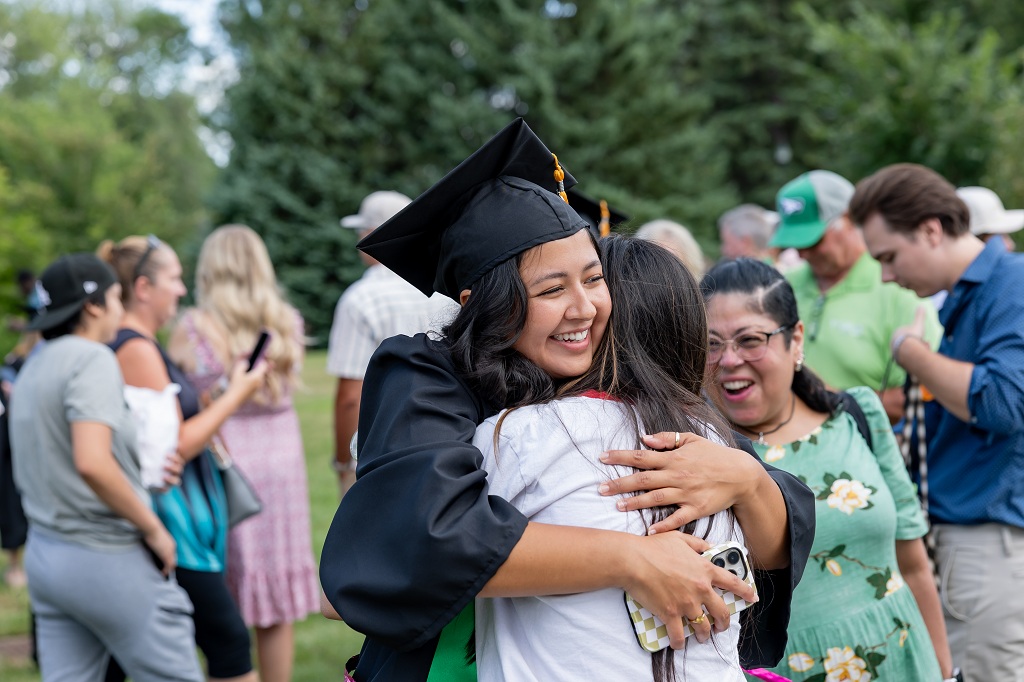
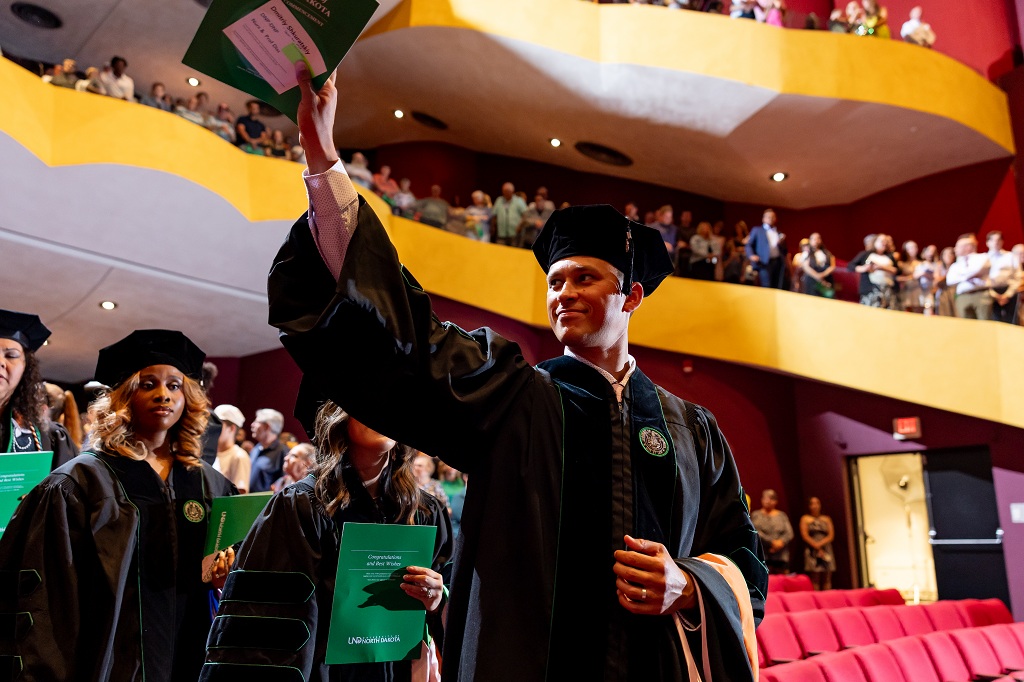
Editor’s note: On Aug. 7, UND President Andrew Armacost presided over the University’s Summer Commencement ceremony, which was held in the Chester Fritz Performing Arts Center. At the ceremony, graduate and undergraduate degrees were conferred upon more than 500 graduates.
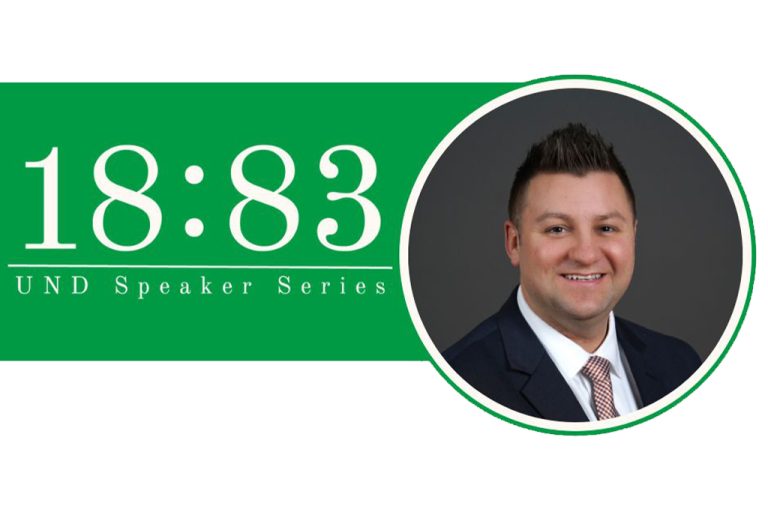
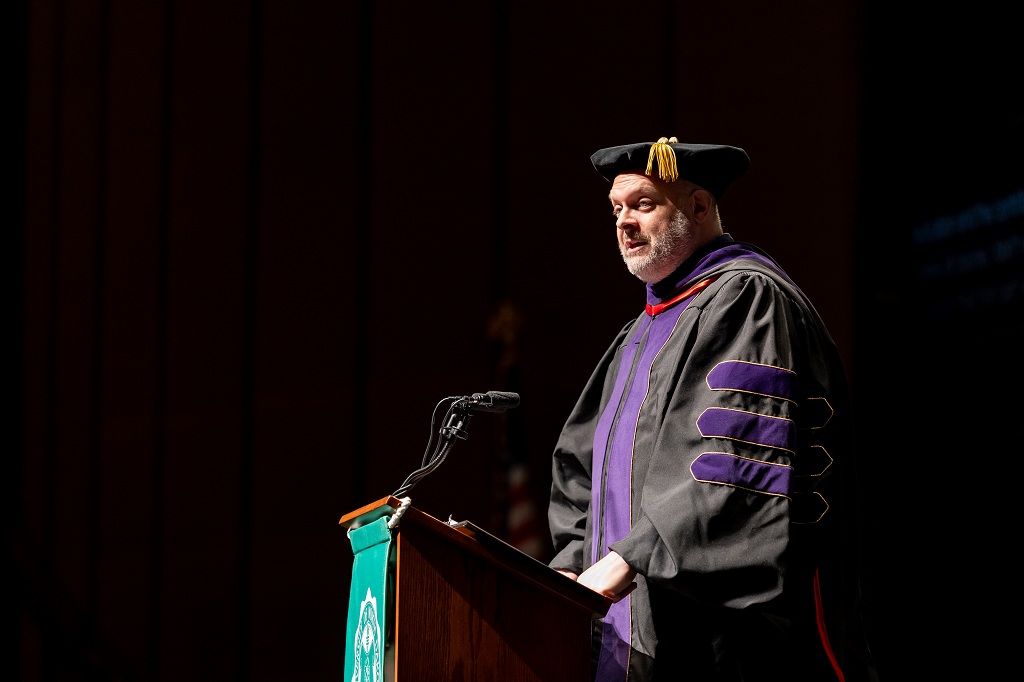
Dan Lewerenz, associate professor of Law at the UND School of Law, delivered a commencement address, which is reprinted below. Lewerenz has taught at UND since 2022 following a career in journalism and law, most recently serving as a staff attorney for the Native American Rights Fund in Washington, D.C. He is a member of the Iowa Tribe of Kansas and Nebraska and is the chief judge of his tribe’s appellate court.
At the Native American Rights Fund, Lewerenz was one of two attorneys who staffed the Tribal Supreme Court Project and drafted amicus briefs in both state and federal courts, including the U.S. Supreme Court and various U.S. Courts of Appeal.
He previously served as an attorney-advisor at the U.S. Department of the Interior’s Office of the Solicitor in the Division of Indian Affairs. Prior to earning his J.D. From the University of Wisconsin Law School, Lewerenz spent 10 years as a reporter and editor for The Associated Press in Kansas City, Mo.; Helena, Mont.; Columbia, S.C.; State College, Pa.; and Cheyenne, Wyo.
****
I must admit I felt a bit of trepidation when President Armacost called to invite me to be your commencement speaker. Not because I have a fear of public speaking, but because I had just read an article by Molly Fischer in The New Yorker, where she wrote: “The graduation speech is a thankless form: generalized, impersonal exhortation/congratulation is almost guaranteed to be forgettable, if all goes well. But this year,” she observed, “on at least a few American campuses, all did not go well.”
Then she described a number of commencement speakers who were booed by their audiences, booed by the very students they were supposed to be celebrating.
So while President Armacost was saying, “Dan, we would be honored if you would be our commencement speaker in August,” my brain filtered that message through Fisher’s article, and interpreted it as, “Dan, we trust that you’re savvy enough about these things that you won’t get yourself booed,” or even worse, “You want to give a commencement address, Dan? You’re expendable.” Thank you, President Armacost, for this opportunity.
But then I remembered why so many students booed their commencement speakers this spring: Those speakers insisted on talking about artificial intelligence. So I resolved then and there that I would not, under any circumstances, talk to you about A.I.
Accepting help enables success
Instead I’m going to talk to you about something a bit more old-fashioned. I’m going to talk to you about thanks-giving.
I know what you’re thinking: “Thanksgiving is three months away. Professor Lewerenz is off his gobbler.” I’m not talking about the holiday. I am talking about the act of giving thanks.
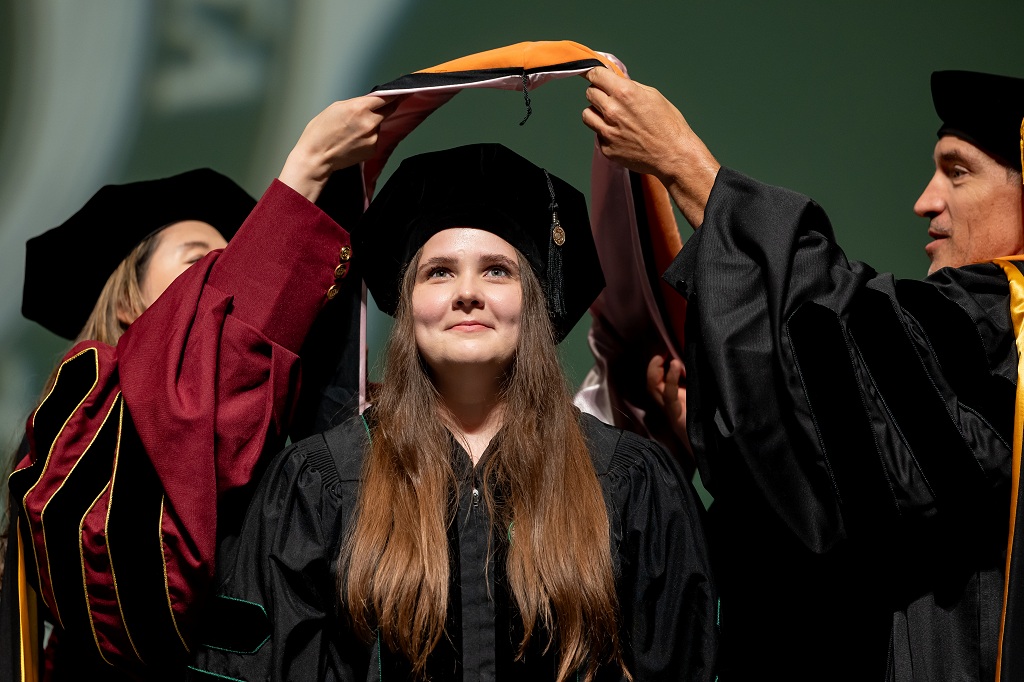
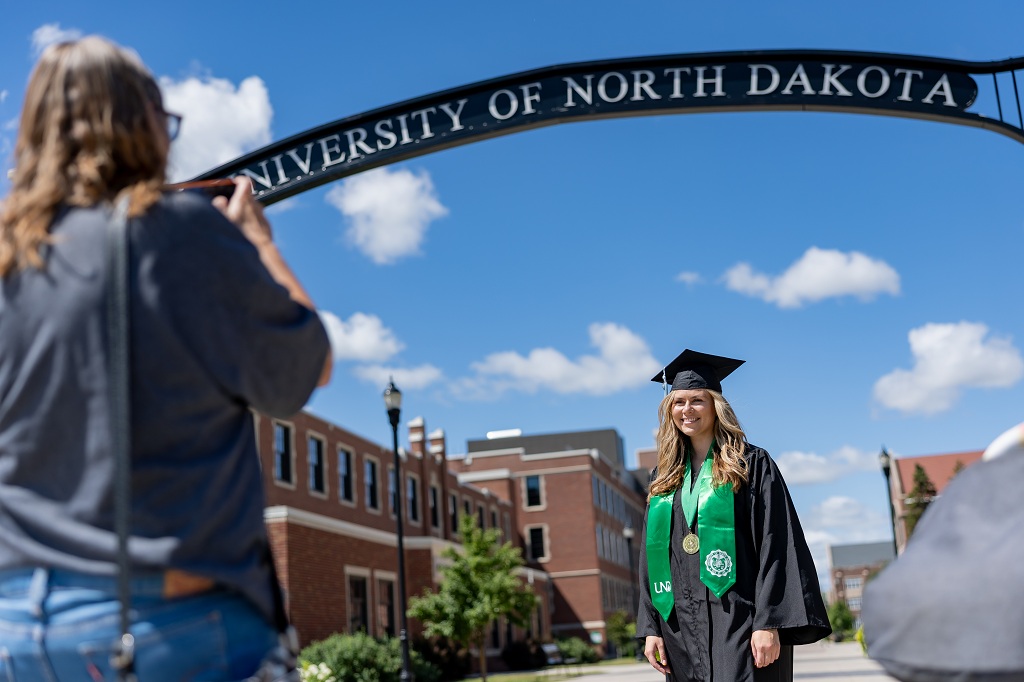
Because each of you is where you are today, having earned your degree, wearing that cap and gown, prepared to receive your diploma or your doctoral hood or some other signifier of achievement, because of a combination of two things: your own hard work and dedication, and the contributions of others.
Of course, I don’t want to diminish that first part: your own hard work and dedication. Each of you has earned your degree. You took the tests, you wrote the papers, you practiced your instrument for hours on end, you performed the experiments in the lab over and over and translated the results into a poster presentation. You endured cold walks to morning classes, powered through long nights of studying for exams, and ticked off the degree requirements one by one until you had earned the right to wear that cap and gown.
Be proud of that. You earned it.
But nobody does it alone, which is why I think of commencement as an occasion for thanksgiving. There are so many people I would thank: the law professors who encouraged me to pursue an academic career and enthusiastically recommended me for this job; the work colleague at the Department of the Interior who suggested that I apply for a position with the Native American Rights Fund; the mentor from my journalism days who encouraged me to pursue leadership positions both at work and in professional service.
Thank you, Great-Grandma Murphy
And, of course, my parents, who supported me throughout my journey.
My thank-yous reach even farther back, to my great-grandmother, Mabel Murphy. Born Mabel Bragdon in 1904, Mabel didn’t have an easy life. Her family cut her off when she married Leo Murphy, an Ioway Indian boy from the nearby reservation. She and Leo had six children, but the reservation had few job opportunities to support a family of that size, so during the Great Depression they hit the road.
Usually, when they would arrive in a new town, Mabel would find a house or apartment they could rent. Sometimes that lasted only a few days, until the landlord realized he had a bunch of Indians living in this rental and kicked everyone out. Both Leo and Mabel worked when they could, Mabel most often in service jobs, waiting tables at a restaurant or housekeeping for a hotel.
It was honest work, and it helped support her family. It wasn’t fulfilling, and it didn’t support them very well.
So Mabel began taking correspondence courses through Kansas State Teacher’s College, now Emporia State University. The college required all written work to be submitted either typed or hand-printed, no cursive. But the family couldn’t afford a typewriter, and Mabel always wrote in cursive. So my grandfather remembers how he, as a fifth grader, and his sister, a few years younger, would take all of Mabel’s cursive homework and print it out so that she could turn it in.
Mabel earned her bachelor’s degree that way — but she didn’t do it alone. Degree in hand, she began a new career as a teacher, and she went on to earn a master’s degree from the same institution.
Earlier this week, I spoke with my grandfather about Mabel’s penchant for education. He said it was always important to her, even before she had the opportunity to earn a degree through correspondence school. She valued education as a means of self-improvement. But she needed an education to better provide for her family.
So she did what she needed to do, and she got the help she needed. She earned those degrees, and she did it with the help of her two little scribes, who made sure that her assignments were properly printed the way the Kansas State Teacher’s College wanted them.
Don’t wait to say thanks
I was fortunate to know my great-grandmother, who passed away when I was 21. But I knew her as a child knows their great-grandmother, as the one who always had a bowl of lemon drops when we went to visit, and who always sent a card with $5 for our birthdays.
I knew her the way a teenager knows their great-grandmother, as the one who would talk about people I never knew. I knew that she never stopped learning — she learned to swim when she was in her 80s. But I didn’t know how important education was to her, or how hard she’d worked for it, or how she hadn’t done it alone, until after she was gone.
I tell you all of this because I never thanked her for her commitment to education, for passing that along to her children, and they to their children, and so on down the line. But I wonder sometimes if I would be on this stage today, wearing the regalia of a juris doctor, if not for her.
Sure, I’m the one who graduated high school, earned my bachelor’s degree, got into law school, finished law school, embarked upon an academic career, all of that. But would I have done so without my family’s generational commitment to education?
I tell you this because each of you have people who have helped you get to this point, and their contributions are as varied as you are from one another: The UND professor who helped you with that capstone project, the high school counselor who showed you what a good fit UND would be for you, the family friend who swore that when you got your pilot’s license she would be your first passenger even though she’s terrified of flying, the roommate who cheered you up when you’d had a bad day and you just needed to get through it.
Benefactors more attenuated, like the UND alumnus or alumna who donates every year to support your department, the groundskeepers who cleared the sidewalks so that you could get to class on those cold winter mornings, and the members of the Dakota Territorial Assembly who established this institution even before North Dakota was a state.
And, of course, the people in this auditorium who are here to celebrate your achievements today.
A round of applause
Soon you will take the stage, and the rest of us will applaud your accomplishments. But before we do, I would like you all to rise and give a round of applause to the people in this auditorium who have supported you on this journey. And as you leave, I hope you take a moment to think of someone you can thank.
I could bore you with all of the social science about how performing acts of gratitude can improve your physical and mental health, can improve the physical and mental health of the people you thank, all of that. But I won’t. Instead, I ask that you think about how good it feels to have reached this milestone, and how good someone else would feel to hear your heart-felt appreciation.
We don’t need to wait for football weather and pumpkin-spice products and cranberry-in-a-can to give thanks. We should do it every time we achieve something with someone else’s help. In other words, do it every day.
Congratulations, Class of 2026. I thank you for this opportunity to wish you the best of luck in the next stage of your lives.