Campus renewal, Part 1: What’s under construction on campus?
Two-part feature starts with Merrifield Hall to offer latest on UND’s current construction, renovation projects
Editor’s note: In the UND LEADS Strategic Plan, the “Learning” core value calls on UND to “enhance physical and virtual learning spaces to ensure faculty and students have the tools and resources necessary for productive and enriching educational experiences..”
In this story, which UND Today first published on Sept. 5 and is the first of a two-part series, facilities experts describe the extensive efforts now underway to make the UND campus one of the most up-to-date and attractive in the nation.
Part 2 of the series also was published on Sept. 5 and can be read on the UND Today website.
* * *
The work of UND is in teaching, research and service.
The work of making those activities possible is in power tools, sawdust and high-visibility vests.
That’s because teaching, research and service at UND happen most often inside campus buildings, and some of those buildings are more than 100 years old. So, the many dirt piles, temporary road signs and backhoes now on campus are the signs of the University evolving, much like the academic work evolves through new programs and multi-million-dollar grants.
This article will describe the status of several major construction and renovation projects now underway, but even that won’t account for all of the activity of campus renewal. Some of the biggest projects, such as the Hyslop Sports Center’s demolition and replacement with a STEM complex, will be reported as more details emerge. Also, construction activities related to major UND Athletics facilities will be reported in a September story in UND Today.
For further reading on campus renewal projects, visit the Campus Renewal blog. There, readers will find not only archives of campus notifications regarding construction but also original reporting on specific projects in collaboration with UND Facilities Management.
Merrifield Hall
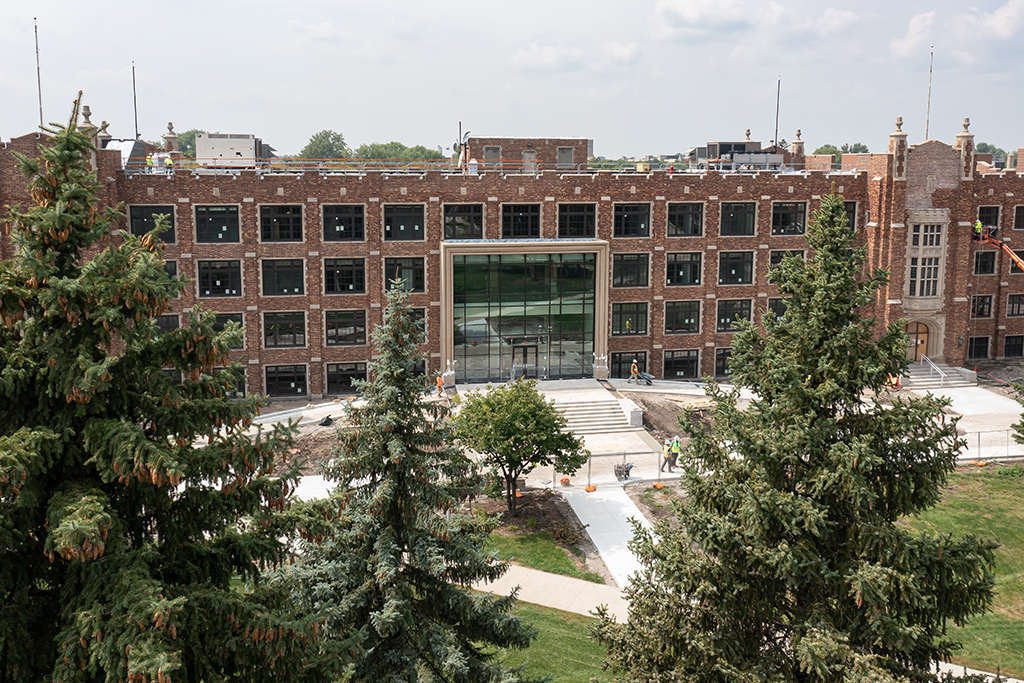
While touring the work site every month or two throughout the renovation process, anticipation built for Brad Rundquist, dean of the UND College of Arts & Sciences, as he observed progress at the University’s Merrifield Hall.
As modern upgrades took root, just as many historic hallmarks remained — terrazzo floors, original banisters and gnomes in the stairwell window seats.
And now, it’s only a matter of weeks until it all comes together.
Originally slated to be open for the fall semester, wet conditions earlier this year pushed back the replacement of Merrifield’s roof, causing delays to the $55 million project.
It was a frustrating setback in the short term, but a minor inconvenience for a project planning to accommodate the next 100 years of educating students, Rundquist said.
“Merrifield Hall has long been a campus ‘gem,’ although it lost some of the luster over the years,” he said. “I have come to think of the work inside and out as equivalent to polishing a gemstone.”
As summer turns to fall, the semester ahead represents the final push (or polishing grind, rather) for restoring Merrifield, said Brian Larson, director of construction management at UND.
Contractors are working on all fronts, setting up the building’s essential energy and HVAC systems and restoring its exterior masonry. It’s a flurry of activity.
“We’re focusing on completing the electrical installations, as well as finishes such as paint, carpeting and furniture installation,” Larson said. “Into fall, construction crews will be testing and balancing the HVAC equipment and installing classroom technology and networking.”
The goal: move faculty and staff into Merrifield Hall over the winter break, leading into 2025.
The College of Arts & Sciences already has fully booked its free guided tours to give Homecoming Week visitors a “sneak peek” to see how things are coming along inside.
With work underway, visitors won’t be able to wander freely, but they’ll be able to see the new east entrance that “enhances Merrifield’s impact on the heart of campus and brings light into the building,” said Tracy Backstrom, director of Alumni & External Relations for the college.
Departments are looking forward to their first spring semester in the newly updated space, she said. But the official ribbon-cutting likely will happen during next year’s Homecoming Week festivities.
“Throughout this process, since planning in 2019, my outlook has not changed,” Rundquist said. “The renovation of Merrifield Hall will impact nearly every UND student, given the importance of the coursework there to UND’s Essential Studies program and liberal arts mission.
“The learning spaces being built will enhance teaching and learning while showcasing our outstanding programs to future generations of students.”
Carnegie Hall
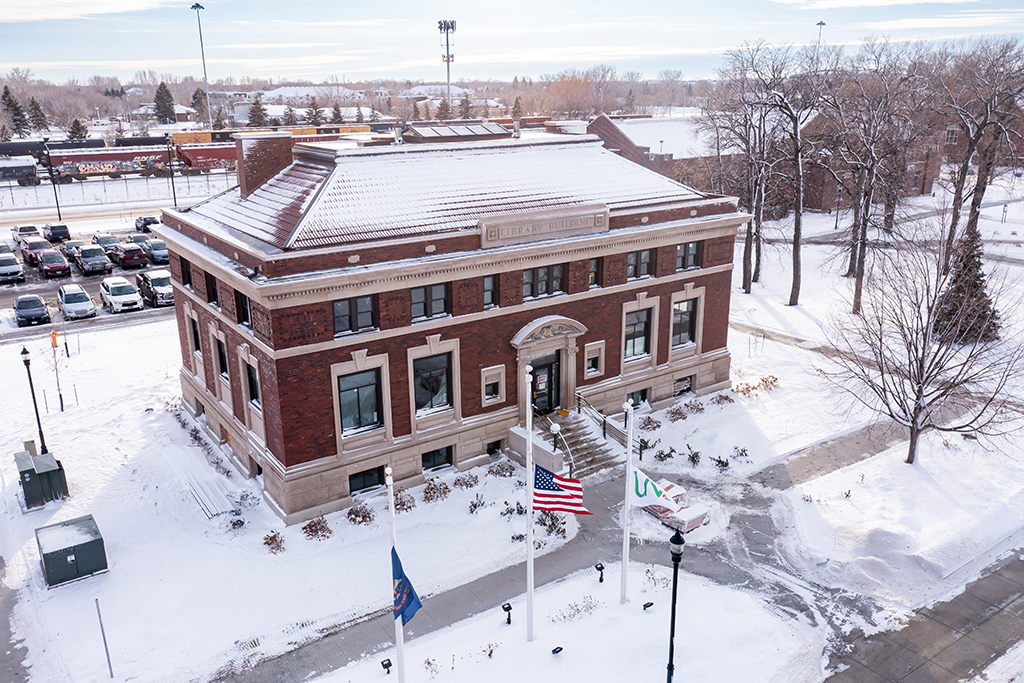
As with Merrifield, this semester will be the final push for completing renovations at UND’s Carnegie Hall.
The future offices of the president and provost have been under construction since the building’s midcentury add-ons were removed in 2020. Work on the exterior did much to restore the building’s original visage.
First built in 1908 as one of three Carnegie academic libraries in North Dakota, Carnegie Hall (again, much like Merrifield) has long stood vigilant on the perimeter of UND’s central quad.
Back in December, as reported in UND’s Campus Renewal blog, crews framed the interior’s updated floor plan for offices and conference rooms. In the basement, new plumbing was installed before a fresh pour of concrete.
That blog post also detailed the “Parts A and B” of its final construction phase. Today, renovations are in Part B: “the culmination of interior installation, including furniture, fixtures, flooring and paint.”
“Crews completed installation of mechanical and electrical equipment, and drywall has been installed,” Larson said. “With drywall tape and texture work finished on the second floor, work will proceed to the first floor and basement. Painting is underway.”
This semester, the goal is to fill out the space with the expected wood casing, paint, furniture and audio/visual technology of a functioning office space.
Chris Wetch, project manager and assistant director of design for Facilities Management, confirmed that a few factors delayed the project from a fall 2024 opening, including final designs for the wood casing and longer-than-expected lead times for crucial components.
The furniture in the building will be new, including a reception desk modeled from the original Carnegie Library’s entryway desk. Another nod to the original building will be the chandeliers, re-created and custom-made to match lighting fixtures shown in archival photographs.
Fireplaces, though transitioned to gas-operated rather than wood-fired, are also original pieces maintained for the president and provost’s offices.
“There was a request to keep some original, exposed brick if possible,” Wetch said. “It turned out that the best and easiest place for us to do that was above the fireplace mantel in the provost’s office. In the break room, there is exposed iron-spotted brick, which is also original and not too typical these days.”
Wetch commented on some of the “elevated finishes” that will complement the legacy of the building, as well as its new charge as an administrative office building. There will be real wood floors in reception areas, subway tiles on the bathroom walls — pieces that go a long way without costing too much to create a warm and welcoming space.
Larson said staff should be able to move to the new office by January.
UND School of Law
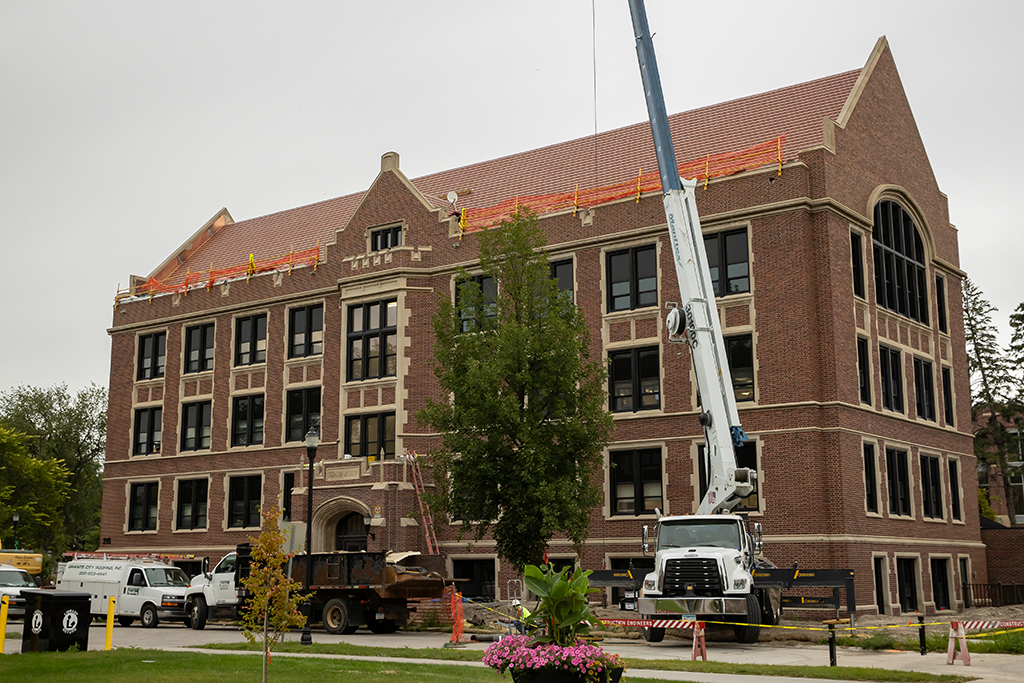
Since early June, the west entrance to the UND School of Law has been closed for exterior renovations.
The goals were to replace the 100-year-old clay tile roof that was original to the building; waterproof the foundation; install drain tile to help groundwater flow away from the building; and replace the west entrance stairs.
In an unfortunate twist, it was heavy rains that added further work to the project, Larson said.
“The rain earlier this year caused damage to a few offices,” he said. “Crews are working now to replace drywall and restore offices located in the northwest corner of the building.”
The new clay tile roof uses “modern roof materials and best practices,” according to Larson.
He estimated the project to be completed sometime in October, once the granite stairs arrive for the west entrance.
New EERC facility
Digging is underway for the foundation of a new facility at the Energy & Environmental Research Center east of campus.
Expected to be completed in March 2026, the Materials Exploration building — known as “MatEx” — will be a state-of-the-art facility allowing the EERC to address rapidly developing opportunities for renewable energy, critical minerals and alternative production and uses for carbon-based materials, said Nikki Krueger, director of Communications & Information Services at EERC.
“The facility will replace multiple, smaller buildings previously used for storage and research,” Krueger said. “The buildings’ existing research capabilities have been relocated to a newer facility on EERC grounds.”
The buildings being replaced date from the 1950s through the ’80s, she added.
The MatEx construction project is financed through UND Alumni Association & Foundation lease revenue bonds, and future upkeep will be maintained through research funding.
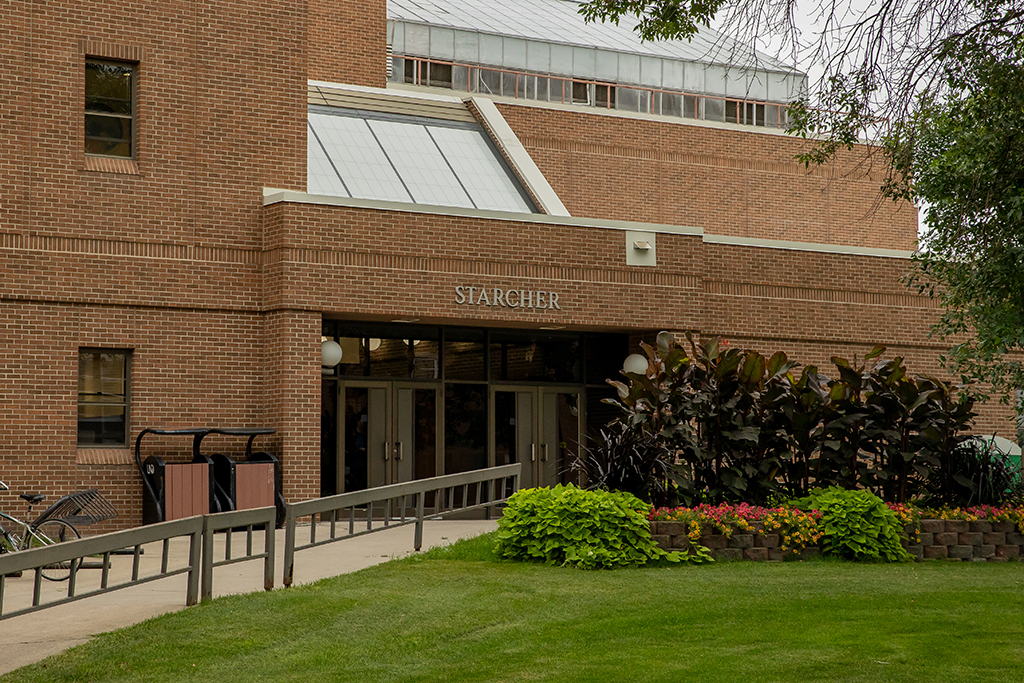
Starcher Hall
Over the summer, the Hyslop at Memorial Village complex on the former site of Memorial Stadium opened for UND Athletics. The lower floors of what is otherwise a private housing development now are home to UND’s coaches, administrators and academic services for UND’s student-athletes.
More details on these new digs will come in a future story focused on Athletics-adjacent projects. But the move has a domino effect on the future of Starcher Hall, the home of UND’s Department of Biology and once-temporary home of UND Athletics offices.
Starcher Hall is located just south of Hyslop Sports Center, in between that building and the railroad tracks. And in the next year, Starcher Hall will become the home of the Department of Theatre Arts.
“We would move today, if we could,” said Emily Cherry Oliver, barely holding back a smile. For the professor and chair of the department, the day of housing Theatre Arts’ programs and activities under one roof can’t come soon enough.
Since the removal of Chandler Hall, the work of the department has required several locations, including Gamble Hall, the Burtness Theatre and the Hyslop Sports Center.
“In Starcher, we will have office facilities, performance classrooms, traditional classrooms, our costume shop and a new lab theater — we’ll be able to say that this is the hub of UND Theatre,” Oliver said. “That has so much value as we’re working with current students and recruiting future students.
“It will be huge for showing others what we do at UND.”
The department will take over the south half of the building, in areas previously occupied by Industrial Technologies and UND Athletics, according to Larson.
The dance studio and new offices are expected to be completed by this year’s winter break, Larson added. The new lab theater — also referred to as a black box theater — will be ready by fall 2025.
Oliver is excited for feature-complete spaces such as the second-floor dance studio. Starcher also will house the department’s costume shop and a design classroom primed for crafting and painting sets and props.
“It’s really the first time our department will have a space with all of the right materials for dance and performance classes,” she said. “It gives us so much flexibility.”
Flexibility in the case of the dance studio means sprung floors, mirrors along the walls and a piano and sound system for developing choreography, as well as a projector for using the space as a classroom when needed. Precautions were taken to make sure activities such as tap-dancing class won’t disturb those underneath the studio, Oliver said.
And by developing a new lab/black box theater space at the back of Starcher Hall, the basement of Burtness Theatre can be used to combine the department’s storage currently found in five buildings on campus: set pieces, props, costumes and other equipment regularly needed across the performing arts.
The term “black box” is used for a simple and flexible space, one readily changed to fit different styles and presentations. Dark walls and intimate seating arrangements are hallmarks of the design, which at UND will become a proving ground and learning space for aspiring actors, dancers and artists.
Oliver and the department refer to it as the lab theater due to its role as the laboratory experience of their classrooms — teaching the ins and outs of putting on a show.
The Burtness Theatre still will play an important role for hosting UND Theatre’s big shows each year, but Oliver hopes the lab theater will become a new star in sharing UND’s talents with the community.
When asked how the coming changes enhance the department, Oliver’s answer was simple: “Facilities matter.”
“They matter to our current students, so those students can eventually go into the world and be prepared to work in this industry on Day One,” she said. “They matter for recruiting students, to be able to show them the dedicated space and ability for them to focus on their craft.
“And we’re going to be connected in Starcher, building that sense of community between faculty and students. We’re an unusual department in how well we get to know our students through teaching and rehearsals. Being located here is huge for the organic, additional learning that takes place in what we do.”
>> QUESTIONS OR COMMENTS about the UND LEADS Strategic Plan? Your thoughts are welcome! Please contact Mike Wozniak, coordinator of Leadership & Programming, and/or Ryan Zerr, associate vice president for Strategy & Implementation, the co-chairs of the UND LEADS Implementation Committee.
You also may offer your thoughts by visiting the UND LEADS Strategic Plan home page and clicking on the “Provide your feedback” link that you’ll find there.
Thank you for your support of the UND LEADS Strategic Plan!