FBI to UND: Be vigilant, as national security concerns are real
North Dakota — including UND — is drawing increased interest from foreign intelligence agencies, FBI special agents say on campus
Where landscapes are concerned, North Dakota has a reputation for being somewhat dull, with its table-flat farmlands and windswept prairies.
But when it comes to national security, the University of North Dakota seems to be a source of real excitement. In fact, it’s drawing keen interest from around the world — including from potential adversaries of the United States.
“We have seen an increase in foreign interest to the Dakotas specifically, because they don’t think anyone’s looking here,” an FBI special agent said to campus leaders campus on Aug. 4.
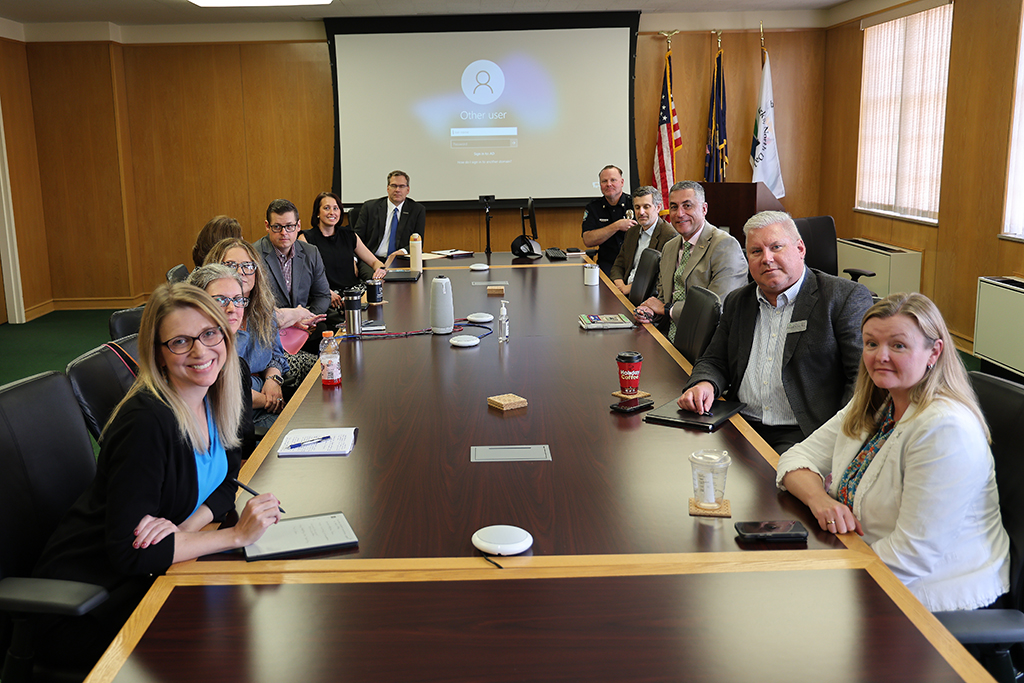
That was part of the message given to UND senior administrators, deans and faculty members by that agent and another from the FBI’s Minneapolis field office. The special agents visited UND to speak about trends they’re noticing when it comes to national security issues at academic institutions, and to offer their support, should it be required.
Note: The agents asked UND Today to neither photograph them nor identify them by name, due to the nature of their work. UND Today is complying with that request, and the agents will simply be identified “an agent” or “one of the agents” in this article.
Over the course of the day, the agents met with different groups across campus. Together with UND representatives, they discussed the importance of awareness and developing potential training programs to prevent threats to universities and their students. They also discussed the vulnerabilities academic researchers and international students may face in a globalized world, and the challenges of protecting intellectual property and research integrity, considering the potential for foreign interference.
Up first on that Wednesday morning, the special agents met with a group of UND leaders including Mark Askelson, associate director of National Security, and Ryan Adams, associate dean of National Security, The leaders talked about UND’s National Security Initiative, which is generating opportunities for research and education in areas such as autonomy and space.
The UND administrators noted the level of care they employ to protect sensitive information and technology, such as shielding the sensor nodes of certain drones when on display. It’s important, they said, to avoid even the perception of poor security, given the relationships UND enjoys with such companies as Northrop Grumman and General Atomics. Not acting in a secure manner would hinder collaboration with those businesses.
The discussion resonated well with the agents.
“It sounds like you are super on top of what is going on up here,” one agent said.
National Security realities and responsibilities
And it turns out there is a lot going on “up here,” in a location few might imagine being of interest to a foreign intelligence agency.
The UND researchers spoke about satellite research and design efforts, in which UND is sharing its expertise with the Space Development Agency. Some of that work, as well as other research being conducted for agencies such as the U.S. Department of Defense, may be approaching the level where it must be classified. Askelson and Adams told the agents that they regularly work with Controlled Unclassified Information (CUI), which requires special handling.
Adams mentioned that UND, with the state’s assistance, is pursuing the construction of a Sensitive Compartmented Information Facility, known as a SCIF. This is a secure facility within a building where work can be undertaken on sensitive or even classified programs.
The facility is a necessary condition for doing the kind of research that is crucial for the University’s National Security Initiative.
As for building the SCIF, an agent said, “I do think it is the right move for where you guys are, in terms of research.”
And research, generally, is meant to be shared. That’s part of the purpose of academia: to share ideas so they can evolve.
But faculty members should be careful with sensitive research, an agent said, especially when they travel for conferences.
Even in a friendly nation, researchers should pay attention to the people they interact with. For example, people interested in securing sensitive information can compare lists of scholars attending a conference to public information about those scholars. Then they might “accidentally” bump into an attendee, offering an excuse to ask the scholar out for a drink, where the parties might chat about their “interesting work.”
When traveling, scholars also should consider taking with them a bare-bones laptop so their research can’t be accessed if it is stolen or lost. This is what the FBI recommends to universities and private industry members when they travel, the agents said. Askelson said he is considering implementing this idea for UND’s Research Institute for Autonomous Systems.
Yet another area where a scholar can be exploited is through contracting with an entity to write a white paper on the scholar’s own research. This may be a perfectly harmless activity, but it also could involve something more, the agents suggested. The pressure to provide more information could step up, and so could the money being offered.
“Then you get paid more and more and more, and you’re maybe a little more lenient with the stuff you’re providing,” an agent said. “It’s a slippery slope, where people don’t realize it’s happening to them.”
Threats to international students
International students may also face threats – from their own government. This is a phenomenon called transnational repression, wherein a student may be coerced into returning home, where the student might face sanctions for their behavior in the U.S. This is made all the easier when the student has family who can be threatened in their home country .
A similar situation happened in 2019, when a University of Minnesota student tweeted something unfavorable about Chinese President Xi Jinping. After returning home for a break, the student was incarcerated for six months — and that sentence was extended to 18 months, once the coronavirus pandemic broke out.
Ultimately, the student was released and returned to the U of M to complete their studies – but they suffered extreme trauma from their incarceration.
International students in this situation might hesitate to contact the FBI for assistance, the agents said. But they might turn to a trusted professor or advisor, who could reach out on their behalf.
The FBI, one agent said, takes this kind of situation very seriously, and may be able to offer services to students in this situation.
“It’s something I personally care very much about, trying to work with our victim’s services to be able to provide mental health and counseling services for these victims of transnational repression,” the agent said.
After touring the National Security Corridor in Harrington Hall, the agents repeated the discussion session with a different group of deans and faculty members in Twamley Hall. The agents let the group know that professors should reach out to them or to the University Police, who then could contact the FBI, should they feel they are being approached by a group or person seeking sensitive information.
The message is important: “We’re trying to prevent foreign entities from exploiting our intellectual property, our research, the things that make the U.S. so much stronger in so many areas than our formal adversaries,” an agent said.