UND launches Gero-STARR to tackle rural nursing shortage, improve older adult care
Editor’s note: In the UND LEADS Strategic Plan, the Service core value calls on the University to “cultivate North Dakota partnerships that highlight our national and global leadership in areas such as Rural Health, Autonomous Systems, Energy and Environment, Space Studies and National Security.” The story below, which UND Today originally published on Feb. 5, highlights an innovative UND partnership that’s aimed at a problem which afflicts rural health care facilities nationwide: the shortage of nurses, especially those nurses who are skilled in caring for older adults.
####
The University of North Dakota’s College of Nursing & Professional Disciplines has launched Gero-STARR, a federally funded program designed to expand North Dakota’s nursing workforce and improve care for older adults across the state’s rural communities.
Funded through a $3.6 million grant from the Health Resources and Services Administration (HRSA), Gero-STARR — Specialized Training to Advance Recruitment and Retention of Nurses in Acute and Long-term Care — addresses a need in rural North Dakota: recruiting future nurses from North Dakota who commit to practice in hospitals or long-term care facilities in North Dakota, where older adults make up the majority of patients and residents.
The program pairs specialized Age-Friendly Care training with scholarships, monthly stipends, mentorship and hands-on clinical experience — all with the goal of strengthening the rural nursing workforce and improving care for older adults across North Dakota.
Recruiting rural nurses to strengthen rural health care
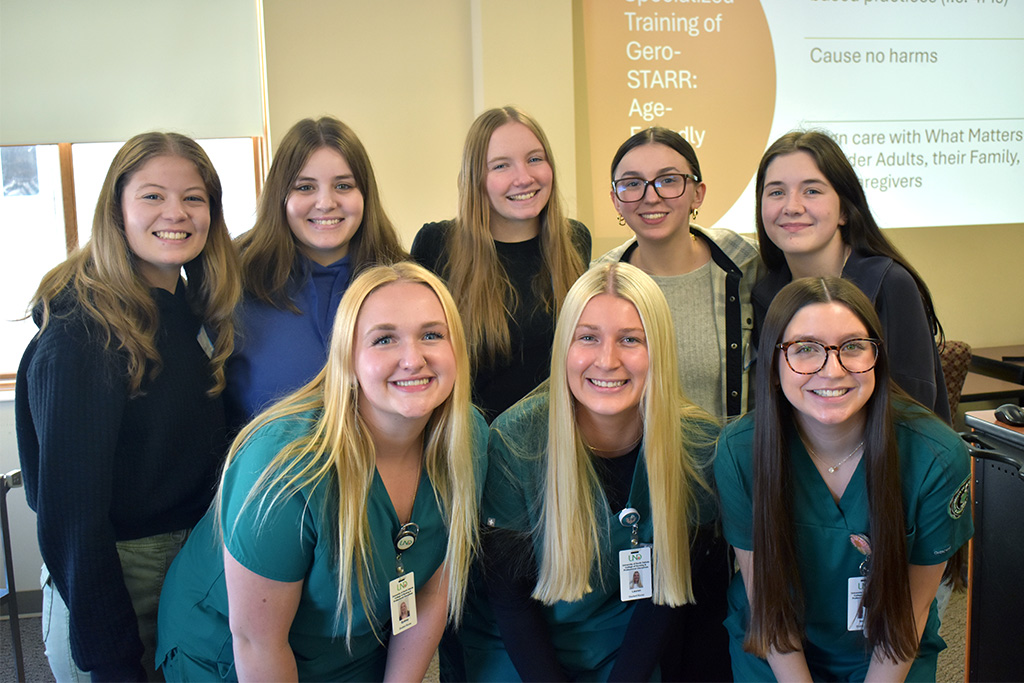
The program’s inaugural cohort includes eight nursing students, all with roots in rural North Dakota. Each Gero-STARR student signs an agreement indicating they intend to work in North Dakota in acute care or long-term care for at least one year after graduation, helping ensure the program’s impact reaches communities across the state.
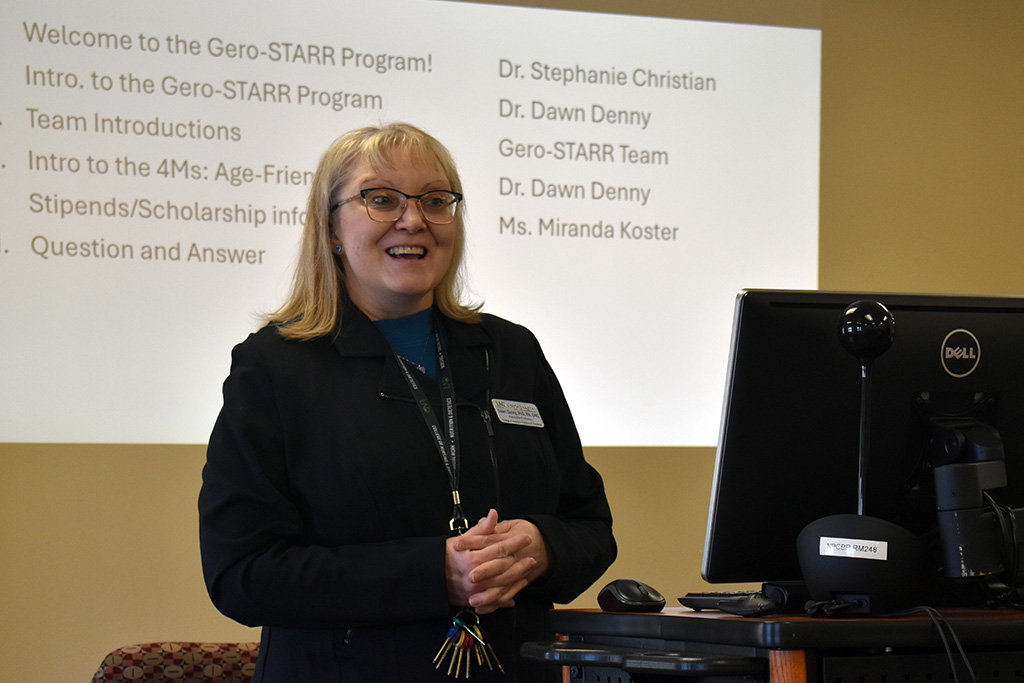
“The overarching goal is to keep newly graduated nurses, who are from North Dakota’s rural communities in our state,” said Dawn Denny, associate professor of nursing and principal investigator for the Gero-STARR grant.
Gero-STARR’s focus on older adults feels especially relevant in rural North Dakota, where aging populations are significant and access to care can be limited.
“I don’t really feel like it’s talked about enough,” said Isabella Saykally, who graduated high school in Bottineau before coming to UND. “I feel like, especially where I live, the elderly population is the majority of the people in my community, and so I feel like it’s important that they’re talked about.”
A new framework for age-friendly care
At the heart of Gero-STARR is the nationally recognized “4M” Age-Friendly Care model — What Matters, Medication, Mentation and Mobility — an evidence-based practice framework that offers a consistent approach to assessment and decision-making while keeping an older adult’s goals and quality of life at the center of each encounter.
“If we can teach nurses to assess all 4Ms at each encounter with an older adult, evidence suggests that health outcomes will improve,” Denny said.
“After 25 years of clinical experience, much of it centered on older adults,” Denny said. “Age-Friendly Care is as much about listening as it is about clinical skill — especially as patients weigh quality of life and the realities of complex care.”
“There comes a point where people just get tired of all the treatment, all the doctor visits, all the specialists,” she said. “They just want it simplified, and they just want to focus on what matters, which may be to see their grandkids and their family.”
Training and supporting the future of ND’s eldercare
Gero-STARR trainees will receive specialized education through a combination of classroom learning, simulation training and clinical experiences with UND’s health care partners.
The program includes monthly training sessions and a two-week intensive training course scheduled for May 18–June 1. The process culminates in an Age-Friendly Care credential.
Students will practice applying the 4M framework in simulation, then bring it into real-world settings with guidance from clinical preceptors and a UND clinical instructor — support that’s designed to make the experience both structured and confidence-building.
Gero-STARR provides significant financial assistance for participating nursing students. Students receive a $1,200 monthly stipend for 12 months and a one-time scholarship of up to $10,000.
“It’s huge,” Saykally said. “The living stipend is very monumental for me. I feel like it takes a weight off my shoulders, and I can focus on studying.”
More than money
Beyond scholarships and training, Gero-STARR is designed to foster connection between students and the program’s mentors and staff. One key piece is a dedicated gathering and study space for Gero-STARR trainees, complete with a microwave, refrigerator and coffee maker.
The space also supports the mentorship model built into Gero-STARR. Mentors and advisers will help students with balancing the realities of academics and student life.
“I want our students to feel like they belong, that they’re welcome, and that it’s a place where you can come get help, resources, professional advice and have support,” Denny said.
And ultimately, Denny said, the program is designed to prepare and support future nurses who will provide care that keeps the needs of older adults in mind while building a more sustainable healthcare workforce for rural North Dakota.
“We want our students to think about what matters to their patients so that, in every encounter, they’re addressing what matters most to the older adult,” she said.
####
>> Questions or comments about the UND LEADS Strategic Plan? Your thoughts are welcome! Please contact Ryan Zerr, associate vice president for Strategy & Implementation, or Anna Marie Kinney, coordinator of the University Writing Program, the co-chairs of the UND LEADS Implementation Committee. You also may offer your thoughts by visiting the UND LEADS Strategic Plan home page and clicking on the “Provide your feedback” link.
Thank you for your support of the UND LEADS Strategic Plan!