In Service, through providing free radon detector kits
Project combines public health communication, service to state by making it easy for residents to test homes
To see UND’s commitment to Service in writing, visit the web page devoted to the UND LEADS Strategic Plan. That’s where you’ll find this listing among the University’s strategic priorities:
“Address the health, educational, safety, cultural, economic, and workforce needs of our community, state and region via research and educational collaborations.”
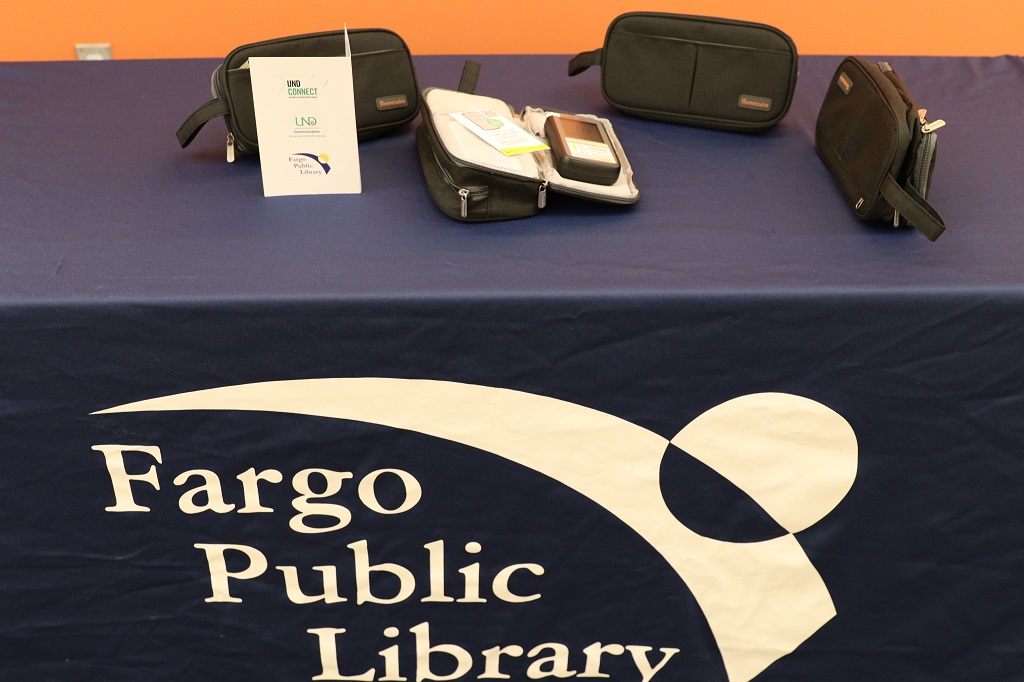
And to see that commitment to Service in action, visit the Fargo Public Library. That’s where, since August, library patrons have been able to check out free radon detector kits that have been made available through a partnership with UND.
The idea is to make it easy for residents to identify and mitigate a very real risk: the risk of exposure to radon gas in their homes, said Soojung Kim, associate professor and chair of the Department of Communication at UND.
Radon is a colorless, odorless gas produced from such radioactive elements as uranium and thorium, present in rocks and soil. When the gas seeps into homes and offices, it becomes an important cause of lung cancer — in fact, the leading cause among people who have never smoked, and the country’s second leading cause of lung cancer overall, the American Lung Association reports.
And because North Dakota has high levels of uranium in its soil, the state “has the highest indoor levels of radon in the United States,” Kim told The Forum newspaper in Fargo.
As a result, she continued, “this partnership is to support the Fargo Public Library to make those radon test kits available, so that the community members in the greater Fargo area can check them out and then test their houses for radon levels.”
Grateful for the opportunity
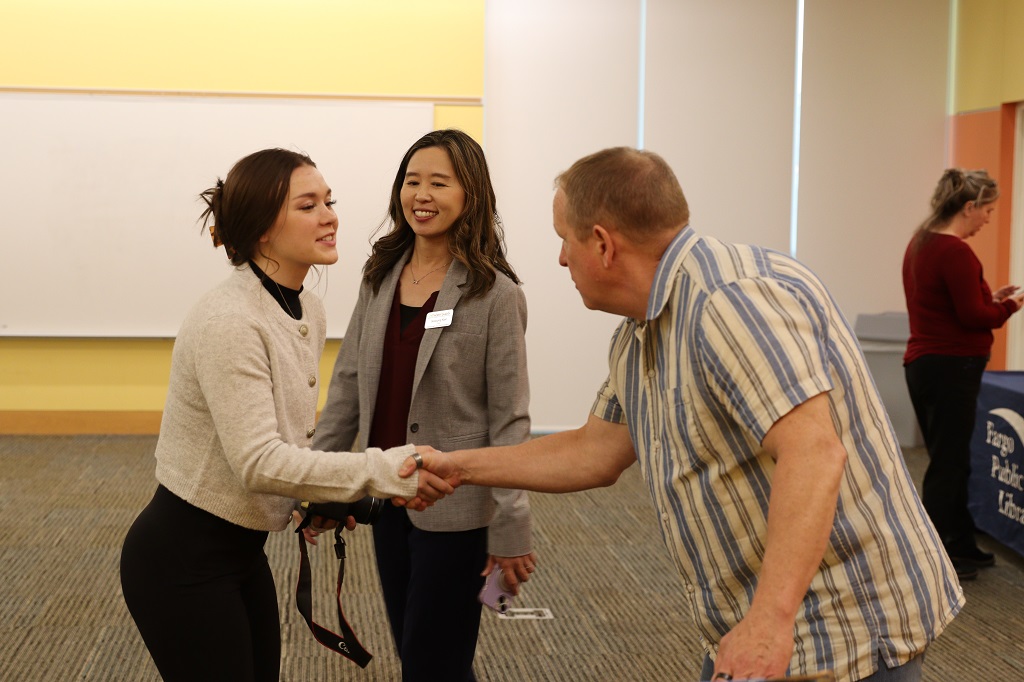
Tim Dirks, director of the Fargo Public Library, said he was thrilled to be offering the new service.
“Anything that can enhance community health and safety is tremendous, and to be chosen by the University of North Dakota for this opportunity — we’re very grateful in that regard,” Dirks said to Lauren Huso, a Communication major at UND and undergraduate research assistant to Kim.
“Hopefully, folks will take advantage of it and make sure that their homes are safe for themselves and their families,” Dirks continued. “And again, we’re excited to have this opportunity to provide the test kits to the community, thanks to the University of North Dakota.”
At the library, a total of 30 radon test kits now are being made available through the partnership. The Grand Forks Public Library earlier was equipped with its own radon test kits, thanks to a similar partnership with UND that went into effect last year.
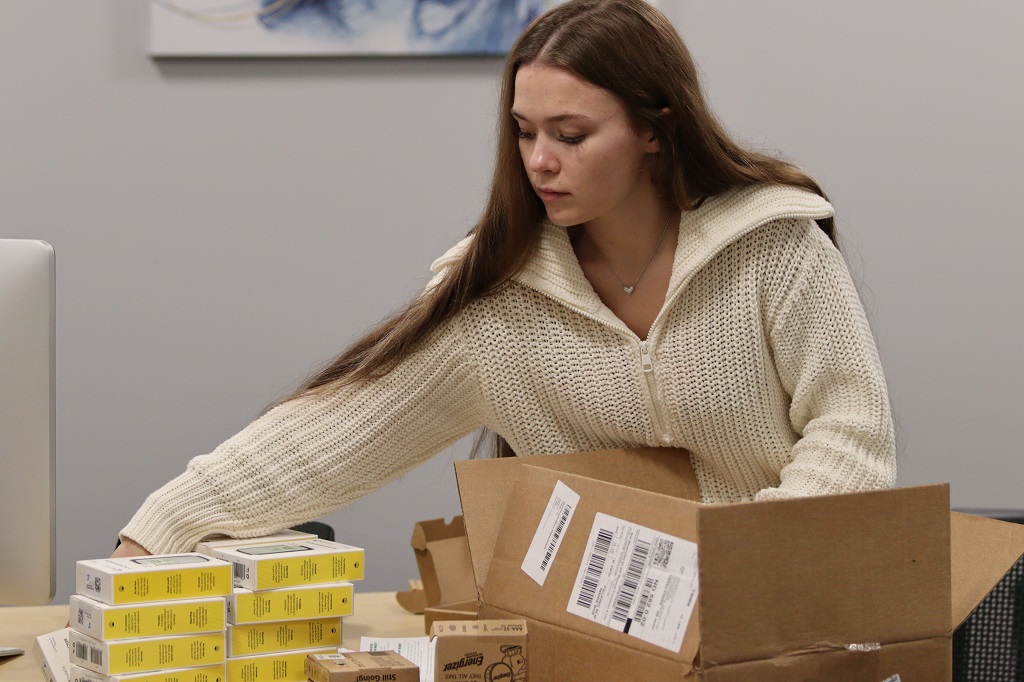
And unlike one-time-use radon detectors that need to be sent to a diagnostic center, the Fargo and Grand Forks libraries’ detectors not only are re-usable, but also can inform residents about radon levels in real time because the kits don’t have to be analyzed by a lab.

Effective public health communication
Kim’s research in communication focuses on increasing the awareness of public health issues and changing health behaviors via effective media strategies. As part of that work, Kim found that merely offering radon test kits for free wasn’t enough, if the kits still had to be analyzed in a lab for the resident to get results, UND Today reported in 2023.
After that finding, Kim and Gary Schwartz, chair of the Department of Population Heath in UND’s School of Medicine & Health Sciences, pursued the current plan, in which UND buys battery-powered, digital radon detectors and makes them available through public libraries.
The project is among those being funded by the UND CONNECT program. Earlier this year, UND CONNECT selected nine faculty-led projects — each of them aimed at making life better for North Dakotans — for up to $5,000 per project in funding from the University, UND Today reported.
Kim’s plan to expand Grand Forks Public Library’s digital radon detector lending program to the Fargo library and, in the process, provide her students with an experiential learning opportunity was accepted as one of the inaugural UND CONNECT programs.
“Radon is not just a cause of cancer,” Kim said to UND President Andy Armacost, when Armacost interviewed her as part of his State of the University Address on Aug. 22.
“It’s also a health disparity because of the costs involved with the radon detectors. With the previous grant support, our team was able to purchase 40 digital radon detectors, and we made them available through the Grand Forks Public Library.
“My UND CONNECT project is to implement the same lending-library program in the Fargo Public Library. And by doing that, we are removing a financial barrier to many families in North Dakota,” ultimately with the goal of helping to protect them from lung cancer, Kim continued.
‘I believe leaders serve’
Moreover, UND students who take part in this work get hands-on experience that supplements their classroom learning, she said. “And in this way, our students are involved in this public-health intervention project from beginning to end.”
At UND, doing good work for the benefit of the state is a charge that’s taken very seriously, Kim said in the interview.
“I believe leaders serve,” she said. “And my colleagues and I have a privilege of serving our local communities, tribal nations and the state of North Dakota by the skill sets that we have and the educations that we’ve been fortunate enough to receive.”