UND’s newest citizens
Among the reasons that drew UND faculty members to become U.S. citizens: The chance to watch their children play
Editor’s note: At 10 a.m. on Sept. 17, Constitution Day, UND will be honored to host a Naturalization Ceremony in the Henry Ballroom of the Memorial Union. All are welcome to attend.
And in celebration of this event, UND Today presents the story below, which tells how three faculty members at the University recently took part in such a life-changing ceremony of their own.
* * *
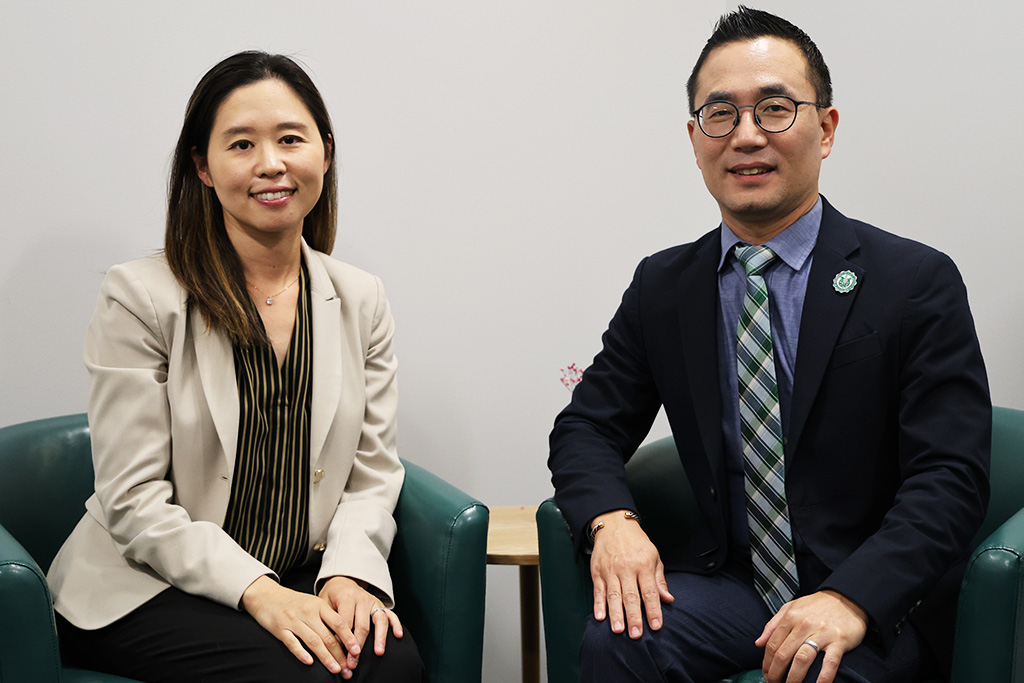
Joonghwa Lee and Soojung Kim didn’t initially plan to become U.S. citizens when they each moved to America from South Korea nearly two decades ago.
But their plans changed when they met, got married and then settled in as scholars at the University of North Dakota.
Lee and Kim, both associate professors in the Department of Communication, with Kim also serving as department chair and graduate program director, moved from their hometowns of Busan and Seoul to the U.S. to continue their university educations as young adults. Later, they crossed paths while both were rooted in academia in different states.
“When we met, I was in grad school at the University of Minnesota, and he was a faculty member at a university in Tennessee,” Kim recalled. “We were doing long distance for a few years, but then I got a job at UND right after I finished my Ph.D., and he was also offered a position. It worked out really well for us.”
Initially, the couple had planned to return to Korea to pursue their careers. However, as Kim explained, “Being a faculty member in Korea as a mother of young children comes with multilayered challenges unique to Korea, and we valued both of our careers. We decided to build our careers together and make this community our new home.”
This was a turning point for the couple, who have been at UND since 2015. Years later, they would begin the process for gaining U.S. citizenship, culminating in a naturalization ceremony two months ago that cemented their status as Americans.
The path to citizenship
Although the path to U.S. citizenship can be challenging for many immigrants, Kim described the process for herself and Lee as relatively straightforward. Requirements for green card holders include living in the U.S. for at least five continuous years and showing the ability to read and write in English.
The more challenging aspects of the process include an interview and a 10-question citizenship test, which can be daunting for many. Each prospective citizen is asked 10 questions, randomly selected from a pool of 100. That means passing it requires a holistic knowledge of American history.
Lee admitted that he was a bit nervous about the test. Not knowing which questions would appear on it, he spent many hours studying various sources, including YouTube videos, to prepare.
“I learned some American history when I was in Korea, but when I moved here, I was focused on getting my master’s degree and Ph.D. I didn’t have much time to learn more American history,” he said. “Some of the questions on the test are difficult. I showed the questions to my American friends and students, and even they had trouble answering some of them.”
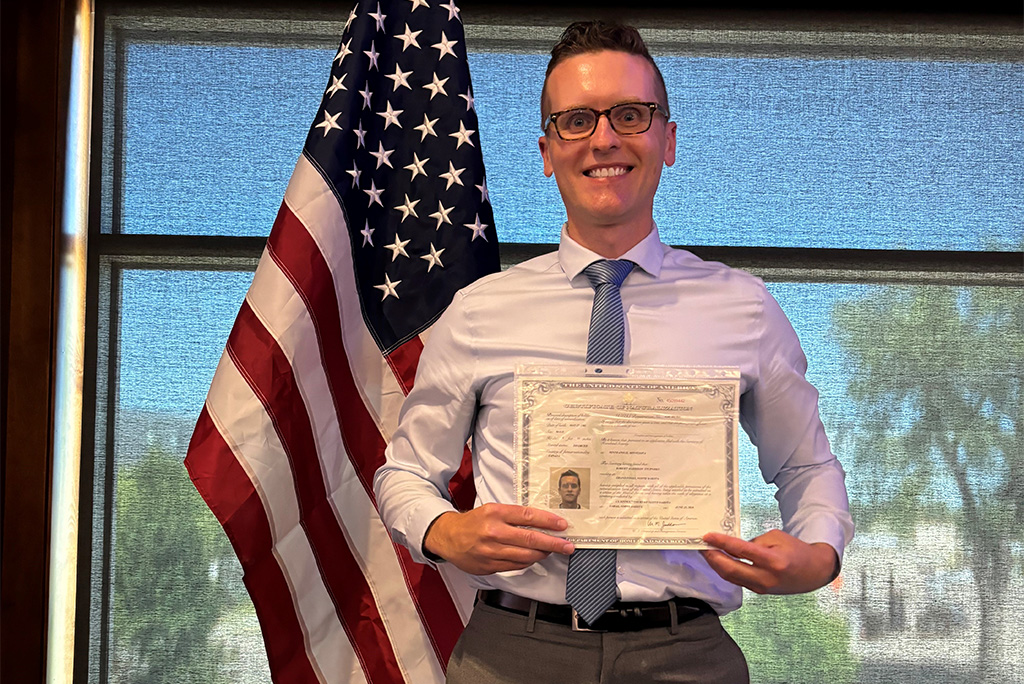
After passing the test, Lee and Kim had to take one final step: taking the oath of citizenship. They attended the naturalization ceremony on June 25 in Fargo, where more than 40 new Americans from 22 countries were present.
At the ceremony, they were surprised to see a familiar face: Rob Stupnisky, associate dean for Research and Faculty Development for the College of Education & Human Development. Originally from Morris, Man., Stupnisky has lived in North Dakota since starting his job at UND 14 years ago.
“The ceremony was fantastic,” Stupnisky recalled. “It was an official court proceeding, but there were also some inspiring speeches about the importance of becoming an American and the responsibility that comes with it. The room was full of people from all these different countries, and it felt really inspiring to be a part of that group.”
A new chapter for new Americans
Stupnisky long had planned to become a U.S. citizen when the time was right, recalling the strong connection he felt to many parts of American life. As Morris is located close to the border, he remembers taking trips to the U.S. throughout his life, which left a lasting impression on him.
Still, like Lee and Kim, he did not initially plan to become an American citizen until he arrived at the University.
“I think, for me, the biggest factor in my decision was that I really like being in Grand Forks, and I love working at UND,” he said. “I want to stay here and I thought, ‘Why wouldn’t I?’ ”
Stupnisky said that for him, becoming a U.S. citizen hasn’t been the sweeping change one might expect. Instead, he views the milestone as an expansion of his identity rather than a complete transformation.
“I’m definitely still proud of my heritage and proud to be a Canadian,” said Stupnisky. “I do feel proud to be an American now, too, because of the opportunities that living here and working at UND have brought for me and my family.”
There are other important perks, he added, with one of the biggest being that he now can participate in elections.
“Basically, the only thing I couldn’t do living here on a green card was vote,” he said. “But voting is such an important part of the American culture, so I look forward to having the opportunity to participate.”
Kim shared this excitement and said that for many noncitizens, the inability to fully participate in political and civic life brings about a level of detachment from their communities. Even obligations that many Americans see as burdens — think of jury duty — excite Kim, as she embraces the responsibilities that come with her status as a newly minted American citizen.
“There is a sense of belonging that comes with being able to participate in political and civic duties,” Kim said. “There are also more immediate benefits, such as receiving a Social Security number. But what we’re really looking forward to is being able to fully participate in our communities.”
Bittersweet decision nevertheless brings hope
For Lee and Kim, the decision to become U.S. citizens came with some personal sacrifice. Due to the Korean Armistice Agreement signed in 1953, South Koreans older than 20 cannot hold dual citizenship. This meant that Lee and Kim had to give up their Korean citizenship to become U.S. citizens.
“It was difficult to give up our Korean citizenship,” Kim said. “Giving up our national identity was much more than just getting a new passport for us. It doesn’t change who we are, but it was a symbolic decision that wasn’t easy to make.”
Lee, who had completed 22 months of compulsory military service in Korea at age 22, initially felt conflicted about relinquishing his Korean citizenship. He said that both he and his mother struggled with the idea of him no longer being a citizen of South Korea.
“It was pretty emotional,” Lee said. “When we made the decision, I called my mom, and she cried. She felt like there would be a disconnect, like I would be leaving behind my Korean identity.”
Still, Lee and Kim both maintain a solid connection to South Korea. In 2019, they took a group of students to visit Seoul and Busan, Kim and Lee’s respective home cities. Seeing the country through their students’ eyes revitalized their appreciation for their former home. Reflecting on this experience, Lee said he believes new Americans can use their identities to strengthen their communities.
“I think it’s important for people in situations like ours to remember that gaining citizenship doesn’t erase your original identity,” Lee said. “When you become a U.S. citizen, you can bring your background and culture to contribute to and inspire your community.”
Ultimately, Lee’s mother understood that the decision was about more than just their careers. Lee and Kim were considering the future they were building for their two children.
Notably, Kim said that the experiences of school-aged children in America are very different from those in Korea, where a competitive job market and a tiered university system put immense pressure on students from an early age.
“Even first-graders in Korea have to start being tutored and studying late into the night. And, from then until high school, the only goal is to get into one of the top three universities,” Kim explained. “Playing isn’t valued, and being a child isn’t really allowed. That was another major reason we stayed here — so our children could experience childhood.”
Lee agreed, adding that one of his favorite things is watching his children play, unfettered and free. Through his children’s eyes, Lee says he has found a new perspective on what makes America so special.
“If I were reborn, I would want to be an American child,” Lee said with a smile. “Without pressure, without demands — just spending time with friends and family. It’s something we never had the chance to do, but I’m happy to watch my children enjoy it.”