Dance + fun + preschoolers = UND research
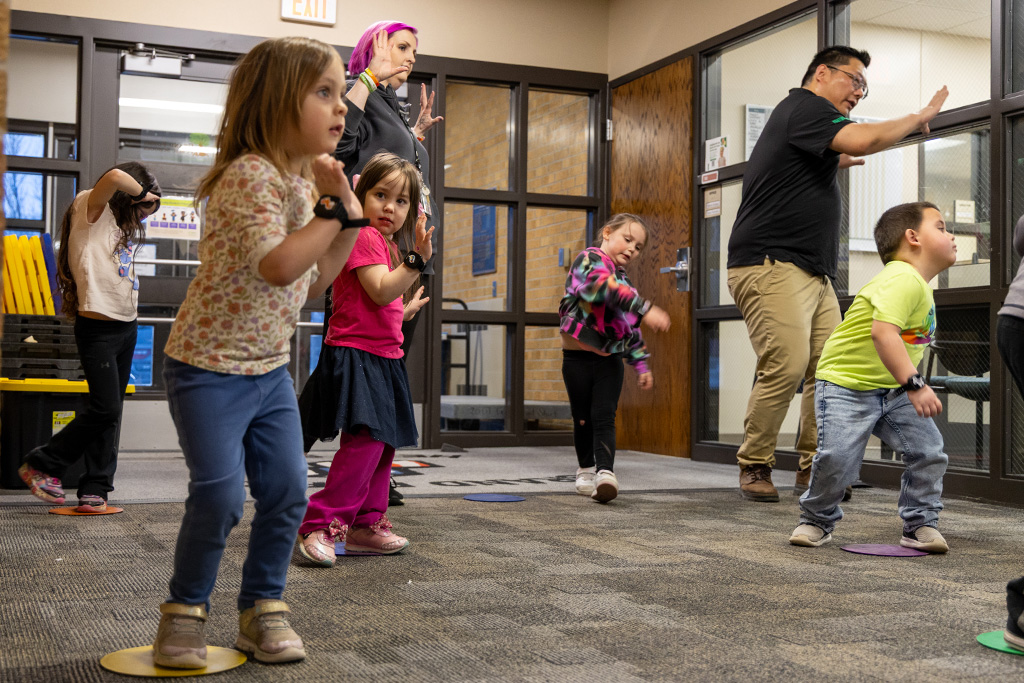
And with a “Five, six, seven, eight,” the kids are dancing — clapping, jumping and turning as they move through light choreography with their instructor.
The routine isn’t just about learning steps, though. It’s part of “Joyful Dance,” a preschool dance project from the College of Education & Human Development that brings together kinesiology and public health faculty, graduate students and community partners to help young children build lifelong habits around movement, health and play.
Led by Harry Liu, assistant professor of kinesiology, and Tanis Walch, professor of public health, the program places UND faculty and students inside early childhood classrooms at the University Children’s Learning Center and Grand Forks Head Start.
Over eight weeks, children take part in structured dance and movement sessions while faculty and graduate students behind the scenes track changes in physical activity, motor development and social-emotional growth.
Joyful Dance as community partnership
Early on a Monday morning, graduate student Wanting He leads a group of children through a series of games and dance moves at Head Start.
Without a large gym space, the children practice right in the entryway — a reminder of why dance was chosen for the program. Unlike organized sports, it requires little equipment and can happen almost anywhere, making it accessible both in the classroom and at home.
Participation varies by age and comfort level, but movement remains the common thread.
“You’ll see a little bit of everything out there,” said Tracey Johnson, director of Head Start. “Some are jumping with joy, and some are a little more shy. That’s OK — they’re all getting in there and moving.”
At Head Start, Joyful Dance is part of a broader network of University partnerships connecting UND students and faculty with the community.
“We really enjoy our collaboration with UND,” she said. “We feel very fortunate to be part of a university city that gives us access to those opportunities for kids.”
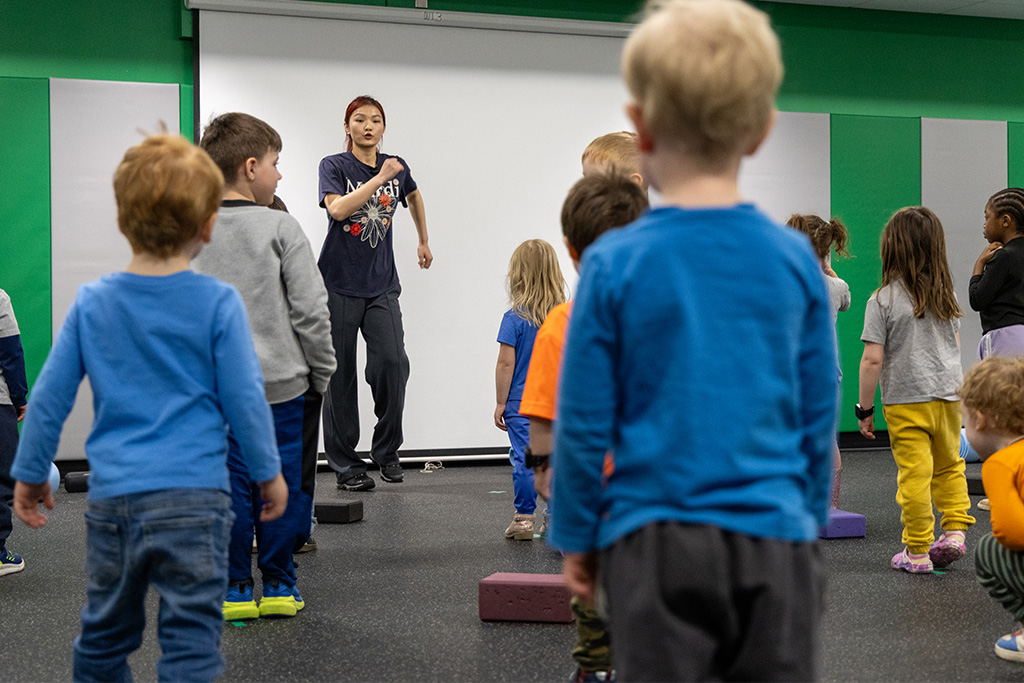
Just across the street, the same approach continues at the University Children’s Learning Center, where graduate student Mai Wei leads another group through the program in a shared kinesiology space.
At both locations, Joyful Dance introduces more structured physical activity for children ages 3 to 5, while maintaining an emphasis on fun and engagement.
Through repetition and choreography, children at both sites are building foundational skills that support long-term physical development.
“They’re learning so many different skills — balancing, left and right, shapes, color, counting,” said Amy Peterschick, a teacher at UCLC. “Our students really like it.”
The response has been overwhelmingly positive, with teachers noting both enthusiasm and growing confidence among students.
Movement as early intervention
While the program looks playful on the surface, it’s rooted in a deeper public health concern: declining physical activity for preschoolers.
“These are some of their most active years of life,” Liu said. “As they get older, physical activity decreases dramatically.”
To better understand that trend, the Joyful Dance team collects data throughout the program. Children wear research-grade activity monitors on their wrists that track movement in multiple directions — tracking levels of light, moderate and vigorous activity — before, during and after the program.
Alongside those measurements, researchers assess motor skills — such as running, jumping, throwing and balance — as well as cognitive and social-emotional development.
Researchers also use interactive, iPad-based questionnaires to measure changes in children’s social-emotional development over time.
“We measure physical activity, but also social-emotional learning and motor development,” Liu said. “If you cannot do very well in your locomotor skills early, it becomes harder later to participate in more complex activities.”
Walch said the activities are carefully designed, even if they feel like play.
“It’s really good to focus on some of those gross motor movements, but also to make it fun — they don’t realize they’re working certain body movements,” she said. “It’s like a game.”
The research also highlights disparities tied to access and environment. By teaching dance at two locations with different economic populations, they can have a better understanding of how to tackle the challenges the disparities present.
“In lower socioeconomic communities, there are fewer opportunities,” Walch added. “They may not have safe places to play or the resources to support movement. So, programs like this meet kids where they are.”
Making movement the norm
For Walch, the long-term goal goes beyond a single program.
“Physical activity should be the norm,” she said. “It shouldn’t be unusual to see people moving. What’s unusual now is how much time we spend sitting.”
That shift is already visible in early childhood habits. Pre-program surveys revealed many children spending hours each day on screens.
Joyful Dance offers an alternative that encourages children to engage with movement in a way that is accessible, social and fun.
“If they enjoy it, they’ll ask for it,” Walch said. “They’ll say, ‘Mom, come dance.’ And that’s how change starts: not just in the classroom, but at home.”
Carrying that rhythm forward
The program will conclude with a showcase performance, where children demonstrate what they’ve learned for families — extending the impact beyond the classroom.
“We want to facilitate that they can continue at home,” Liu said. “They can find space and dance together. It’s that simple.”
And Liu and Walch agreed that bringing it to children in the Grand Forks area is a win-win, both for the University and the community.
“I think it’s important to translate our knowledge to the community,” Liu said. “Schools don’t always have the time or resources to do this. So our job is to connect and support.”