Brad Hawk celebrates resilience, progress in Indigenous communities
Executive director of the North Dakota Indian Affairs Commission shares updates on Indigenous communities for Indigenous Peoples’ Day

Editor’s note: In the UND LEADS Strategic Plan, the Equity core vale calls on UND to “promote diverse perspectives and inclusive worldviews by offering … opportunities to understand diverse populations and meet their changing needs.”
With that objective in mind, this story calls attention to the appearance of Brad Hawk, executive director of the North Dakota Indian Affairs Commission, on campus as part of Indigenous Peoples Day.
* * *
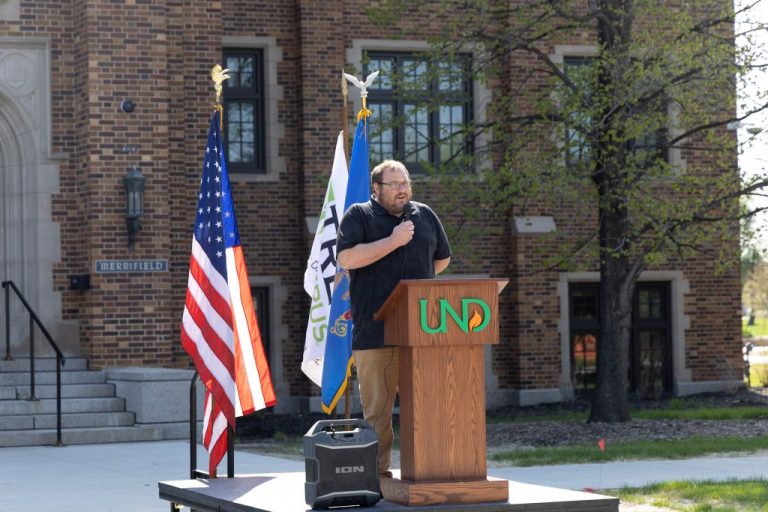
On Indigenous Peoples Day, UND welcomed Brad Hawk, executive director of the North Dakota Indian Affairs Commission, who delivered a address on the history, resilience and future of Native American communities in North Dakota. Hawk, a member of the Crow Creek Sioux Tribe in South Dakota, has been working to strengthen state-tribal relations since his appointment by Gov. Doug Burgum in January.
Hawk began by giving a brief history of historical injustices faced by Native communities, including cultural suppression through Native American boarding schools and the impacts of the Burke Act of 1906. The Burke Act required Native individuals to pass a “competency” assessment to gain land ownership and citizenship rights
“These are some of the things that really impacted tribal nations and our Indigenous people,” Hawk said. “Disease, land loss and all of these things had a great impact on Indigenous people.”
But, Hawk sees in tribal communities a strength which has led to their continued ability to retain the integrity of their culture and traditions.
“Resilience is the word that comes to mind,” Hawk emphasized. “Our Native nations have overcome significant loss and adversity. Celebrating our culture and traditions, we see them returning stronger than ever today.”
Hawk stressed that, despite these challenges, Indigenous communities in the Dakotas are reclaiming languages and traditions through programs at tribal colleges. To Hawk, this is a sign of forward momentum to reclaim their history.
“The part that I want to emphasize is the resilience of our Native nations to overcome a lot of this, to continue celebrating our culture and traditions,” he said. “It’s beautiful to see it and to see that it’s coming back even stronger today.”
Hawk’s background also includes an emphasis on health care administration, serving as associate vice president of community wellness in his time at United Tribes Technical College. Accordingly, Hawk’s speech included a focus on health care programs across the state that specifically address Native communities.
Citing UND’s INMED (Indians Into Medicine) and RAIN (Recruitment and Retention of American Indians into Nursing) programs, as well as North Dakota State University’s American Indian Public Health Program, plus programs at tribal colleges across the state, Hawk said there is a lot of momentum helping to bridge gaps in health care disparities and promote education on traditional medicine.
“We are seeing more work in traditional medicines, where a lot of tribal colleges are doing education on traditional medicines and trying to bring that information back,” he said.
Hawk also spoke about the increasing potential of the Community Health Representative program, where health care workers visit homes in tribal communities for appointments and to promote health education.
“One program that I feel has a lot of potential is the expanding Community Health Representative program,” he said, adding that CHR programs have become a “champion” for health care in Native communities.
Specifically, he noted the success of a pilot program in the Mandan, Hidatsa and Arikara Nation, which has included registered nurses in the CHR system to increase connections between Indigenous communities and health care workers.
Hawk also discussed the efforts the Indian Affairs Commission has made to increase economic diversification and access to locally controlled food resources in tribal communities.
One of the major efforts that Hawk says they are focusing on is cultural tourism which, in addition to supporting local economies in tribal nations, creates pathways for people to experience tribal culture.
“Today, we’re seeing a lot of the impact of charitable gaming industry in North Dakota and how that’s really diminishing the revenues that a lot of our Native casinos have gotten over the years,” he said. “In our office, we’re looking for ways to diversify the economies and that includes tourism. I think there is a lot of opportunity there for people to come to visit and learn about different tribal cultures and traditions.”
Hawk said that food sovereignty is an essential part of the economic development in Indigenous communities, citing examples such as tribal bison and elk herds and the MHA Nation’s greenhouse as ways of helping tribes become more autonomous and increasing access to fresh fruit, vegetables and meat in tribal communities.
“There’s been a big push for food sovereignty and having options for access to healthy foods, so our role has been to come up with ways that our tribes to interact with each other,” Hawk said. “Right now, we’re really looking at the food market festival in Fargo that they have every year. We’ve been talking to them about having an Indigenous food market for the state of North Dakota, but that’ll take some time.”
Hawk highlighted that food sovereignty efforts are just one example of tribal communities working together to build more robust, self-sustaining economies. These collaborations, he said, reflect the larger mission of the Indian Affairs Commission to strengthen the connection between state agencies and Indigenous communities.
“For our agency, we really want to work on having that connection with state and tribal governments. And we really have that connection with a lot of different groups,” Hawk said. “Our tribal nations have come through a lot, but with their resilience they are moving forward. There are a lot of good things happening and we just want to have the opportunity to showcase what they’re doing.”
>> Do you have questions or comments about the UND LEADS Strategic Plan? Your thoughts are welcome. Please contact Mike Wozniak, coordinator of Leadership & Programming, and/or Ryan Zerr, associate vice president for Strategy & Implementation, the co-chairs of the UND LEADS Implementation Committee. You also may offer your thoughts by visiting the UND LEADS Strategic Plan home page and clicking on the “Provide your feedback” link. Thank you for your support of the UND LEADS Strategic Plan!
>> Do you want to read more UND Today stories? Just hit the link or go to our home page to subscribe to our twice-weekly newsletter.