UND CONNECT project brings RedRover Readers to North Dakota
UND Clinical Assistant Professor Chelsea Hughes leads pilot program using animal stories to teach children skills
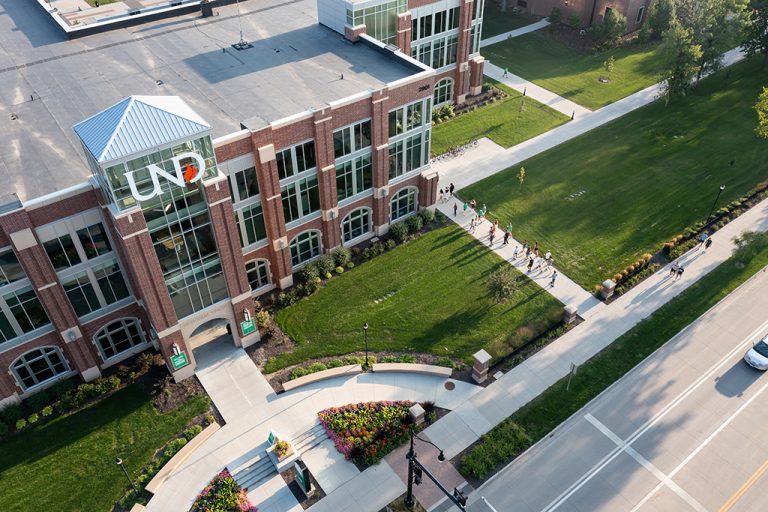
Editor’s note: In the UND LEADS Strategic Plan, the “Affinity” core value includes a call to embrace environments where people “can interact, be valued, and know they belong.” The following story describes a UND CONNECT project that tries to do just that, by giving UND faculty and students the chance to engage in community-based research, development, and outreach — thus strengthening the civic connections between the University and the larger community.
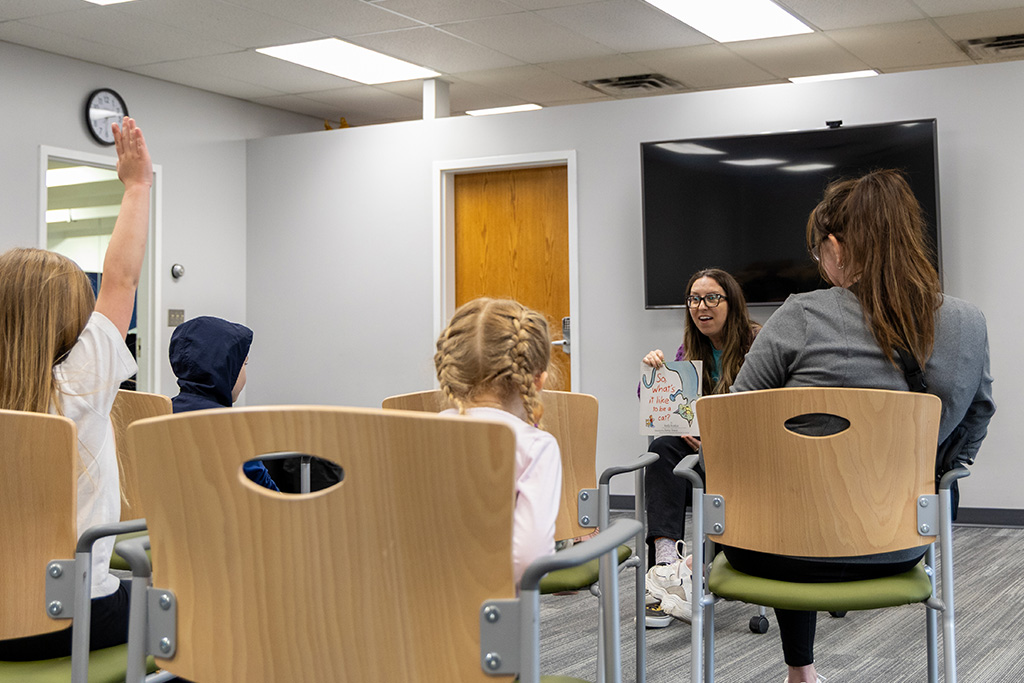
On a rainy Sunday afternoon, Chelsea Hughes held up a picture book to a group of young children seated in a small room on the second floor of the Grand Forks Public Library.
“So, what’s it like to be a cat?” she read aloud to the group. “I’m very glad you asked me that.”
The book she’s reading from, “So, What’s It Like to Be a Cat?,” is a simple story about a boy talking with a cat. But it gives Hughes the opportunity to ask questions that get the children thinking about something they might not normally think about: What might it be like to see the world from a different perspective?
“Why might a boy ask that question of a cat?” Hughes asked after reading a couple of pages.
One child offered a practical answer: “Because he’s not a cat.”
Another guessed that maybe the boy wanted to get to know the cat better.
For Hughes, clinical assistant professor of Social Work at UND, this conversation gets to the heart of RedRover Readers, a national program that uses stories about animals to help children aged 5-11 practice empathy, observation and critical thinking skills.
And through a UND CONNECT grant, Hughes is bringing the program to North Dakota for the first time.
Bringing RedRover Readers north
RedRover Readers is part of RedRover, a non-profit based in Sacramento, Calif. focused on helping people and animals. The Readers program is designed for children ages 5 to 11 and uses selected picture books, guided discussion and activities to support social and emotional learning.
Hughes first volunteered for the program while living in South Texas, where she was involved in animal welfare work. Later, she became a workshop facilitator for RedRover Readers, allowing her to teach others how to lead the program.
“I first started volunteering with them in South Texas,” Hughes said, “I really liked it. Then I thought the UND CONNECT grant was kind of a great opportunity to bring it to North Dakota.”
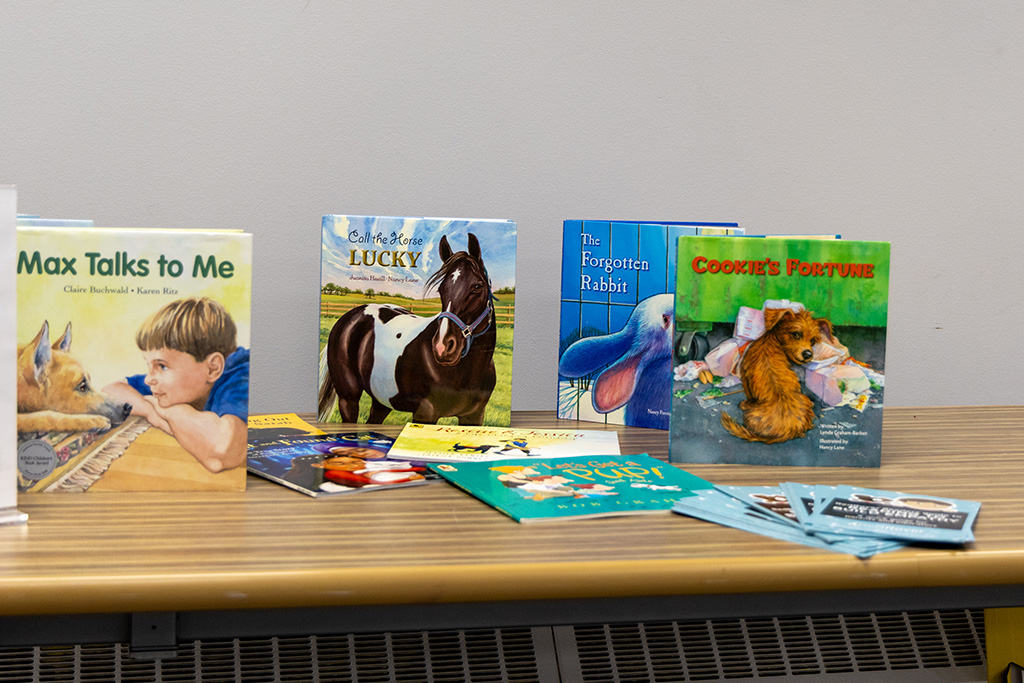
With support from UND CONNECT, Hughes and two student fellows in the social work program piloted Red Rover Readers this spring at the Grand Forks Public Library. Hughes also received a collection of RedRover Readers books, with the grant helping cover shipping costs.
This spring they hosted five readings, with each event focusing on a different theme. Books featuring dogs and rabbits were used to teach children about communication, friendship and responsibility among other skills crucial to early development.
“It’s kind of under the umbrella of humane education or social and emotional learning for children,” Hughes explained. “We use these stories and discussions about animals and people to foster empathy in children.”
Reading with purpose
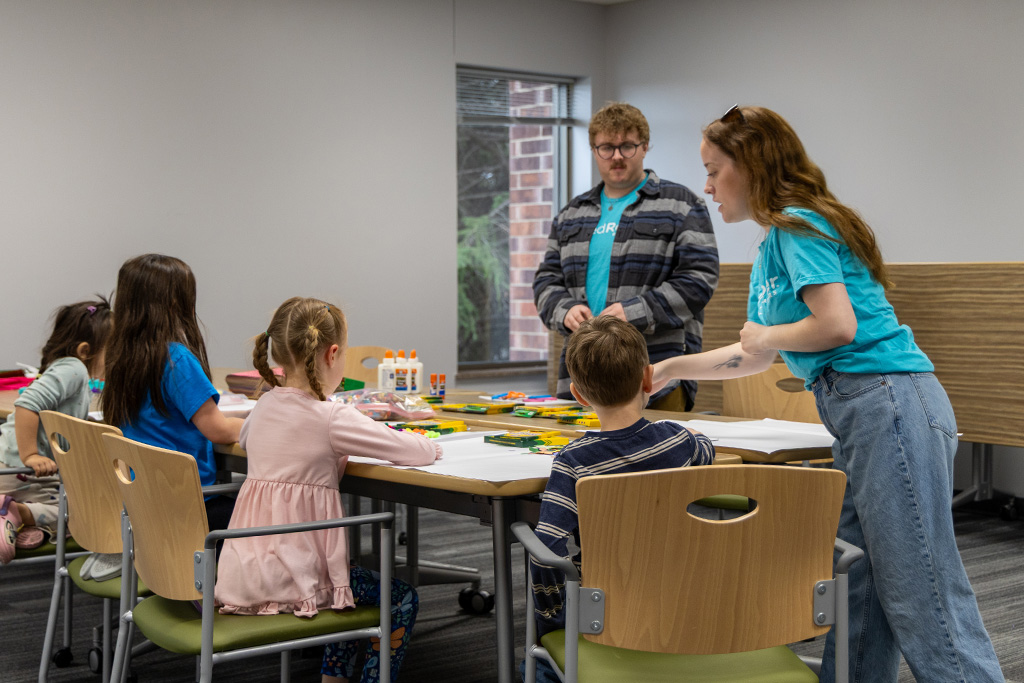
The readings follow a simple structure: a facilitator reads a story, pauses to ask open-ended questions and gives children room to respond in their own words.
“The program in and of itself is really designed to foster perspective-taking in children,” Hughes said. “And we use a discussion framework as we’re reading to give children some authority to respond to questions in a way that makes sense to them.”
In this case, “perspective-taking” is the social skill that allows us to see situations from an alternative point of view.
During the reading, Hughes asked the children to notice what the cat in the story did, how the cat might be feeling and what clues they could find in the illustrations. When the book showed a cat that seemed to want space, Hughes asked what its body language might be saying.
Some of the children knew the answer from experience with their own pets. Cats might hiss. Or they run away and hide. But, sometimes they simply do not want to be petted.
By using cats and other animals to teach children about empathy, Hughes and her students also teach the children attending how they can learn about people and animals by observing their actions and habits.
“In the book, the cat talks,” she told the group. “The cat says how he’s feeling and what he’s doing, but normally we learn about cats by watching them, by observing them.”
A lesson in slowing down
And that practice of slowing down and observing closely is what makes the program valuable, Hughes said — not only for children, but also for the UND students learning to facilitate it.
The UND CONNECT project trained 14 volunteers during the spring semester, most of them UND social work students. Hughes said the four- to five-hour training teaches participants how to use RedRover Readers’ discussion method, including neutral, non-leading questions that allow children to make their own meaning from a story.
Students can use the program at the library, Hughes said, or eventually bring it to other settings such as schools or animal shelters.
Jack Bjerke, one of the student fellows helping with the project, said the pilot has involved a lot of learning in real time.
“It’s been interesting, because I’ve never really done anything like this,” he said as he cut out cat-shaped masks for the after-reading activity. “It’s been a lot of us just kind of figuring stuff out as we go, since it hasn’t been done here yet.”
For students entering fields such as social work, child welfare or health care, Hughes said, the program offers practice in listening, building trust and creating a space where children feel comfortable speaking.
“I think the community-building element and literacy connection are really important pieces for kids,” she said.
More stories ahead
The spring pilot included five readings at the Grand Forks Public Library, with attendance varying from week to week. Each session included a story and related activities. On this Sunday, after learning about cats, children could decorate cat masks or make cats from pipe cleaners.
Hughes said that the pilot program was successful enough that the library is interested in continuing the program in the fall. Now, they have readings planned for September, October and November which means more stories, more opportunities for social work students to help children practice those crucial skills.
****
>> Questions or comments about the UND LEADS Strategic Plan? Your thoughts are welcome! Please contact Ryan Zerr, associate vice president for Strategy & Implementation, or Brandon Wallace, senior financial accountant, the co-chairs of the UND LEADS Implementation Committee. You also may offer your thoughts by visiting the UND LEADS Strategic Plan home page and clicking on the “Provide your feedback” link.
Thank you for your support of the UND LEADS Strategic Plan!