Ed O’Keefe talks T.R., journalism and more at Eye of the Hawk
Storied journalist enlightens about his life and career, plus Teddy Roosevelt and ‘The Women Who Created a President’
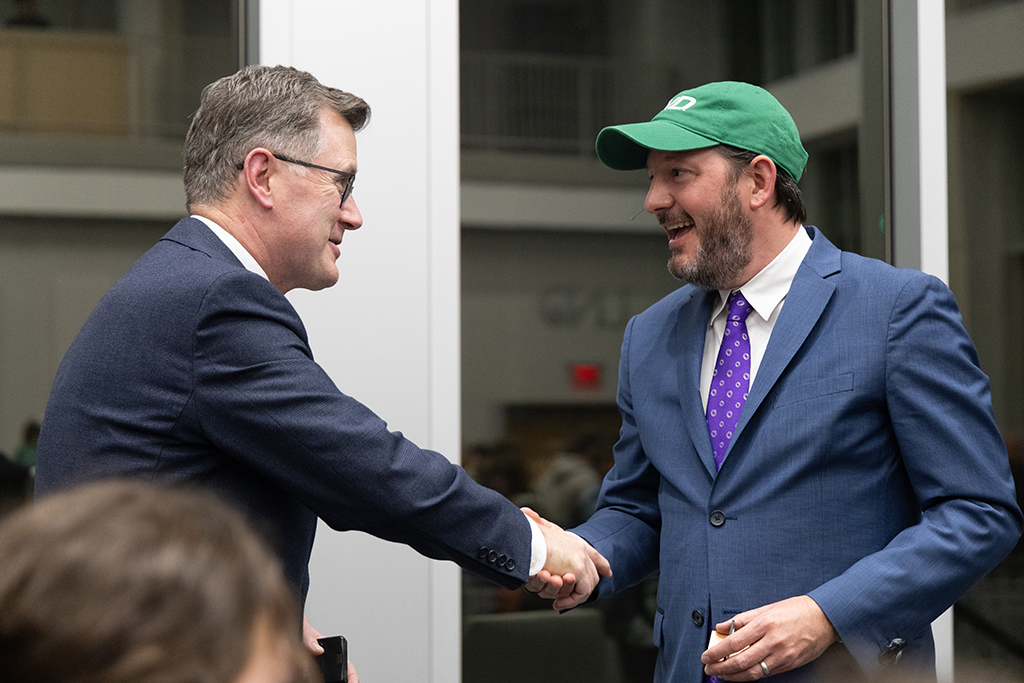
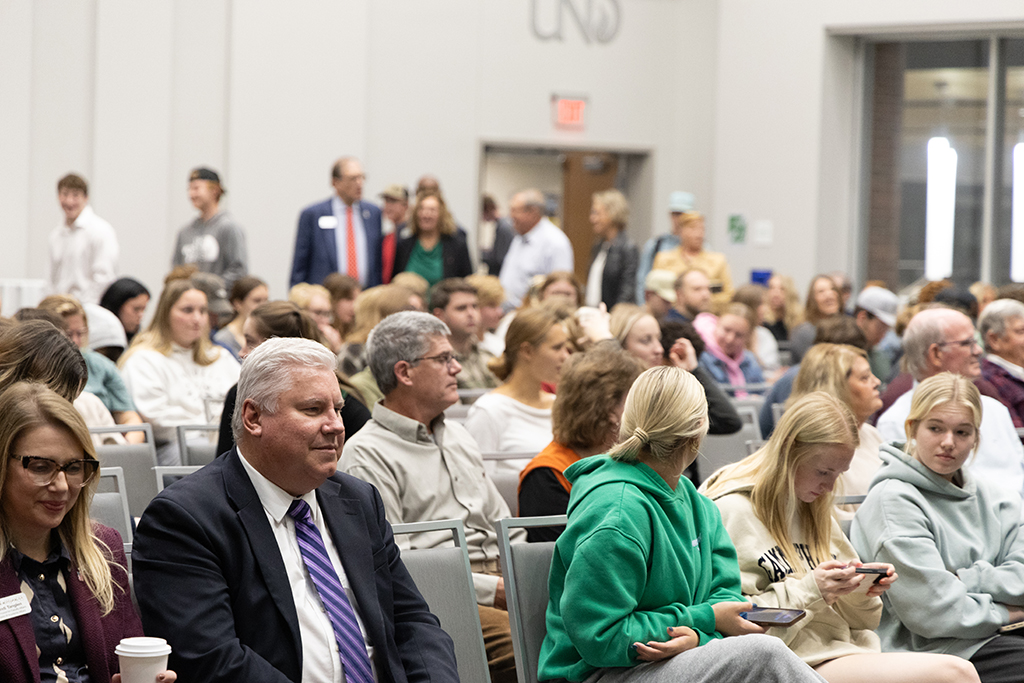
On Monday, Oct. 21, shortly after 7 p.m., people began filing into the Henry Family Ballroom in the Memorial Union — and they didn’t stop coming.
Soon all the chairs, set up neatly in rows, were full, but people kept coming. This prompted Memorial Union staff members to jump into action to bring in more chairs, so people could have a place to sit for the discussion that was to come.
Primetime Emmy Award-winning broadcast journalist and author Edward O’Keefe, it seems, sure can fill a room.
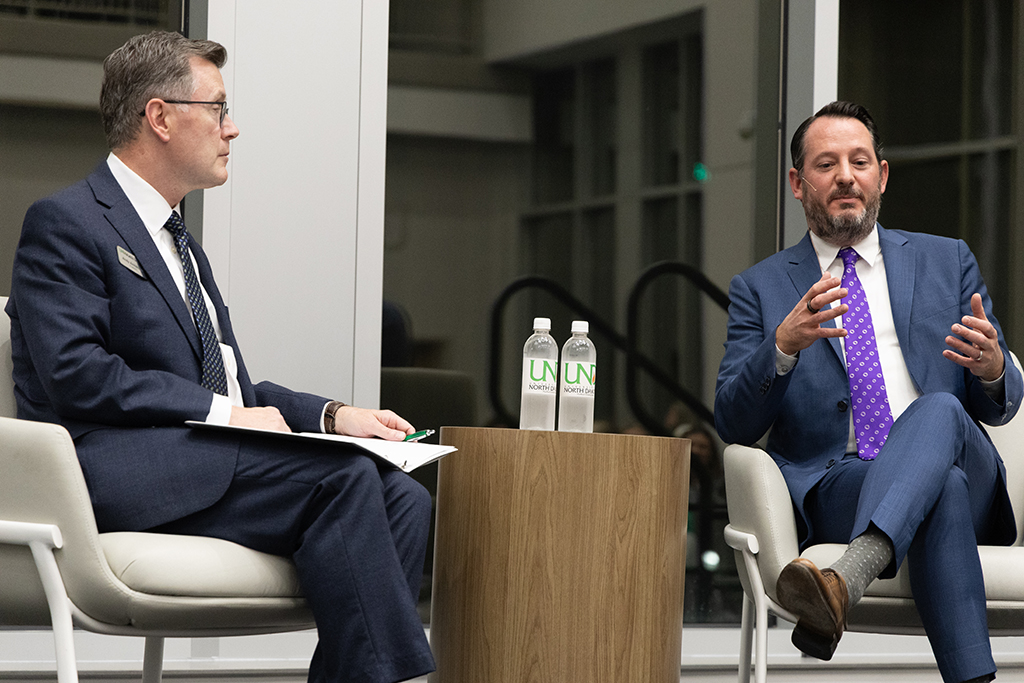
O’Keefe was the latest guest to come to UND for the Eye of the Hawk lecture series. The series is a way for people at UND and in surrounding communities to discuss interesting events and topics with leading scholars and experts. The series usually takes the form of a lecture, but Monday’s installment was that of a fireside chat, hosted by President Andy Armacost.
“This is an amazing opportunity for all of us to hear Ed O’Keefe talk,” Armacost said, before welcoming O’Keefe, a Grand Forks native, back to his hometown.
“I love coming home,” O’Keefe responded.
And growing up in Grand Forks was first on the list of topics they covered.
O’Keefe, a nationally recognized journalist and scholar who is now the CEO of the Theodore Roosevelt Presidential Library Foundation, described his boyhood before discussing his career and latest book, “The Loves of Theodore Roosevelt: The Women Who Created a President.”
O’Keefe said it was “magical” growing up in Grand Forks, a place he said “has small-town values with big-town opportunities.” UND played no small role in his life here, as his mother, Heather, was a professor in the Department of Communication. He said she would take him along on trips to New York with her students, and that his family was friends with a UND archaeology professor, and they would go on trips to Montana to explore ice caves.
“It’s just a wonderful community where neighbor cares for neighbor, and yet you’ve got all these diverse interests of people and perspective and life that you can explore,” he said.
O’Keefe, a 1996 graduate of Red River high School, said he missed experiencing firsthand the devastation of the flood of 1997, which inundated large swaths of Grand Forks and drew national media attention, as he was attending Georgetown University in Washington.
He learned about the flood by speaking with his father, William, but he also obtained facts about it while working as an intern in the office of then-North Dakota Sen. Byron Dorgan. He decided to write a paper on the flood, called “A Flood of Politics,” which he credited with leading him to his choice of profession.
“It led me down the dark, dark path of journalism,” he said, drawing laughs.
And O’Keefe certainly has had success in that career. He spent about 20 years in broadcast and digital media at ABC News, CNN and NowThis, and he received a Primetime Emmy Award, two Webby Awards, the Edward R. Murrow Award and a George Foster Peabody Award for ABC’s coverage of 9/11.
On that last topic, O’Keefe said his first day covering Capitol Hill was actually on 9/11. He recalled having to abandon his assignment (a conference on rural cellphone coverage) when he learned of a plane crashing into the World Trade Center.
Police gave word that another plane was heading toward the Capitol, which caused a scramble as people sought cover. He said he picked up a colleague’s shoes — she had run right out of them — and gave them back to her while they sheltered.
“I said ‘(to former ABC NEWS journalist) Linda Douglas, I’m Ed O’Keefe, and here are your shoes,’” he remembered.
O’Keefe worked to get Joseph Biden, then a senator and chair of the Senate Foreign Relations Committee, to do an on-air interview with Peter Jennings, the ABC News anchor. That interview resulted in Biden being the first American leader to say the targetings were likely terrorist attacks by al-Qaida.
“My day started with a run for my life, and it ended watching all members of Congress gathered back together to sing ‘God Bless America’ on the steps of the Capitol,” he said.
Recognizing the emotion in O’Keefe’s voice, said Armacost: “These kinds of stories are certainly harrowing and bring back those memories, and we need to pay attention and continue to remember that history. Thanks for sharing that.”
Turning to working with Jennings, whom generations of Americans remember as the face of ABC News, O’Keefe (then working as a production assistant) said he had a unique way of influencing how the famous anchor chose stories for his nightly program.
O’Keefe said Jennings would pick stories by checking the ABC News website. Being prior to the days of social media, people emailed interesting stories to their friends. Jennings selected the stories that had been emailed the most, which O’Keefe turned to his advantage.
“I would self-assign a story that I could report and write, and I would write that story, and then I would email it to every single person I’d ever met in my entire life,” he said. “I’d email it to my mom, my dad, my brother, my sisters, my cousins, my friends, my enemies, anybody.”
That story would then become the most-emailed story on the company’s website, and Jennings would select it to be aired — which meant it got reassigned back to O’Keefe so he could produce a TV piece from his original story.
Armacost and O’Keefe then turned to discussing Theodore Roosevelt, and how O’Keefe came to write about him. The seeds may have been planted when O’Keefe was a boy living in North Dakota, but they came to fruition, he said, when he found himself studying Roosevelt’s writings, stored in the Houghton Library at Harvard University.
After 20 years working in media, and a stint working with celebrated chef and TV host Anthony Bourdain, O’Keefe took a fellowship at Harvard to study the future of media. He wanted to continue to work with people like Bourdain, as they told nonfiction stories that people found to be unifying, instead of divisive.
But he was drawn to another topic entirely: Roosevelt’s writings. O’Keefe would “sneak off” to the library to study Harvard’s extensive collection on Roosevelt, Harvard Class of 1880. During his research, he kept running into the extraordinary women in Roosevelt’s life, including Roosevelt’s mother and both wives, all of whom helped shape his outlook on life.
Those women, O’Keefe said, always had been depicted as secondary in the president’s life. So O’Keefe decided to tell their story.
That story includes Roosevelt’s first wife, Alice, and his mother, Martha, both dying on the same day in the same house, Feb. 14, 1884. Their deaths prompted Roosevelt to mark the day in his diary with a bold “X‚” and to write, “The light has gone out of my life.”
Later that year, Roosevelt came to then-Dakota Territory, to live as a rancher and cowboy, and to grieve. On a return visit to New York, he encountered Edith, a childhood friend, and a romance kindled.
“It is the loss of love that brings him to the Badlands of North Dakota,” O’Keefe said. “It’s the rediscovery of a childhood love that brings him back out. That’s the story that had to be told.”
The discussion was well-received, and people lined up to get copies of “The Loves of Theodore Roosevelt: The Women Who Created a President,” signed by the author.
Students who attended the discussion said they came away knowing that there is much more to understand about Roosevelt than his presidency. The same held true for faculty members in attendance.
“He humanized him in a way,” said Nikki Berg Burin, assistant professor of History and American Indian Studies. “Those personal relationships he talked about with his mom and his wives and his sisters, that just shows a different element of Teddy Roosevelt.”
The UND College of Arts & Sciences Eye of the Hawk Lecture is sponsored by Rick & Jody Burgum.
>> Do you want to read more UND Today stories? Just hit the link or go to our home page to subscribe to our twice-weekly newsletter.