Kenyan classmates reunite through UND’s Nurse Anesthesia program
Two students from the same Kenyan high school find their way to UND’s Nurse Anesthesia program — and back to each other
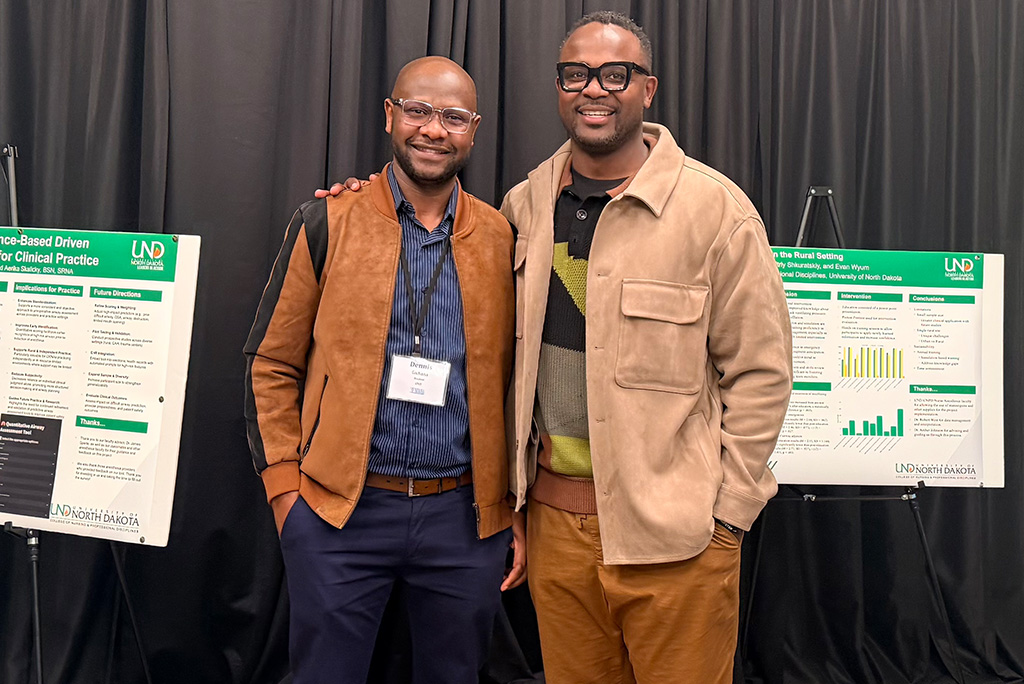
Kevin Ogutu had to look twice.
He was back in North Dakota for a nurse anesthesia conference, chatting with former classmates and faculty from UND’s Nurse Anesthesia program, when someone mentioned that another student in the room, Dennis Gichana, was from Kenya.
It had been long enough that Oguto did not recognize Gichana right away. But once they started comparing hometowns and high schools, the connection came back.
They had grown up in the same region of Kenya and attended the same high school, separated by just one year. As they talked, Gichana recalled that he had even disciplined Ogutu at one point — he had served as school captain, a leadership role that included enforcing rules among students, a memory the pair greeted with laughter.
“I may have landed into some trouble,” Ogutu said. “He gave me a little bit of a whoop in the back, but it all came from a point of caring and wanting to make sure that we were doing the right thing.”
And now, years later, their separate journeys across continents, careers and health care systems came full circle, leading them both to UND’s Nurse Anesthesia program, the only one of its kind in the state.
“What are the odds?” Ogutu said. “Two different kids from Kenya, we end up in the same program in North Dakota.”
Starting over in North Dakota
Gichana’s interest in health care began in high school, where he served as captain for health — overseeing student wellness, providing first aid and helping classmates get care when they needed it.
“I chose health because I wanted to be that person who comes through when you need help,” he said.
Before immigrating to the United States in 2016, Gichana worked in Kenya as a clinical officer, a role similar to a physician assistant.
But there was a catch: His credentials did not transfer. He had to start from square one.
So, when he got to North Dakota, he became a certified nursing assistant, then an LPN, then an RN, working in intensive care while earning his bachelor’s degree and building the critical care experience required for UND’s nurse anesthesia program.
The process was frustrating, but it brought him back toward the work he had always wanted to do.
“I want to be there when people are the most vulnerable,” he said. “That fulfillment is just something that I couldn’t find anywhere else.”
Finding another path to nurse anesthesia
Ogutu’s path followed a different route.
After earning his nursing degree in Michigan and working around the country, he moved to Minot to be closer to his parents, who had recently relocated from Kenya. Working at Trinity Health, he met ICU nurses who had gone through UND’s Nurse Anesthesia program.
He considered medical school, but the cost, time commitment and the life he hoped to build for his family pointed him toward nurse anesthesia instead.
“I wanted to practice at an advanced level,” Ogutu said. “I wanted to be able to make a comfortable income and afford a lifestyle that I would imagine for my family.”
Ogutu entered UND’s Nurse Anesthesia program in 2019 and graduated in 2022. He now works for Kaiser Permanente in Northern California and said UND’s training prepared him to practice across adult anesthesia, pediatrics, obstetrics and trauma.
“The program was very stressful and intense,” he said. “But the professors understood that, and they were there each step of the way.”
Gichana, still completing the program, echoed the sentiment. He credited clinical associate professor James Sperle — the former program director and his advisor — with helping set that tone.
“They don’t make you feel out of place,” he said. “It’s a good culture over there.”
Training for the unexpected
Though both men found their calling in the profession, they were challenged by the ebbs and flows of the program.
UND’s Nurse Anesthesia Doctor of Nursing Practice program prepares students to become Certified Registered Nurse Anesthetists, or CRNAs, who provide anesthesia care during some of a patient’s most uncertain moments.
After classroom work at the College of Nursing & Professional Disciplines, students rotate through clinical sites across North Dakota, Minnesota and South Dakota.
For Gichana, that hands-on time has been crucial to his growth as a future nurse anesthetist. Equipment, operating room setups and hospital cultures shift from site to site, and students must learn to adapt quickly in new environments.
“You can imagine a situation where you need to crank up your oxygen, but you can’t find the button on this equipment because you’re not used to it,” he said.
But all of that pressure is part of preparing students for a profession where lives are at stake every day.
“You go home some nights and you ask, ‘Why did I even begin this?’” Gichana said. “But I look at those times as learning moments, not something meant to break you.”
Two paths, one purpose
For both men, the real pleasure of the work lies in supporting patients in times of need and uncertainty.
“They’re extremely scared. They don’t know what the outcome is going to be,” Ogutu said. “And just being there for them — to give them a word of encouragement, to hold their hand — it’s so fulfilling.”
That shared calling makes their reunion all the more remarkable. Two students from the same Kenyan high school, separated by years and continents, arrived at the same program in North Dakota through a shared drive to help people.
“Not once did it occur to me when I was in high school that the same person that was disciplining me — somehow our paths would cross in the future,” Ogutu said.
“Always be kind to people,” he added. “Always know that you came into this earth for a purpose.”
And for Ogutu and Gichana, UND became an essential part of that purpose.
Or, as Ogutu put it: “UND gave me the opportunity to be who I am today.”