Healthy gaming gets a 1-up on campus
Esports, Public Health Education and Graphic Design programs team up to create posters to promote healthy gaming
For gamers, it’s easy to lose many hours joining lobbies, playing matches and practicing. Many high-skill games such as “League of Legends,” “Apex Legends” and “Counter Strike: Global Offensive” encourage this, but falling into the pattern can leave little room for self-care.
As UND Esports continued to grow, Director of UND Esports Matt Knutson knew that he had to remind players to practice healthy gaming habits. So last spring, he came up with the concept for a cross-campus collaboration between UND’s Public Health Education, Esports and Graphic Design programs to create posters for the Esports Nexus.
A growing need for healthy gaming habits
As many as 80% of professional Esports players quit within two years of starting their careers, Knutson said. Often, that’s due to burnout and injuries (such as carpal tunnel syndrome and tendonitis) from repetitive strain.
“We want to make public health a priority for our Esports athletes,” Knutson said. “The messages on these posters are all supported by research on what will keep these students healthy as they compete.
“We wanted something to be a part of their environment, and it was a good opportunity to have this interesting collaboration.”
Knutson approached Scott Telle, part-time instructor of graphic design and owner of Grand Forks ad agency Ad Monkeys, with the idea of having one of the Graphic Design classes create posters for the Esports Nexus. Telle thought it would be a good chance to give students some hands-on graphic design experience.
“I thought it was a great opportunity for all these students to get a taste of working with a real client, real deadlines, real expectations and a real end product,” Telle said.
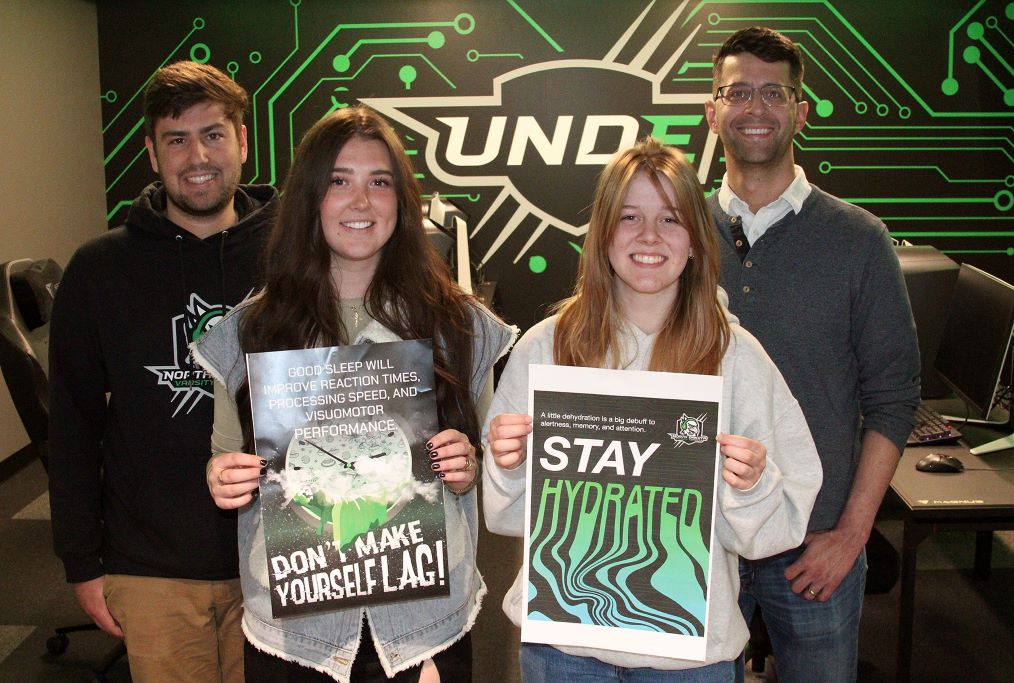
Students in Telle’s class worked to create five posters for the Esports Nexus with messages that encourage healthy gaming. The concepts were chosen by Knutson, Tanis Walch, a professor of Public Health Education, and Ryan Kraus, head coach of UND Esports.
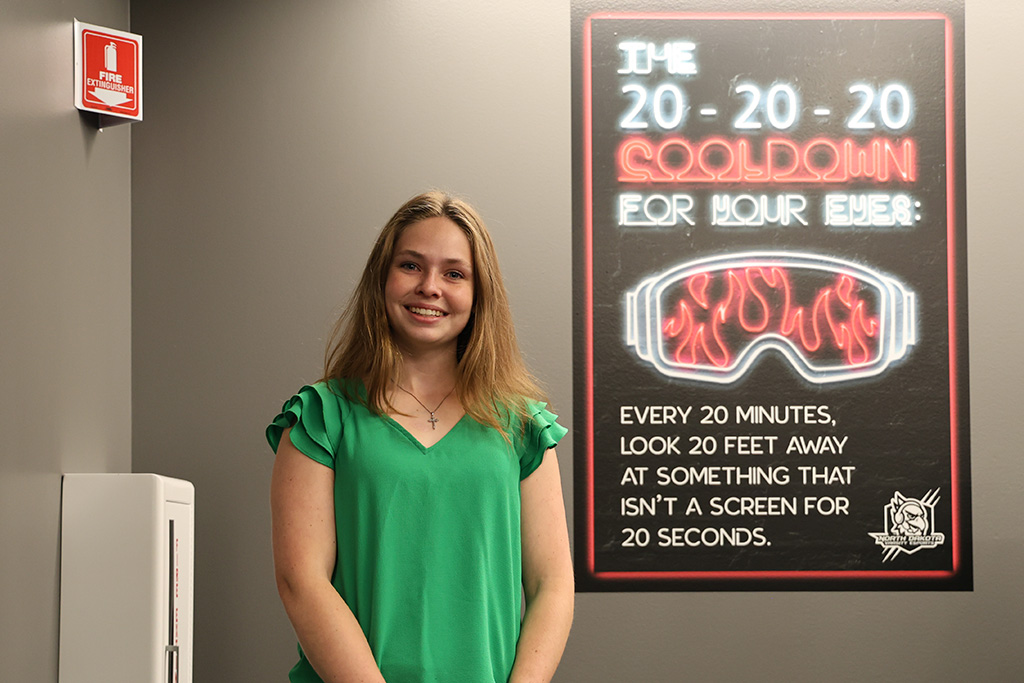
From hydration and posture to the eye-strain-reducing “20-20-20 rule” — which suggests gamers take a 20-second break every 20 minutes by looking at something 20 feet away to reduce eye strain — these reminders are designed to help gamers stay healthy and prevent burnout, both in-game and in school.
“I think having those reminders — not only verbal but visual — is going to be a great thing for their health in the future,” Knutson said. “Ryan Kraus, the Esports head coach, is good about reminding the athletes to practice these things, but it’s great to have another way to communicate them that’s not as disruptive as someone tugging at your shirt.”
A vision for healthy gaming at UND
Knutson, Kraus and Walch served as the judges for the posters at the end of the spring semester. Jasmine Schmitz, a junior studying Graphic Design, ultimately was selected as the winner.
Her designs are both simple and eye-grabbing. Each poster features a single, striking image meant to look like it’s made of the neon LED tubes commonly found in dedicated gaming computers, along with text in the same style. The resulting posters complement the blinking lights of the computers in the lab while adding a pop of vibrant color to the otherwise dimly lit room.
During the initial design, Schmitz took great care to achieve a clean look for the posters, a process that included a lot of tweaking and fine-tuning, she said.
“Margins and text were very important to me in these pieces. I wanted everything to be aligned so they are easy to read,” she said. “I worked hard to make a neon effect that looked natural and realistic. The first time I tried to create the effect in InDesign, it turned out poorly. So, I had to use Photoshop and add the highlights and fade the colors manually to make it look right.”
Knutson said the vibrancy and simplicity of the designs made it a natural fit for their purpose and offered visual appeal to students who gravitate toward gaming as both a hobby and a discipline.
“You don’t need a highly detailed illustration to communicate something like hydration. We wanted a cohesive aesthetic and immediate reinforcement in the designs,” Knutson said. “I thought Jasmine’s ideas were clever, and the aesthetic fits perfectly in the Esports Nexus.”
Telle held a similar sentiment and said that much of the success of Schmitz’s designs came from her singular vision as both a designer and an artist.
“We had conversations about whether AI could be used in the design process, and some did end up using it in their designs. Jasmine used her own creations, and I give her credit for that,” he said. “I think what she came up with in those simple, iconic images really made them stand out as appealing and unique to the judges.”
Research-backed approaches for healthy gaming
Research supports the idea that signage and posters are effective for public health interventions, Walch said. Constant, subtle reminders of healthy gaming habits that fit naturally in their environment can serve as good, nonintrusive reinforcement.
“We’ve done signage interventions before — like encouraging people to use stairs instead of elevators — and they’ve been effective in the short term,” said Walch. “I’m confident that these will have a positive effect on students’ health and performance. And these posters will be up here for a long time, so as new students rotate through, they’ll continue to be effective.”
Walch said that, in addition to having an immediate reminder for students, the project has opened doors to explore the intersection of gaming and public health. She hopes that the collaboration between Esports and public health will continue with a study on gaming performance and physical health.
“We don’t want to jeopardize what they’re doing to win; we want them to be successful esports athletes,” Walch said. “But will these behaviors improve performance? We have some grad students interested in exploring how it will impact performance. So, that research will be our next step.”