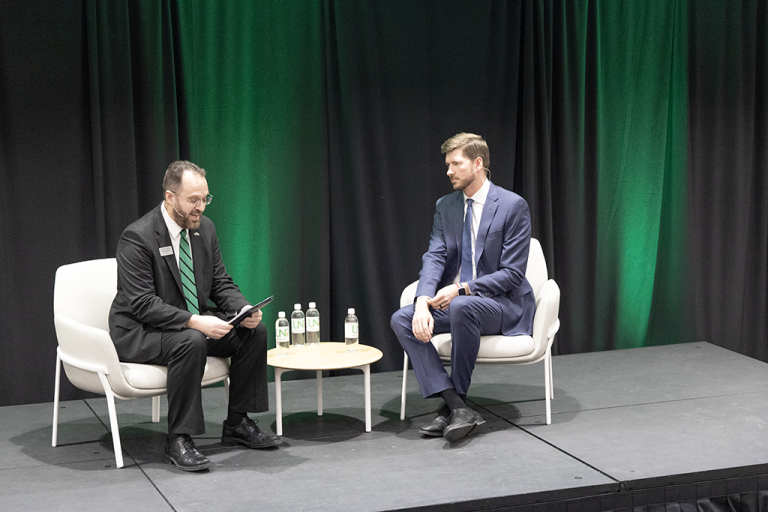
Honoring North Dakota’s health care firefighter
Like a fire chief running toward the flames, UND’s Dr. Joshua Wynne confronts the state’s health care problems – and solves them, speakers say
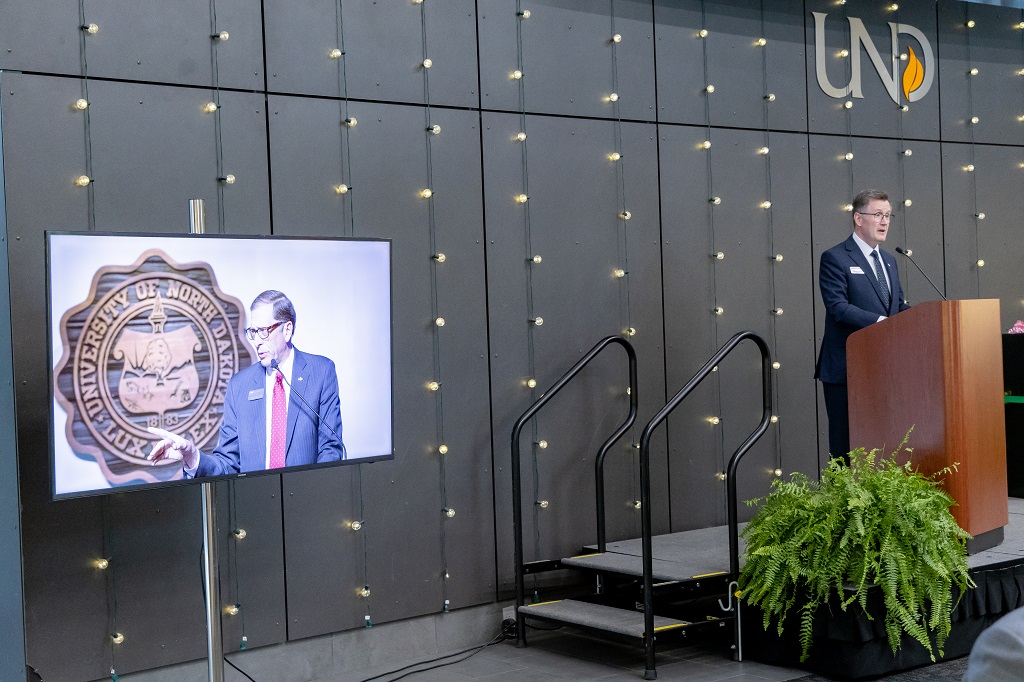
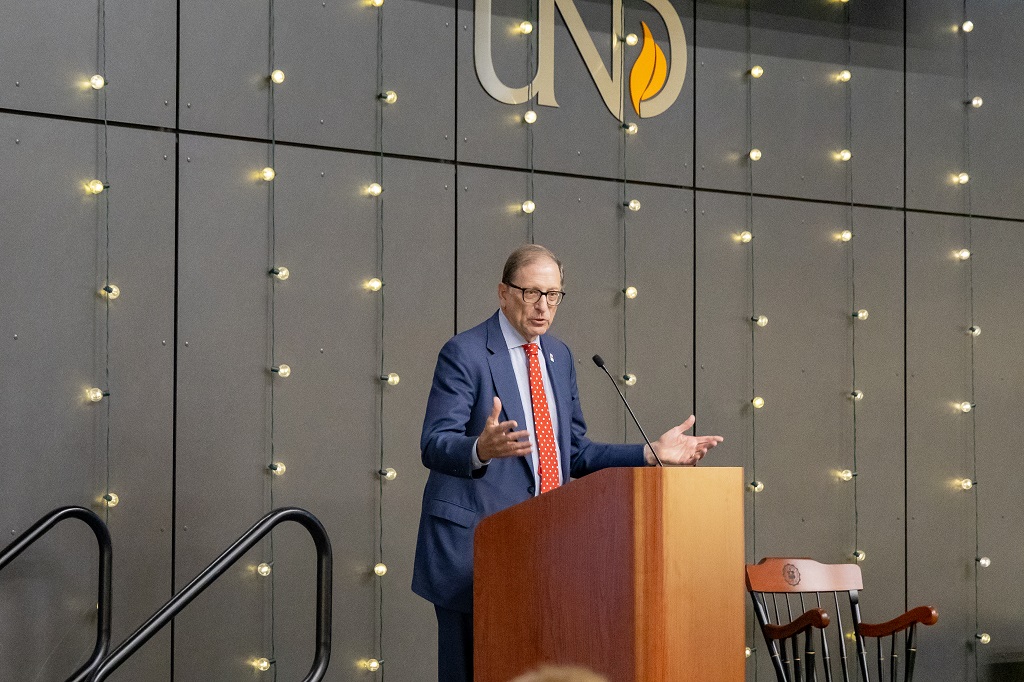
If you want to really take the measure of a person, said Dave Molmen, a leader of Altru Health System in Grand Forks and its predecessor organization for more than 40 years, start with taking a mental photograph of them.
“You should imagine it showing the picture of the person’s life and career, and all the things that are that are in it,” Molmen said.
“Next, you should cover up the person, and not look at them.” Instead, “look at all the things around them, and ask yourself, ‘What kind of an environment did they create? What did they build? And what will still be here when they no longer are?”
Then Molmen smiled.
“And I think that when you take that view of it, there will be few who could measure up to the things that Joshua Wynne has brought to all of us,” he said.
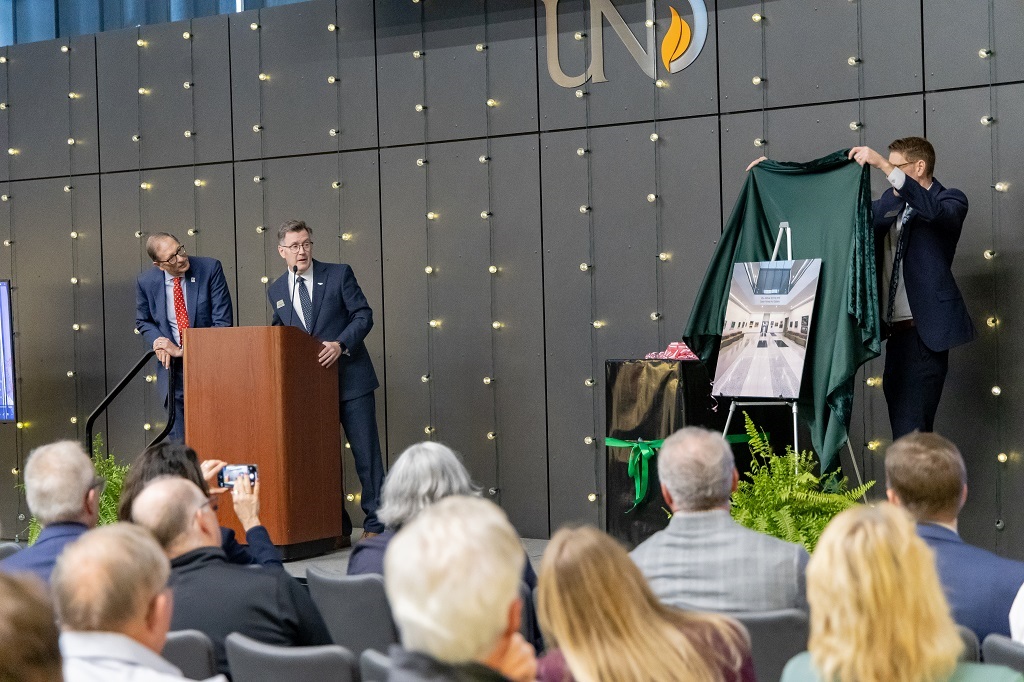
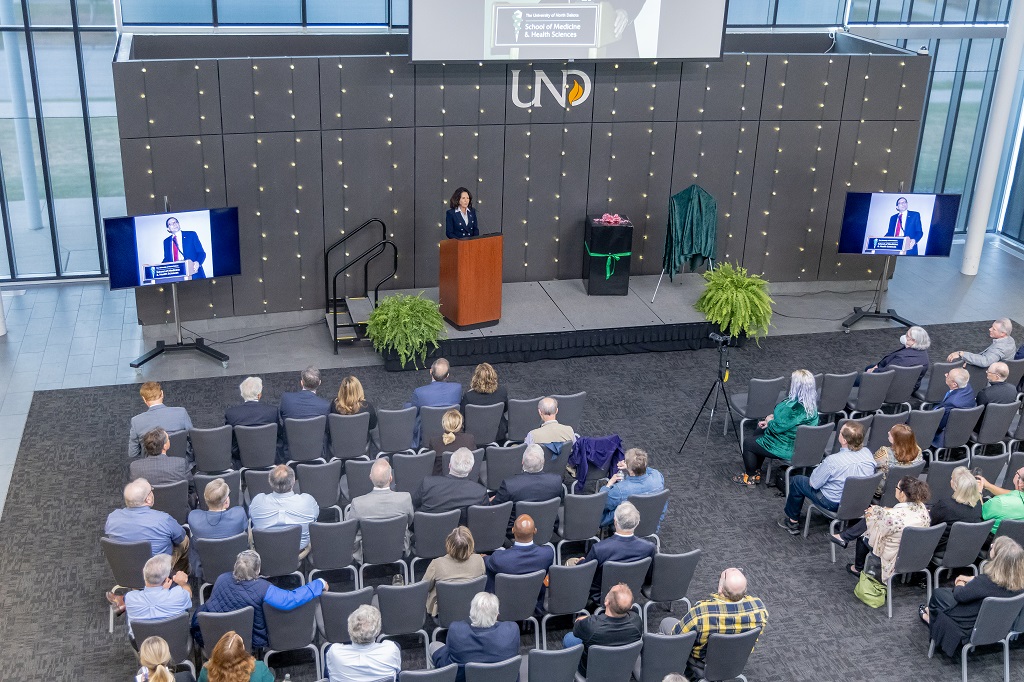
Molmen was a featured speaker at an appreciation reception Oct. 21 for Dr. Wynne, longtime vice president for Health Affairs and dean of the School of Medicine & Health Sciences at UND.
About 100 people – including state legislators, hospital presidents from Fargo, Minot and beyond and the president of the North Dakota Medical Association – came to the Gorecki Alumni Center to thank Wynne for his 20 years of service, which includes duties not only as VP and dean, but also president of UND, leader of the University System’s systemwide COVID Restart Task Force and chief health strategist for North Dakota.
Moreover, Wynne’s advocacy for strengthening North Dakota’s health care workforce was instrumental in persuading the state to build the $124 million School of Medicine & Health Sciences building.
“I have to tell you what a privilege it is to be here to help recognize one of the most extraordinary and talented people I have ever known,” Molmen said.
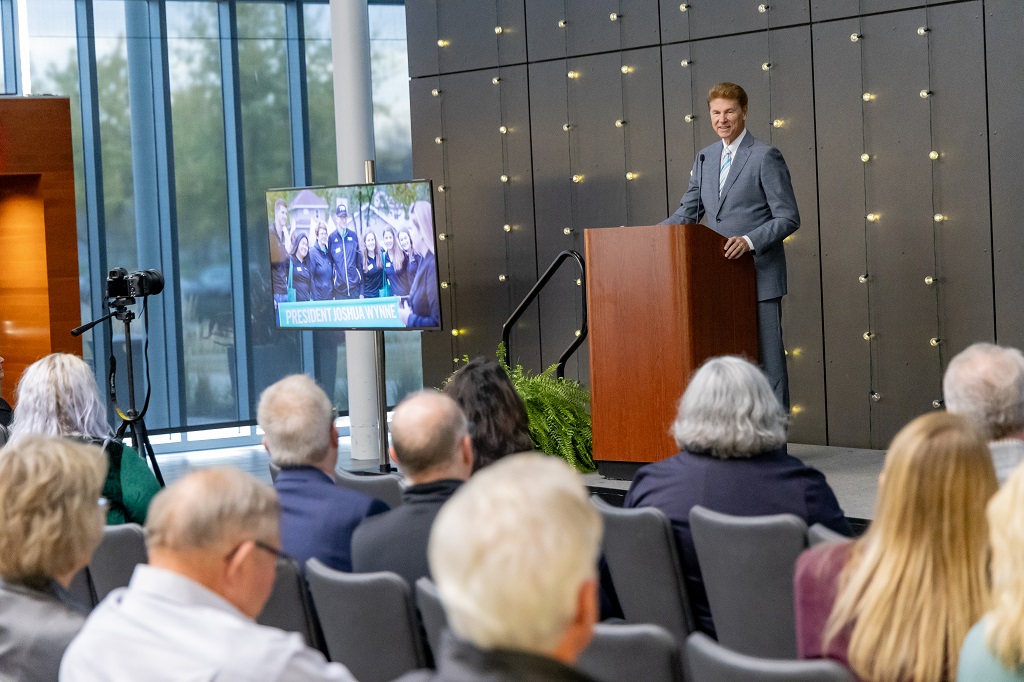
A cardiologist by training, Wynne arrived in North Dakota in 2004 to serve in an associate leadership role at the School. Following a national search, he became the School’s dean and a UND vice president in 2010.
Wynne announced a timetable last year for stepping down from School and UND leadership, while also saying he’d be staying on as a faculty member and continuing to operate his private practice as a cardiologist in Fargo.
If one were to take Molmen’s advice and conjure up a picture of Wynne’s life in North Dakota, here is what one might see:
Impact on the School of Medicine & Health Sciences
“On behalf of all the presidents who have served here at UND, including Chuck Kupcella, Ed Schafer, Bob Kelley, Mark Kennedy and myself: Josh, we extend our complete and utter gratitude for what you’ve done for UND, and what you’ve done for the School of Medicine and Health Sciences,” UND President Andy Armacost said at the reception.
“Your commitment to the members of the School of Medicine & Health Sciences and the entire campus and their well-being is truly exceptional. And there has been no one more important to the future of medicine in the state of North Dakota than you.”
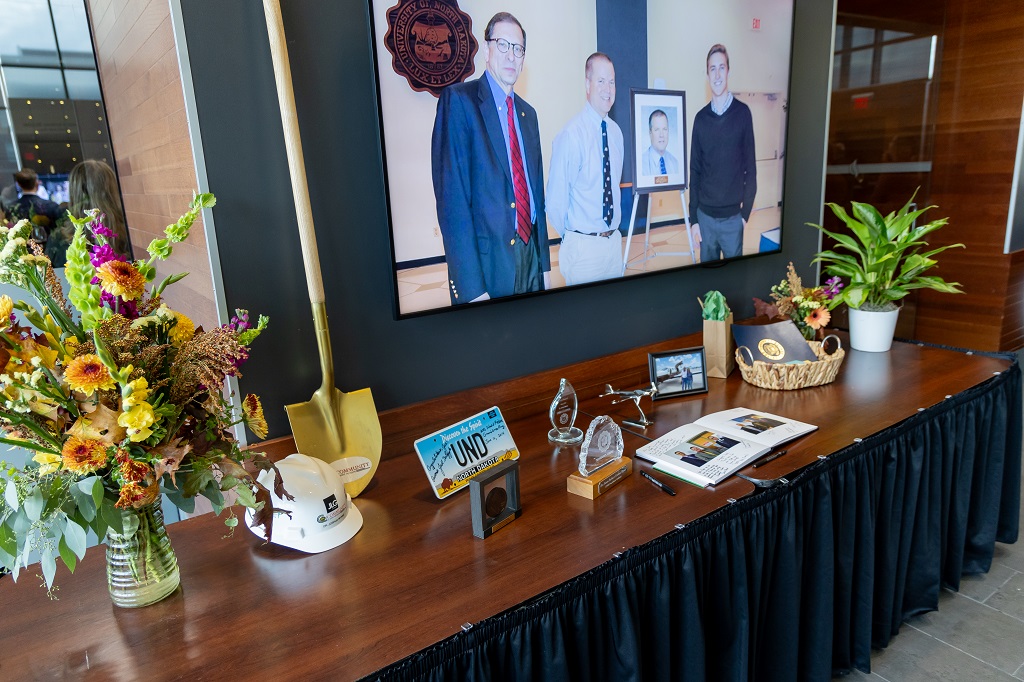
Under Wynne’s leadership, the School saw the expansion of class sizes across the health professions, increases in philanthropic giving to the School and the significant reduction in overall student debt, particularly for medical students. As mentioned above, Wynne also worked closely with UND, the North Dakota Legislative Assembly and health providers across North Dakota on the construction of a new 325,000 square foot School of Medicine & Health Sciences building, which opened in Grand Forks in 2016.
“You’ve led so many innovative changes to the School of Medicine and Health Sciences, including the way we’ve created interprofessional capabilities, the way we’ve modified the curriculum in medicine,” Armacost continued.
“You’ve also led massive growth in the ‘Discovery’ part of being medical professionals.” As a result, the School’s research portfolio is the largest among UND’s academic programs “by far,” Armacost said, and in the case of the Department of Biomedical Sciences, ranks No. 1 among similar departments nationwide for bringing in grants from the National Institutes of Health.
Also during Wynne’s tenure as dean, the School of Medicine & Health Sciences has seen the expansion of class sizes across several health professions, increases in philanthropic giving to the school and a reduction in overall student debt – particularly for medical students – relative to students at other schools.
“That’s an amazing, amazing record, and your personal commitment to the success of those around you has just led to so many great things within SMHS,” Armacost said.

Impact on UND
Wynne became president of UND for a year, starting in May 2019. He served in that role through the early months of the COVD pandemic – a period during which his Master of Public Health degree proved especially useful – and stepped down when President Andy Armacost arrived in June 2020.
During that period, “the leadership you provided to the campus and the entire state of North Dakota was absolutely amazing,” Armacost said.
“And while I value all of those things, most importantly, I value the personal friendship that you’ve offered me,” as well as the welcome that Wynne and his wife, Susan Farkas, offered Armacost and his wife, Kathy, upon their arrival in Grand Forks.
“Josh served as our president just before I stepped into the role, and there could have been no better partner, no better mentor and no better leader than I could have expected coming into a place that I didn’t know a ton about when I took over,” Armacost said.
“And the support that you’ve provided in the aftermath of all of that has been exceptional.”
Impact on the state
“On behalf of Gov. Doug Burgum and myself, we say thank you to Dr. Wynne,” North Dakota Lt. Gov. Tammy Miller said at the reception.
“He offered leadership through the pandemic. He has offered leadership to our universities, and he’s offered leadership as we developed and started to execute our strategy to become the healthiest state in the nation.”
And consider the following: When it comes to the percent of graduates practicing in rural areas, the UND School of Medicine & Health Sciences ranks in the nation’s 99th percentile. That’s close to the best record in America.
For the number/volume of graduates who go into family medicine, UND’s SMHS ranks in the 93rd percentile. Graduates practicing primary care: 98th percentile.
As for graduates who are American Indian or Alaska Native, the School of Medicine & Health Sciences sits at the 100th percentile. In other words, the nation’s best.
“With Dr. Wynne, it is leadership everywhere,” Miller said.
On a personal note, Miller recalled the first day of her first job with Gov. Burgum, that of chief operating officer: April 1, 2020, only three weeks after North Dakota’s first case of COVID-19 had been confirmed in Ward County.
“I’m an accountant by training and worked a long time in business as a CEO,” Miller said.
“But I had zero medical background. So you cannot imagine how impactful it was to have a trusted advisor like Dr. Wynne available 24/7.
“And we did have a lot of calls after hours, trying to figure out how to do mass testing, contact tracing and so on,” she said. “Then we had the vaccinations that came in, and the restart for our schools, businesses and long-term care facilities. … So your footprint on the state of North Dakota – with the pandemic, the strategic plan for health, and all that you have done with the university system and UND – will be with us forever.”
A community-based medical school
Wynne himself credited the people around him for the good work being done at the School and in the state. Whatever he may have accomplished, “it’s because I’m surrounded by phenomenal people, some of whom you’ve seen up on the stage,” he said at the reception.
“So is it any wonder? Aren’t they amazing?”
Wynne thanked the reception’s speakers and attendees, and said he was humbled by the event.
“And you know, as the speakers were talking, it occurred to me that one of their themes is community,” he said.
“Community is critical. The community of the School of Medicine and Health Sciences, the community of UND, the community of the surrounding area. … We’re a community-based medical school. What that means is, we don’t own or operate our own hospital, but we work with our partners in the field: Trinity in Minot, Altru in Grand Forks, Sanford in Bismarck and Fargo – we work with them.
“And what I like to say is, yes, we’re a community-based medical school, and our community is all of North Dakota. And we’ve tried to live up to that.”
As soon as Wynne finished speaking, the event’s attendees applauded and rose to their feet, closing the event with a standing ovation.
“I don’t think I would be exaggerating,” Molmen had said earlier, “if I said that 50 years from now, when the pages of history are written, the name of Dr. Joshua Wynne is surely going to be numbered among a very small and special pantheon of North Dakotans who have made life better and the future better for all of us. … It’s kind of like, you know, if we all smell smoke in a building, we all run out of the building. Well, Josh is the firefighter. He’s the one running into the building.”
And Wynne’s willingness to do that – to face up to, tackle and solve difficult problems – “has really made a difference,” Molmen said.