How to help bees, especially in North Dakota
Using a ‘Traveling Bee Circus,’ among other tools, a UND research team helps North Dakota’s pollinators spread the good news
By Averie Eixenberger
With statewide production of more than 30 million pounds of honey in 2022, North Dakota’s honey bees and other pollinators have put the state in first place in the nation for honey production. And at UND, the members of one research team have made it their mission to study these vital pollinators and what environments can help them to thrive.
The people behind the research
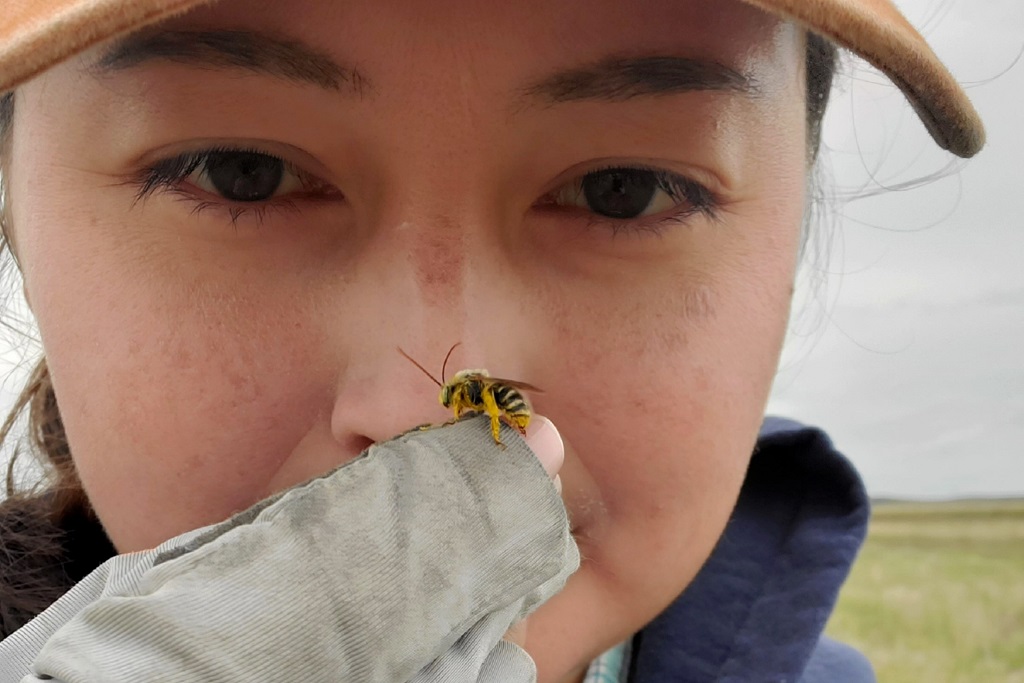
Overseen by Haochi Zheng, associate professor of Earth System Science & Policy, a group of five researchers have focused their studies on the pollinators of North Dakota. The group consists of master’s students Susan Ajonye and Brandon Narum, doctoral students Yeqian Xu and Ossai Alu, and C.K. Pei, a post-doctoral research associate.
The project looks at three different elements: the bees, the land they pollinate and forage on, and the people who make decisions regarding those things. Each team member focused his or her research on a particular aspect of the roles of pollinators.
The pollinators and the land
Alu spends his time researching statewide pollinator forage resources, using remote sensing techniques and machine learning techniques to find and detect floral resources that can be used by pollinators. His focus is to make it easier to study changes in the landscape’s floral resources and how this affects pollinators.
“I am interested in how changes in land affects changes in biodiversity,” said Alu. “My goal has always been to be able to use remote sensing to reduce workload. North Dakota has a unique workspace, and I find this work extremely intriguing and interesting.”
Narum’s research looks at how various pollinators respond to different land covers such as clover, alfalfa, field crops and grasslands He separates bees into different categories and looks for positive and negative relationships to land cover.
“There are so many differences in the types of bees,” said Narum. “How they nest, how far they fly, how they go about their lives. I find it really interesting, and I want to use this to help protect pollinators. I want to understand why biodiversity is important and how we can slow down its loss.”
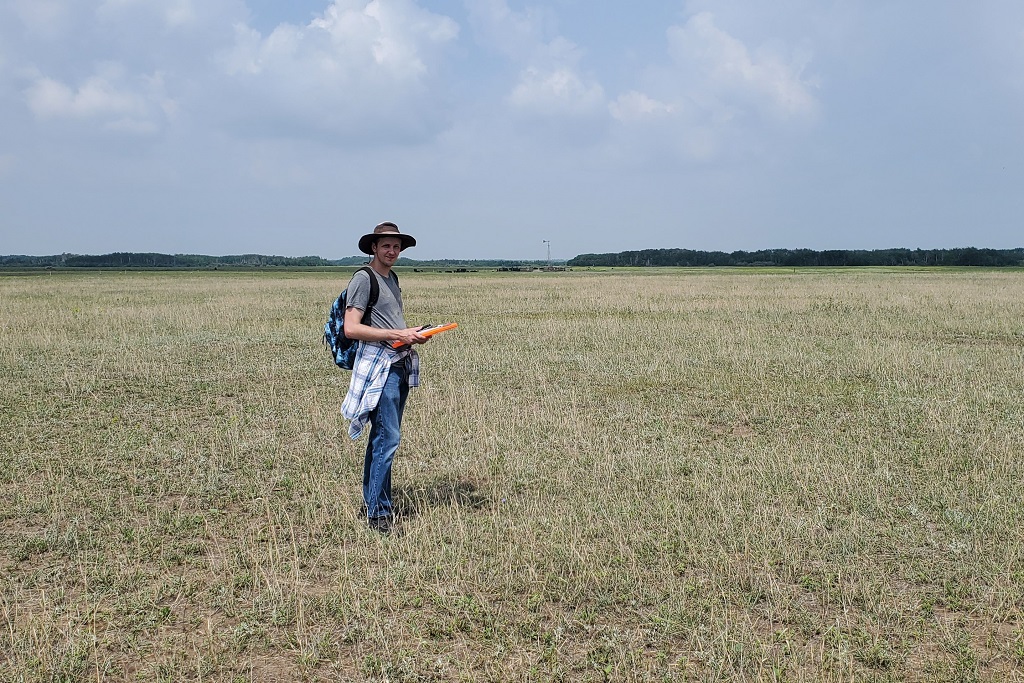
In her own research, Xu looks at roadside habitats. Her focus is documenting flower percentages on roadsides using a GoPro camera while conducting road surveys.
“I’ve always liked honey production as far as food goes,” said Xu. “As I read, I found that pollinator populations were decreasing. Nobody has used this technology in this way yet, and I really enjoy the fieldwork involved. It is relaxing and the landscape is beautiful.”
Ajonye’s research has focused on canola crops. Canola is a major crop for North Dakota, and Ajoyne has been studying the relationship between canola production, pollinators and their forage resources.
People and pollinators
Funded by a UND seed grant, Zheng and Pei’s work focuses on a more social aspect. They conducted surveys to better understand people’s perceptions of pollinators and collaborated with beekeepers and ranchers to explore ways the region’s producers could work together to support pollinators.
Through the seed grant, Pei led an effort to survey private rangelands to understand how livestock movements can interact with the bee, floral and plant communities. The information can help us to understand how rangeland management influences key grassland pollinators.
Outreach
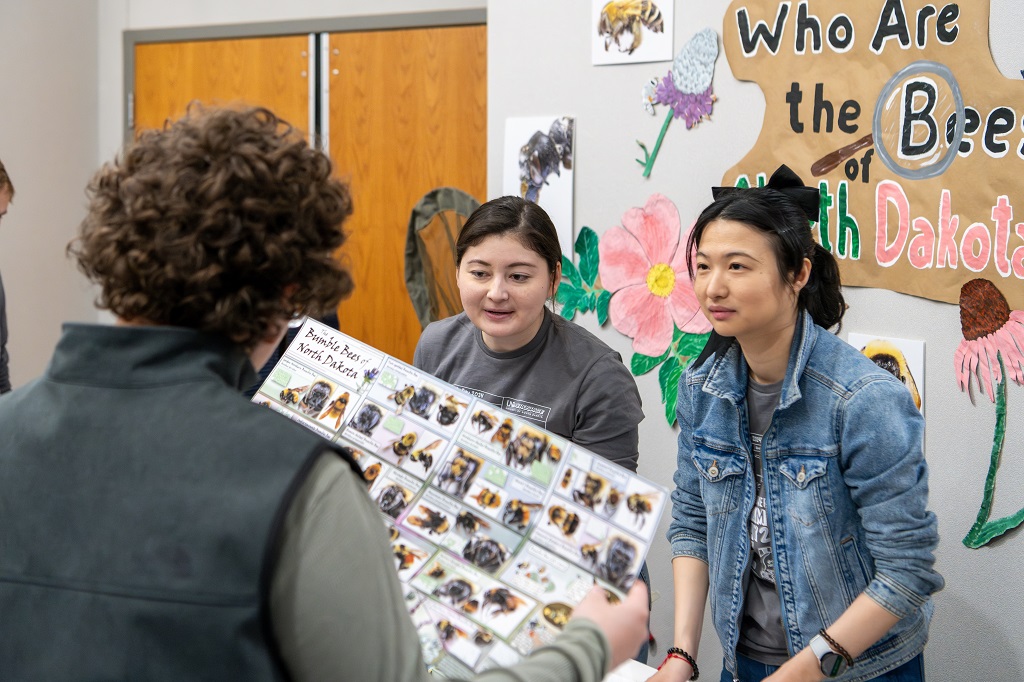
Another aspect of the team is outreach. Team members attend 4H events, visit elementary schools and take part in community events. Through these activities, the team hopes to spread knowledge about bees, starting at a young age.
“With how diverse bees are, you discover new things every day,” Pei said. “When doing outreach, the easiest thing to communicate is that there are many different types of bees and that they live in so many kinds of ways.
“I call myself a traveling bee circus because I just lug these bees around everywhere.”
Why bees?
The research team is enthusiastic about its work, especially discovering new facts about pollinators, learning more about North Dakota and working in nature. And their passion for their work shows.
“Why bees?” Zheng asks. “Because they are important, but many people don’t have a lot of knowledge about them. And every time I learn something new, it makes me realize how much we don’t know. It drives me to discover more.”
About the author:
 Averie Eixenberger is a Commercial Aviation and English major at UND. After graduation, she hopes to pursue a career as an airline pilot and work within aviation journalism.