Liftoff! UND hosts inaugural Space Operations Summit
Summit highlights UND, Grand Forks’ role in space ops, an area vital to national security
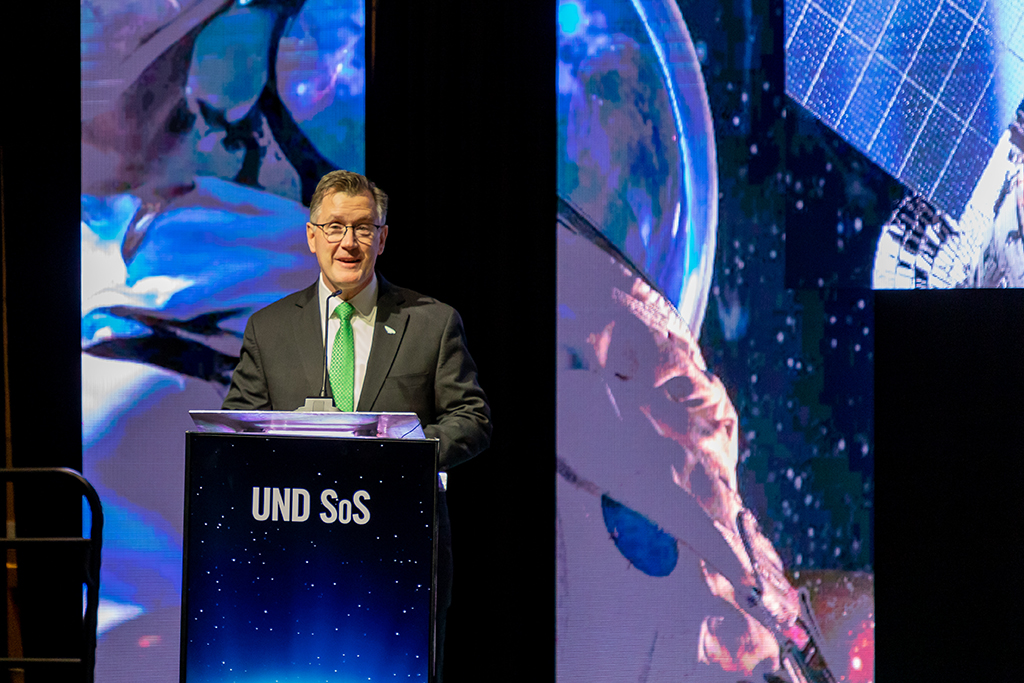
In late October, UND hosted its inaugural Space Operations Summit — an event bringing together academics, military leaders and innovators — to discuss the myriad opportunities and challenges posed by the domain.
In his welcoming remarks, UND President Andy Armacost called the summit a “catalyst for the University’s sense of wonder,” referring to a key pillar of UND’s vision statement that seeks to cultivate an engaged citizenry of lifelong learners.
UND’s Department of Space Studies, Armacost added, has a more-than-40-year history of educating students in fields including propulsion, space law and agriculture and designing and testing satellites.
“UND continues to be a national leader in space education and research,” he said. “Dating back to its founding in the 1980s with the advice of astronaut Buzz Aldrin, there has been a rich history of amazing discoveries and education.”
The department’s momentum is evidenced by student participation, said Ryan Adams, associate dean of national security. Last fall, UND added a bachelor’s degree in Aerospace Engineering, a discipline Adams said “directly impacts space.”
The program is a collaborative effort between the John D. Odegard School of Aerospace Sciences and College of Engineering and Mines. Adams said the number of students enrolled has grown from 56 at its inception to over 150, with interest growing.
Additionally, UND has founded a student satellite development club to supplement the University’s partnership with the Space Development Agency on satellite testing and design.
Attending the summit on behalf of U.S. Sen. Kevin Cramer, Randy Richards, field representative for the senator’s Grand Forks office, reminisced on his upbringing — one that instilled in him a love of space.
“A lot of the books that my parents and relatives gave me when I was learning to read were about space — that was popular at the time,” he said. “I remember my first Darth Vader action figure and watching Star Wars at a drive-in theater.”
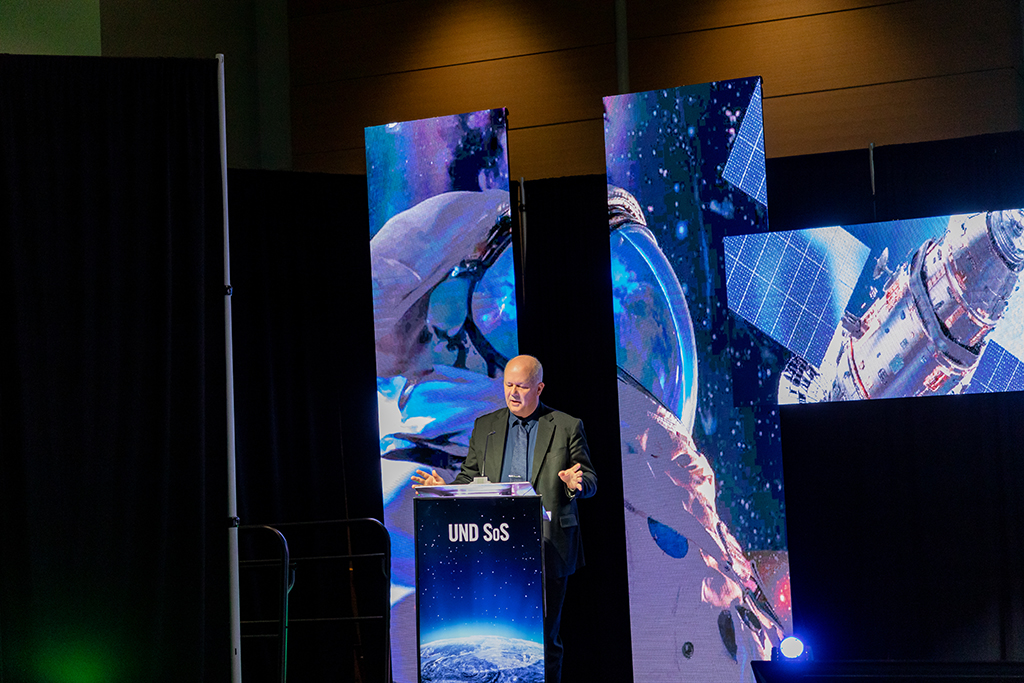
Richards called his boss “the godfather of the U.S. Space Force,” due to legislation introduced by Cramer that proved instrumental in the branch’s creation. He opined that the work being done at UND and across the Grand Forks region in the domain is the result of “dreamers,” who proved naysayers wrong.
“It’s amazing to look back and remember that there were people who said drones wouldn’t get off the ground, and that there was no appetite for space in North Dakota,” Richards said. “Fortunately, I work for a boss who is fond of saying and following up on ‘the art of the possible’ — a motto that certainly applies to President Armacost and his team. The vision they have for the University of North Dakota when it comes to our national defense has been both inspiring and exciting.”
One such instillation bolstering national defense is the Cavalier Space Force Station — located about 90 miles northwest of Grand Forks. The station houses the 10th Space Force Warning Squadron, which partners with the North American Aerospace Command to defend the U.S. and Canada from intercontinental ballistic missiles.
Lt. Col. Michael Stobie, commander of the Squadron, said that although the general public may not fully grasp the importance of the Space Force’s work, it is indispensable to securing the homeland.
“Space plays a vital role in our way of life,” Stobie said. “It is a linchpin connecting people to capabilities. For America and our allies, we use space capabilities for communications, agriculture, financial networks, weather monitoring and more. Last year, U.S. Sen. (John) Hoeven outlined that North Dakota has positioned itself to be at the forefront of this domain — a domain projected to triple in financial impact over the next 20 years.”

Stobie also referenced the Space Force’s university partnership program — of which UND was the first signatory in 2021. The program has since expanded to 14 universities, providing a research and workforce development pipeline for the branch.
Retired colonel and former NASA astronaut Paul Lockhart delivered the summit’s keynote address. Lockhart praised the state’s work ethic, opining that it plays a key role in the developments taking place on campus.
“Here is where the heartbeat of America beats honest and straightforward,” he said. “I think nothing smooths the hard edge of one’s perspective in life more than to find yourself immersed among good people doing good work. And good work is taking place here at UND.”
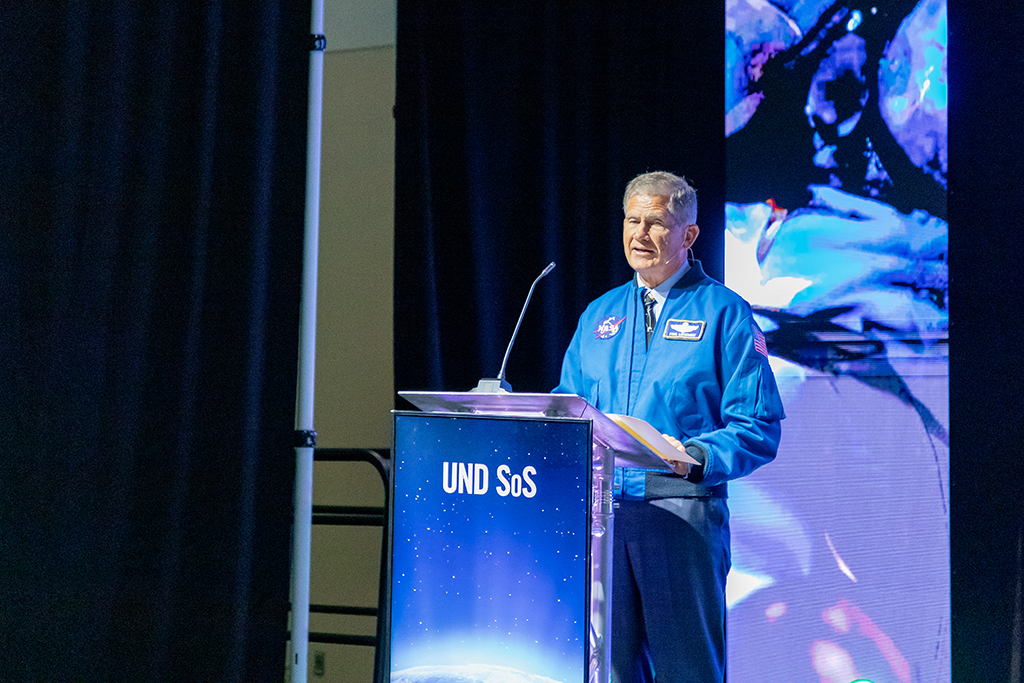
Lockhart called China — which launched its first astronaut into space in 2003 — the greatest threat to America’s preeminence in the domain. China’s rise, he noted, has been rapid over the past two decades, supplanting the position of another historical space power, Russia.
“China is now a major player in spaceflight, space operations and military space,” Lockhart said. “Clearly, China has superseded Russia in innovation, integration of new technologies into its space portfolio and capability to attempt bold missions. Unfortunately, the gap between first and second is closing rapidly.”
The best counter to China’s rise, Lockhart asserted, is institutions like UND, which foster a spirit of innovation and educate future leaders.
“Fortunately, America’s ability to move its space program forward lies within its citizens — especially our youth who are willing to innovate and take risks,” he said. “This Space Operations Summit is just the beginning. Using it as a springboard, UND can and should continue to attract students, widen its corporate support and advance its role and reputation as a university that develops tier-one engineers, scientists and program managers.”
>> Do you want to read more UND Today stories? Just hit the link or go to our home page to subscribe to our twice-weekly newsletter.