Multiculturalism for a better UND
Two-day conference explores how faculty and staff can embrace multiculturalism to help students flourish
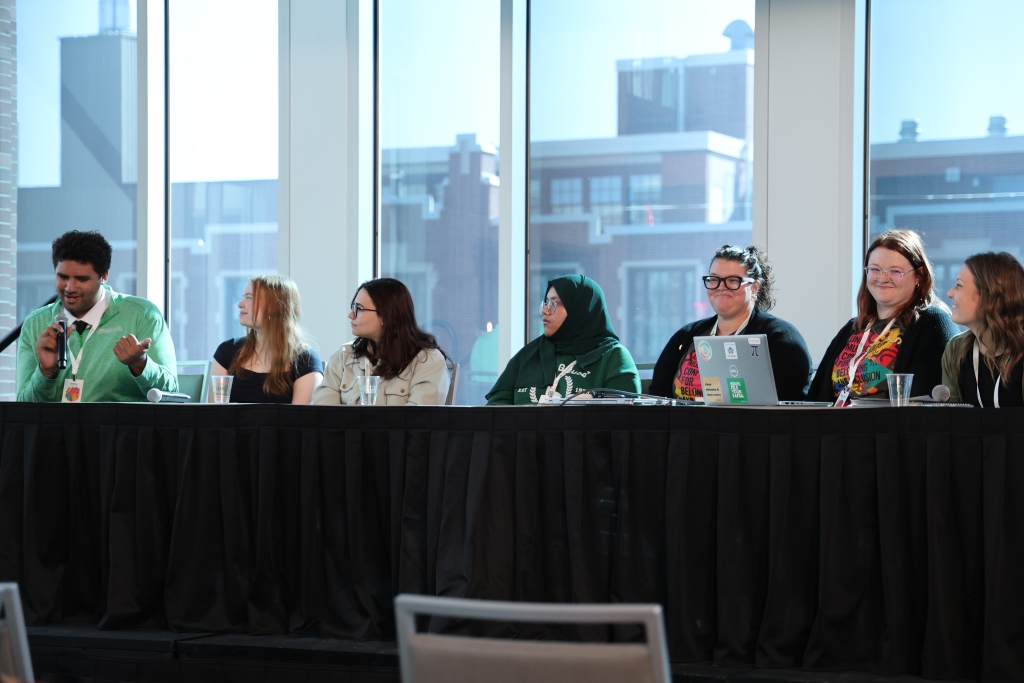
Panelists from left to right: Jaedon Hinds, Ellie Lynch, Raneem Kobeissy, Sumaiya, Stacey Barboa-Peterson, Shelby King and Danielle Schindele. Photo by Walter Criswell/UND Today.
On October 7 and 8, UND’s Office of Community & Inclusion hosted its biennial Multicultural Conference for Belonging and Inclusion. Held in the Memorial Union, the conference invited educators, students and community members to explore how multiculturalism and inclusion can foster a richer, more vibrant campus community.
Throughout the two-day conference, attendees had the opportunity to experience and watch panels centered on topics dealing with racial identities and accessibility for students with disabilities, as well as research presentations.
Multiculturalism and mentorship
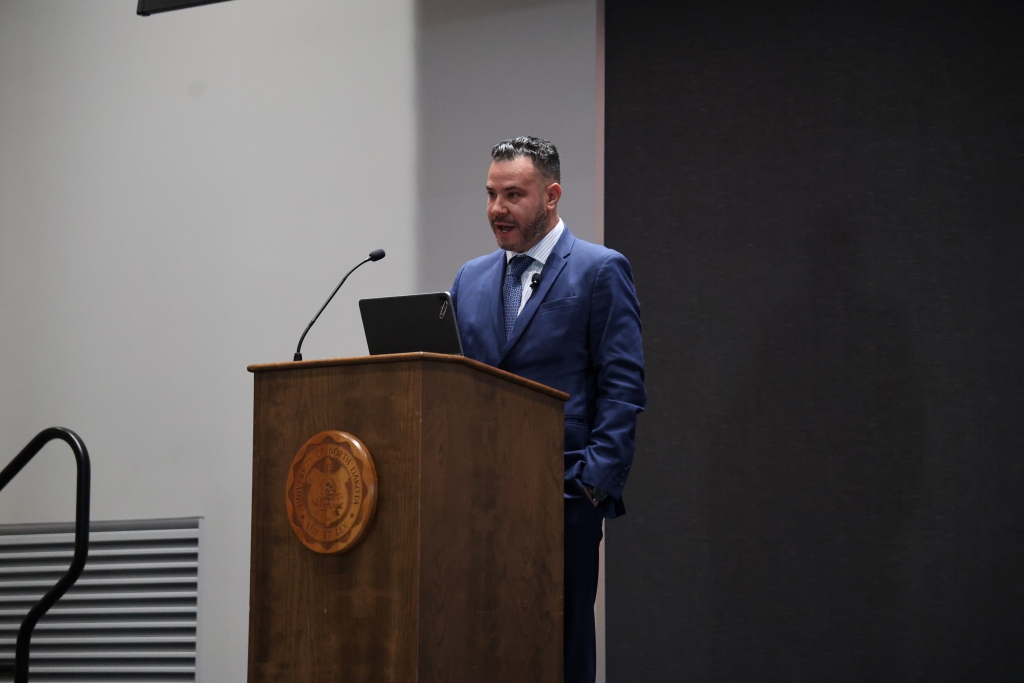
The conference’s opening keynote, delivered by Ray Cabrera, set the tone of inclusivity and student support. Cabrera, director of Upward Bound and Upward Bound Math and Science programs at the University of South Florida, was a first-generation college student. He reflected on his experience to emphasize the importance of offering mentorship and support systems for first-generation and marginalized students.
“You don’t know what you don’t know,” Cabrera said of the often overwhelming experience of being a college student. But a willingness to offer help can make a world of difference for students, he said.
“Many of our students have their guards up; they just want to make it through the day,” Cabrera said. “When you create a loving environment, that provides an environment for success because people now have their guard down.”
He continued this theme by instilling in the attendees that they are in the unique position to support students at an important time in their lives.
“That’s why the beauty of those relationships and opportunities to mentor students and make a difference in their lives is so critical,” he said. “Each and every one of you here represent that opportunity to change lives; in this room, in this institution, in this community.”
Cabrera emphasized that staff and faculty can bridge the gap in access to resources for students needing help, knowing where to turn when they need help. He said educators can equip students with the confidence and motivation to have successful academic careers.
Supporting multiculturalism in practice
A panel hosted by staff and students from the Hilyard Center showcased how Cabrera’s lessons are in practice at UND. During the discussion, they described their work to bridge gaps between students and the tools they need for success.
Stacey Barboa-Peterson, director of the Hilyard Center, said that this kind of work is becoming increasingly necessary due to the changing demographics of higher education.
“This fall, the populations of students of color and international students have increased, compared with the percentage of the white, non-Hispanic population. … That makes this conversation that much more important,” she said.
Barboa-Peterson and Shelby King, student support and engagement specialist at the Hilyard Center, gave an overview of the initiatives and programs they have implemented.
“Institutions will need to plan and implement a design that accounts for the whole student experience,” Barboa-Peterson said. “It impacts student success and develops a stronger sense of belonging when the institution cares for each student as a whole person.”
King explained that one of the ways the Hilyard Center has accomplished this is by engaging with students where they’re at and making a concerted effort to make inroads for academic success.
For example, comparatively few students who were referred for tutoring used to take advantage of the service, King recalled. “We wanted to bridge that gap between students and their available academic resources. We understood that there was this barrier of fear — of being judged or admitting they needed help — so we set out to remove that barrier.”
Their conversations inspired them to start the Breakfast Club, a biweekly, low-pressure study and tutoring session hosted at the Hilyard Center to encourage students to connect through learning. The sessions had a major impact on students’ academic success.
“That semester, we did witness significant growth in our students,” she said. “We tracked their GPAs, and we had one student who wasn’t going to class or doing their homework. They ended up going from a 0.0 GPA in the fall to a 3.5 GPA the next semester. We believe that the supportive environment we built created a safe space for these students and helped break down those barriers.”
Another hurdle the Hilyard Center’s staff wanted to help students overcome was their reluctance to use resources such as Career Services. Dani Schindele, career development coordinator for Career Services, was on the panel and described how partnering with the Hilyard Center improved students’ experience with her office.
The Hilyard Center staff’s willingness to walk with students to the Career Services office and offer encouragement significantly impacted students’ willingness to use their resources, Schindele said. From the Career Closet, which provides professional clothes to students free of charge, to the center’s assistance with building resumes and LinkedIn pages, the resources began to be used by students.
“Helping students with those kinds of things makes them feel more comfortable,” she said. “Understanding and flexibility are key. We know that students are busy, so if they have a job interview coming up but they need to be somewhere, we’ve walked with students to where they were going and reviewed interview questions on the way.”
The student panelists agreed, saying that the Hilyard Center’s efforts have been meaningful.
“I wish I was introduced to the Hilyard Center sooner,” student Ellie Lynch said. “I got to meet such amazing people who are kind, caring and very considerate of students. They make you feel valued and heard. It’s just been a very welcoming community to be a part of.”
Other highlights from the Multicultural Conference for Belonging and Inclusion
>> Bob Newman, professor of Biology, moderated a panel examining the importance of mutually respectful dialogues about tough topics on college campuses. Kirsten Dauphinais, professor at the UND School of Law, provided background on what is considered protected speech on college campuses and how it may differ from other spaces.
>> Brian Pappas, dean of the School of Law, was also on the panel and offered his perspective on why the conversation is vital to a university setting.
“My area of expertise is mediation, and so I’ve spent most of my career helping people to communicate and build better community and find commonality,” he said. “I’m a big believer that most conflicts come from assumptions about other people’s intent.”
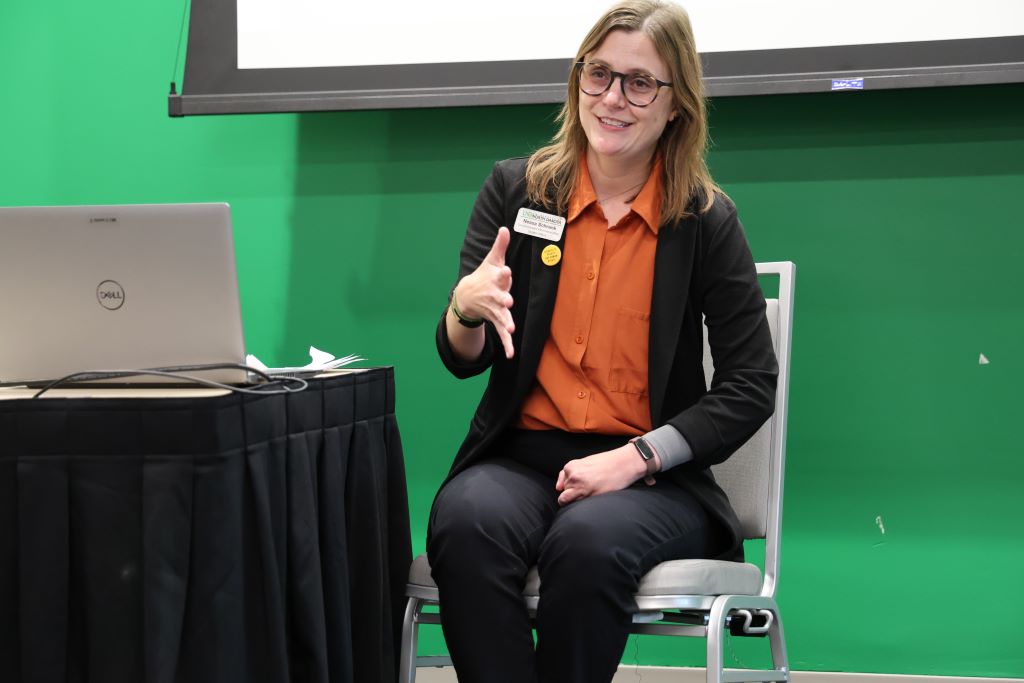
>> Nessa Schrank, executive assistant and administrative officer in the Office of Vice President for Student Affairs, delivered a keynote speech on cultivating an accessible campus for people with disabilities.
Schrank, who became a person with a disability halfway through her college career when she contracted Moyamoya disease, said that making an accessible campus requires collaboration and empathy for students. She added that self-advocacy has been one of the most important skills a person can learn.
“Self-advocacy is one of the most important things I learned along this journey,” she said. “You know yourself best, and if you can find the courage and the power to speak up for what you need, that’s going to be one of the most important things you can possibly do for yourself.”
>> Anne Kelsch, director of faculty development at the Teaching Transformation & Development Academy (TTaDA), and Anna Kinney, coordinator of the U Writing Program at TTaDA, hosted a panel addressing AI bias and how it can show up in classrooms.
They said AI often will revert to implicit biases due to the data used to train it. Careful consideration should be given to AI-generated content, but it also can be used effectively as a tool in the classroom. One example they gave was using AI to promote critical thinking by asking students to identify biases present in AI-generated material.