UND Aerospace unveils space camera, with just a touch of Klingon
The UND-designed International Space Station Agricultural Camera is now on display in Clifford Hall
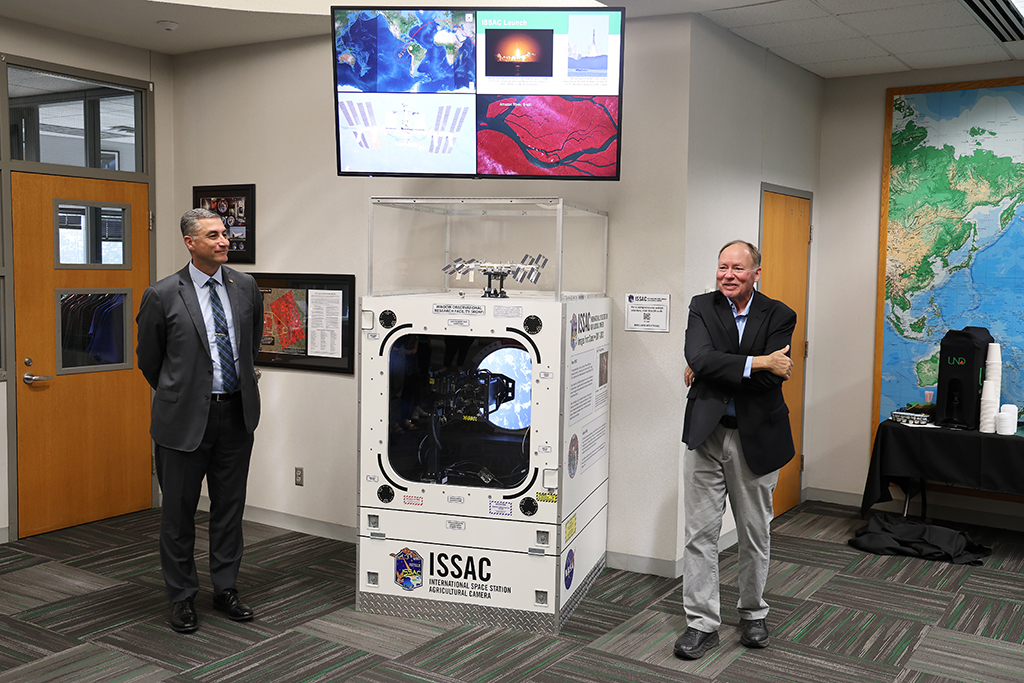
Through a live feed from the International Space Station, people walking past the North Dakota Space Grant Consortium on the second floor of Clifford Hall will be able to see the Earth the way an astronaut does: from space.
And once they look away from the monitor, the passersby might want to study the unique installation below it, as the display is yet another part of UND’s long history of working with NASA.
The installation, complete with a model of the International Space Station set atop it, is called ISSAC, or rather, the International Space Station Agricultural Camera. The camera was built by UND students and faculty members across multiple colleges, in a project supported by the NASA Office of Education. After ISSAC was launched to the ISS on Nov. 15, 2008, it actually was operated by UND students working from a small control center on campus.
ISSAC was unveiled at a ceremony in Clifford Hall on Thursday, Sept. 26. Robert Kraus, dean of the John D. Odegard School of Aerospace Sciences, kicked off the ceremony, which was attended by several UND faculty members along with Doug Olson, a retired Aerospace professor who worked on the project.
It turns out ISAAC, once it had been returned to campus from the International Space Station in 2013, had been sitting in storage until someone wondered, “Why not show it off?”
“I’ve been here a couple of years, and I’ve heard great stories about the ISS Agricultural Camera,” Kraus said. “Then we wondered ‘Where is it? Why don’t we have it on display?’ It’s been sitting in a closet in the Department of Earth System Science & Policy.
“So we said, ‘We need to showcase this.’ And what better place to do that than right here?”
It took a few months, but Olson, working in conjunction with faculty members, mounted ISSAC inside a housing meant to mimic what it looked like while aboard the ISS. People viewing the installation can read ISSAC’s history, printed on the outside of the housing.
According to Olson, ISAAC had a dual purpose: “One was to be an educational project for the students, and the other was to get rapid response imaging for agriculture in this region,” he said.
Prior to ISSAC, farmers could pay for images from a government-owned satellite called “Landsat,” but it could take only county-sized photos that took weeks to deliver. With ISSAC, farmers could get quality images of their fields in just a few days.
For Olson, the ISAAC project represents something bigger than being a student-led project that turned out useful data (both noble ideas). It’s about cross-campus collaboration, he said, as the ISAAC project likely helped pave the way for the collaborative nature that now permeates UND.
“We learned a lot about how aerospace here and engineering across campus and other organizations throughout the University can work together on a big collaborative project,” he said. “Those lessons learned are still put to use today on current and future projects that are going on, whether in unmanned aircraft systems or national defense. I think ISSAC helped lay the groundwork for some of the great things that are going on and will continue to go on.”
Visitors can stop by the installation and learn more about the project either by reading its housing or using a QR code posted there to take them to an informational website.
 Fans of the long-running TV franchise “Star Trek” also may have something to learn.
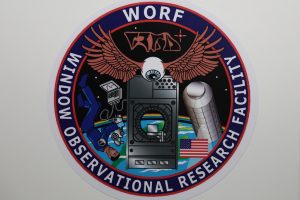
While aboard the International Space Station, ISAAC was mounted inside a special module, from which it did its job. That module was called a “WORF,” otherwise known as a “Window Observational Research Facility.” And as “Star Trek” fans know, Worf was a beloved Klingon character who served aboard the USS Enterprise in “Star Trek: The Next Generation.” He later went on to appear in “Star Trek Deep Space Nine.”
According to Olson, a NASA scientist involved in the project contacted the movie studio Paramount, which owns the rights to the “Star Trek” franchise, to request permission to use official Klingon font on the WORF housing on modules on the ISS, including ISSAC. The Paramount official refused to believe they were speaking to a NASA scientist. It wasn’t until a higher-up at NASA reached out that Paramount granted permission to use the font.
“Since 2011, there’s been a spacecraft circling this planet with Klingon font,” Olson said.
Along with Olson, UND faculty involved with the ISAAC project included George Seielstad, retired Benediktson professor of Astrophysics; Soizik Laguette, associate professor of Earth System Science & Policy; Richard Schultz, professor of Electrical Engineering; and William Semke, professor of Mechanical Engineering. In addition, more than 80 students across 11 departments at UND participated, as did dozens of employees at NASA.