Four keys to leadership, as told by (among others) Calvin & Hobbes
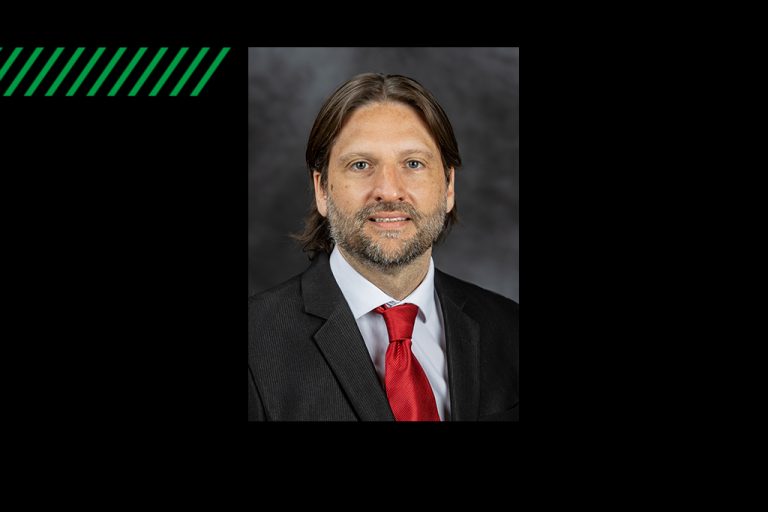
Chris Nelson, dean of the School of Graduate Studies at UND, draws on multiple sources for 18:83 Speaker Series talk

Editor’s note: A video of Chris Nelson’s 18:83 Speaker Series talk is available below.
****
By Madison Dame
Addressing a crowd of UND graduate students two years ago, Angie Freeman, a UND alum and high-level corporate executive, described four practices that are crucial to good leadership.
They are learning, changing, communicating and understanding people, she said.
But among her most avid listeners that day was not a grad student at all, but the graduate school’s dean.
That would be Chris Nelson, dean of the UND School of Graduate Studies. And last week, Nelson incorporated those points into a leadership talk of his own, delivering an 18:83 address while thanking and crediting Freeman for her ideas.
“I am going to frame this in the terms that she put forward to us, because I found them incredibly compelling,” Nelson said. “And that’s what’s going to happen to you as you go on your leadership journey.” Don’t hesitate to learn from others, especially about what works and what doesn’t work, he said.
The 18:83 Speaker Series derives its name from the founding of UND in 1883. Nelson delivered his own 18-minute, 83-second speech at the bottom of the Memorial Union’s Social Stairs on Oct. 27.
Not all about dinosaurs
Nelson explained “learning,” the first of Freeman’s four “power skills,” by referring to a “Calvin and Hobbes” comic strip. This strip showed how Calvin really liked learning, but his report card showed otherwise, so his dad asked him why he was not doing well. Calvin said he likes to learn about dinosaurs, but that is not what they read about in school.
Unfortunately, learning cannot only be about dinosaurs, or what is most interesting, Nelson said. But that’s no reason to turn your mind off.
“Learning agility to her and to me … is a mindset, and that mindset is about continuous learning,” Nelson said. In other words, be open to learning new things as they come about, and don’t ever imagine you know everything, no matter how high you are positioned in a workplace.
To introduce another power skill – change – Nelson brought out another “Calvin and Hobbes” comic strip. In this one, Calvin says that he thrives on change … that is, on making other people change.
Always remember to be open to change, just as you always should be open to learning, Nelson said. Count on it: Problems you cannot imagine today will rear up, and you will need to be adaptable in order to solve them.
Seek to understand
“It has to include understanding,” said Nelson. “You can’t just react.” And that’s vital, because understanding a problem is the best way to think creatively about solving it.
Nelson then brought up the third “power skill”: communication. This time, Calvin is getting yelled at by Susie, but he is not listening; and as she gets more riled up, he tunes out completely, imagining himself as a spaceman and her as a screeching alien.
In other words, he was not practicing listening, which is a big part of communication. Nelson stressed about how communication should be a dialogue, not a monologue. In leadership, people should follow you because they want to, they respect you and feel like they can express themselves and their ideas.
Communication stems a lot from self-awareness, you need to be able to admit your flaws and ask other people to help you with the areas that are weaker.
“It shouldn’t be about your authority,” Nelson said. “It should be about your ability to communicate your vision. … An authority figure does not need to be some sort of invincible person, in fact, what a lie to tell.”
The final “power skill” Nelson described was people. In the last comic strip, Calvin calls himself a natural leader, a proclamation Hobbes ignores. “The problem is that nobody wants to go where I lead them,” Calvin says after Hobbes has deserted and left him alone.
Empathy vs. sympathy
People are a big part of being a leader, and you need to create and foster relationships as part of the job. Teams are vital, but each team is made of individual people, all of whom are different and need different things.
You need to understand each person and how they should be treated to get the best “teamwork,” he said.
Empathy is a huge part of leading people because it allows you to understand their motivations, Nelson said. A really good way to learn empathy, according to a University of Toronto study, is to read fiction because it describes people’s motivations in detail.
“Empathy isn’t sympathy; empathy is about understanding,” said Nelson. “It’s about putting yourself in somebody else’s shoes, understanding where they’re coming from and, to the extent that you can, adapting yourself to that.”
Questions for each leadership ‘power skill’ from Dr. Chris Nelson
Learning Agility
- Are you committed to continuous learning?
- Can you take in new information and adapt it to your work and your approach?
- Can you prioritize growth, continuous improvement in yourself and in your team?
Change Agility
- Can you balance multiple factors and inputs and make decisions?
- Can you demonstrate creativity in problem-solving?
- Can you manage change when there is no road map?
- Can you manage your time and prioritize what is most important?
Communication Agility
- Can you be persuasive?
- Can you harness communication skills to enable collaboration and teamwork?
- Can you set a vision and get others on board?
- Can you communicate the impact of what you have learned, proposed, accomplished?
People Agility
- How well do you relate to others?
- Can you build and strengthen relationships?
- Can you understand the needs of others?
- Can you negotiate with competing interests?
- Can you work with people from a range of diverse backgrounds?
- Can you influence without resorting to authority?
“People are the job,” Nelson said. “That means relating to people, that means treating them as individuals, as people, as human beings in their own right, and then that may also mean adapting yourself to others as a way to be successful.”
View upcoming speakers and watch past speeches on the 18:83 Speaker Series webpage.

About the author:
Madison Dame is a Communications and Journalism major at UND. After graduation, she hopes to pursue a career as a journalist.