Space Operations Summit highlights UND’s expanding role in space and national security
NASA, Space Force and industry leaders gather at UND to discuss advances in space technology, national security and workforce development.
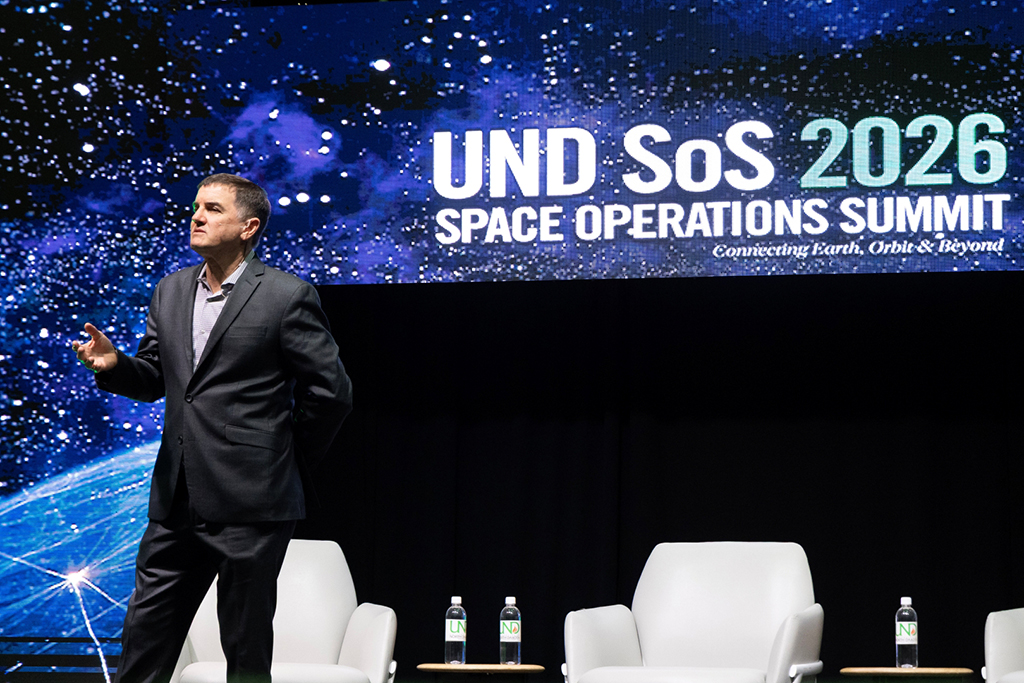
For two days, conversations about the future of space operations unfolded inside UND’s Memorial Union. Astronauts, military leaders, researchers and aerospace executives discussed everything from satellite communications and hypersonic technology to lunar exploration.
A common theme ran through nearly every discussion: the University of North Dakota is becoming an increasingly important contributor to those efforts.
The third annual Space Operations Summit, held Nov. 4-5, brought together representatives from NASA, the U.S. Space Force, defense organizations, industry and higher education. Through presentations, panel discussions and facility tours, attendees got a firsthand look at the research and partnerships helping position UND within a rapidly evolving space sector.
In opening remarks, UND President Andrew Armacost pointed to the University’s growing work in areas ranging from satellite communications to space situational awareness and advanced materials.
“Expect the unexpected, because there’s discovery, there’s a sense of wonder around every corner,” Armacost said. “And our work on not just space flight, but how we communicate — laser communications with satellites, space situational awareness, nanomaterials — this is all part of how we contribute to spacefaring exploration.”
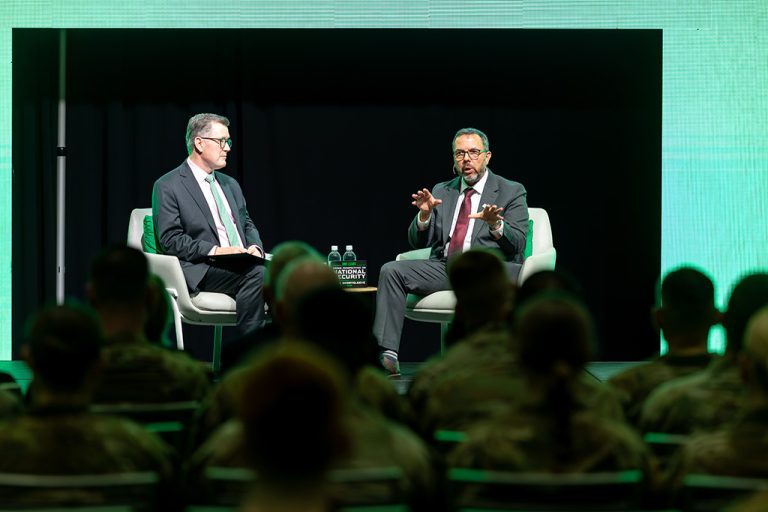
That momentum was echoed during an opening-day fireside chat between U.S. Sen. Kevin Cramer and Brad Clevenger, president of National Security for Rocket Lab.
Clevenger described Grand Forks as a community where the pieces needed for a thriving space economy are increasingly coming together. He pointed to UND’s research enterprise, the presence of the Space Development Agency and Grand Forks Air Force Base, and a growing commercial space industry.
“I see the right things happening, including this conference, where all those elements, commercial industry, government, academia are represented,” Clevenger said.
Giving students a role in real-world missions
A panel focused on UND’s national security research highlighted projects that place students alongside faculty working on emerging technologies.
Among them is UND’s optical ground station, which uses laser-based communications to exchange data with spacecraft. Markus Allgaier, assistant professor of physics, said the facility gives students opportunities rarely found elsewhere in higher education.
“As far as I know, there is no university that has a ground station like that,” Allgaier said. “So there’s no other place that can get students access hands-on to something like that.”
Students are also operating spacecraft already in orbit.
Graduate student Jacob Stanley and associate professor of space studies Ron Fevig discussed UND’s ROADS satellite mission, which allows students to send commands to satellites and receive data from space.
“Not many students can claim that they came away from college getting to talk to real satellites,” Stanley said.
The panel also highlighted a workforce development initiative involving UND, Parsons and Mobius LLC that aims to integrate simulated space operations into coursework and support development of a future space operations certificate.
For Clevenger, those kinds of experiences are essential.
“I think one of our workforce development priorities across this industry needs to be bringing the operational need closer to the talent development,” he said.
Researching the next frontier
The summit’s second day turned to hypersonics, where UND researchers are combining expertise from mechanical engineering, atmospheric sciences and space studies to tackle challenges associated with high-speed flight.
Faculty members Hallie Chelmo, Carson Running and Marcos Fernandez-Tous described an interdisciplinary approach that gives students opportunities to contribute to research with direct applications in aerospace and defense.
The topic also surfaced during Clevenger’s discussion of Rocket Lab’s efforts to reduce the cost of hypersonic testing and accelerate technology development.
Together, the conversations demonstrated how universities and industry are addressing many of the same technical challenges from different perspectives.
Partnerships beyond campus
Collaboration remained a recurring theme throughout the summit.
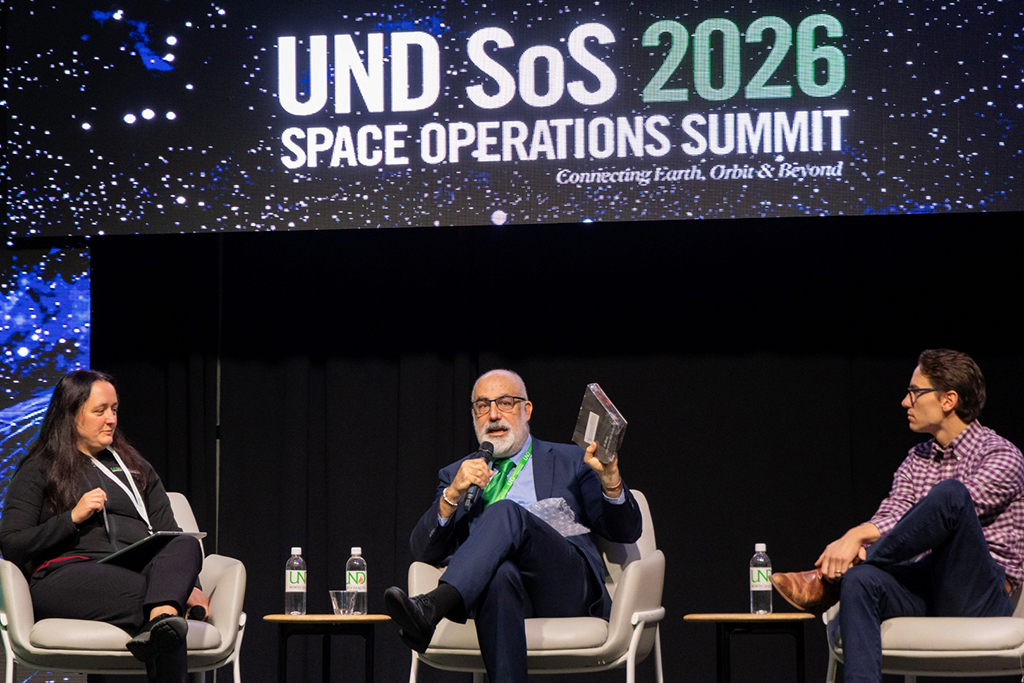
During a fireside chat with Robert Kraus, dean of UND’s John D. Odegard School of Aerospace Sciences, Voyager Technologies executive vice president John Vargas discussed the importance of investing ahead of industry demand.
“We look at University of North Dakota and we saw a kindred spirit,” Vargas said.
He pointed to UND’s neutral buoyancy laboratory as an example of the University’s willingness to develop capabilities that support future opportunities in human spaceflight.
The summit also produced a new partnership when UND and Vorbeck Materials signed a memorandum of understanding to explore collaboration in advanced materials, aerospace, unmanned systems and defense-related research.
Looking toward the moon and beyond
While national security was a major focus of the summit, attendees also heard about the next chapter of human space exploration.
Former NASA astronaut Rex Walheim shared stories from his three space shuttle missions and work helping assemble the International Space Station. Now serving as a crew integration adviser for Blue Origin, Walheim reflected on the challenges of working in orbit and the future of lunar exploration through NASA’s Artemis program.
Walheim also noted a North Dakota connection, recalling an earlier military assignment at Cavalier Air Force Station, now operated by the U.S. Space Force.
Additional sessions explored topics including space medicine, commercial space stations and the Orion spacecraft, while students had an opportunity to meet Walheim during a special lunch and question-and-answer session.
A place where space happens
The summit concluded with tours of UND’s National Security Corridor and optical ground station, giving visitors a closer look at facilities supporting the University’s growing research efforts.
Across presentations and conversations, speakers returned to a similar conclusion: the future of space operations will depend on organizations that can connect research, technology and talent.
For UND, that means more than studying the future of space. It means helping build it.
Mark Askelson, UND associate vice president for national security research, captured that mindset during the University’s national security panel.
“Do you want to wonder about space or do you want to go do it?” he asked. “And I think the doing is a lot more fun.”