Why UND should take the lead in radon research
Radon poses an especially high risk in North Dakota, making UND a natural home for potentially lifesaving research, professor says
By Vanessa Washington and Tom Dennis
In crisis, Albert Einstein is credited with saying, there is always opportunity. And when it comes to the crisis of radon in North Dakota, a UND professor believes the same may be true.
For while many North Dakotans face a serious risk from radon — two out of three homes in the state have elevated levels of the cancer-causing gas, one of the highest percentages in the United State — UND potentially could help not only those residents but also millions of other Americans by leading the way in radon assessment, communication and research.
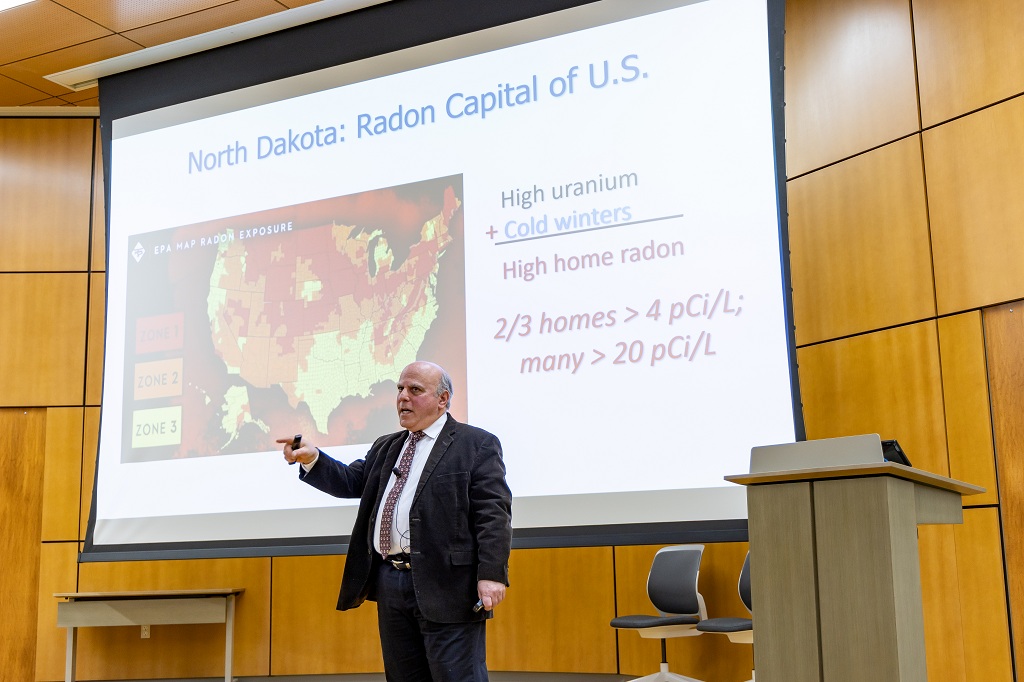
“There is work to do — a lot of work to do,” said Gary Schwartz, professor and chair of the Department of Population Health at the UND School of Medicine & Health Sciences, in a Dec. 3 lecture to students on radon.
“Here’s the biggest take-home message that I want to tell you,” Schwartz said to the assembled students. “If you’re looking for something to work on that makes a difference in the lives of North Dakotans, radon is it.”
For example, very few people know about radon, though the gas kills 21,000 Americans a year from lung cancer. That’s more than the number who die in drunk driving accidents, Schwartz said.
So, it’s a communication problem. There also are policy problems — how should state and federal agencies address radon risks? And engineering problems — what are the most cost-effective ways of blocking or removing radon gas from a home?
And geology problems, and biology problems. …
All told, and considering North Dakota’s unenviable status as the state that faces the highest risk, “it’s a huge opportunity for UND to lead the nation in radon research,” Schwartz said.
What is radon?
Let’s start with some background, Schwartz said in his lecture. Radon is a gas that comes from underground; it is invisible, it is tasteless and it is odorless.
And it is an invisible threat because radon is produced by the natural decay of uranium and other radioactive elements in rocks and soil.
The problem arises when radon, under pressure, enters a home or business through a sump-pump hole or cracks in the building’s foundation.
That’s when people breathe it in, thus exposing them to radon’s radioactivity. Like a Fourth of July sparkler creating a shower of sparks, radon releases energy that damages the DNA in cells in the lungs and respiratory tract, and can cause cancer.
The net effect makes radon the second-largest cause of lung cancer — smoking being the first. The radioactive gas causes 21,000 deaths per year. Again, that’s more than the number who die in drunk driving accidents, and it is about the same as the number of people who die from homicides involving handguns.
In contrast to those other threats, though, radon — as mentioned — is invisible, tasteless and odorless. And it’s very hard to motivate people against invisible threats, Schwartz said.
Radon in North Dakota
But radon is a threat that North Dakotans should pay special attention to, because the entire state is a radon hot spot. For one thing, geologic forces such as glaciation have brought radioactive elements such as uranium closer to the surface here than in other parts of the United States.
For another, warm houses tend to draw more radon-containing gas out of the cold ground; and in North Dakota, that gas tends to stay indoors, because homes and other buildings in the state are so well-insulated.
Nor does it help that people also stay indoors more during North Dakota winters, Schwartz said.
The net result is the following: “The average radon level in homes in the U.S. is about 1.3 picocuries per liter,” he said.
“The average in Grand Forks is 11.7 picocuries per liter, so it is nine times the average radon level in the U.S.”
Which means, “for all intents and purposes, Grand Forks is the most radioactive city in the United States.”
That matters, as can be seen when the risk of radon is compared to that of smoking cigarettes. To visualize this, “all you need to do is multiply the radon levels in picocuries by two,” Schwartz said.
In other words, living in a home where radon is at the U.S. average of 1.3 picocuries per liter is the risk equivalent of smoking about 2½ cigarettes a day.
Meanwhile, in Grand Forks, living in a house with the residential average of 11.7 picocuries per liter roughly equals the risk of smoking more than 22 cigarettes per day. And some 15 percent of homes in Grand Forks boast radon levels of 20 picocuries per liter or more, Schwartz said.
Those residents face a hidden risk that’s akin to smoking 40-plus cigarettes per day.
Speaking of smoking, “there is an enormous synergy between smoking and radon,” he said. “It’s one of the largest such synergies in the literature.”
Smoking cigarettes can increase the risk of radon exposure 10 times, Schwartz said. So, among smokers who live in houses with radon levels of 20 picocuries per liter, fully 25 percent could develop lung cancer.
Add to the above the fact that radon exposure also has been linked to cardiovascular disease and chronic obstructive pulmonary disease — along with cancer, the Big Three major causes of death in the United States — and yes, you can see that North Dakota has a serious problem with radon, Schwartz said.
UND responds
UND is taking action.
Trying to bridge the communications gap is one of the biggest challenges, Schwartz said. After all, “it is very, very hard to persuade people to test for an invisible hazard with a long latency,” he said. “I often say it’s like trying to teach your 9-year-old to start saving for retirement. There are concepts that they just don’t get: Save now? And what exactly is retirement?”
So, Schwartz and Soojung Kim, associate professor and chair of the Department of Communication at UND, have tested how efficient phone apps are at delivering information about radon to various groups. (The answer is “very,” at least when it comes to persuading people to order free home test kits for radon; but less so, when it comes to getting people to actually follow through and use the tests.)
They’ve set up free programs at the Grand Forks and Fargo public libraries through which customers can check out digital, reusable radon detectors for use in the home.
And in an especially successful program, they’ve helped make the ND Quits Tobacco quit line the first in the nation to also offer free radon testing in addition to tobacco cessation services.
Quit line callers not only ordered the testing kits at high rates, but they also proved especially motivated at returning them. This showed that “quit lines are an incredibly cost-effective way to target the group at highest risk for lung cancer and give them something that they might be able to use to take appropriate steps,” Schwartz said.
“What we’ve learned so far is that there’s no one key to unlock the problem of radon testing, and this is why radon testing — although it sounds like an easy thing to do — really is not,” Schwartz said.
But all things are possible when motivated, at-risk people are on the case, and that’s already happening — and should be encouraged to happen — across UND. After all, “radon is an incredibly important carcinogen that also causes, among other conditions, stroke,” Schwartz said.
“We have more of it in North Dakota than anywhere else. That means it’s a huge opportunity for UND to lead the nation in radon research.”
Schwartz’s lecture was part of the TRANSCEND or Translational Science Engaging North Dakota program. The program is a federally funded effort to bring together researchers and clinicians from across the region to develop innovative ways of combating disease and other health issues in North Dakota.
About the authors:
Vanessa Washington is a freshman at UND and an intern for UND Communications and UND Today. Tom Dennis is UND’s associate director of Communications and editor of UND Today.