Early Career Scholars Program grows across campus
Program’s momentum is building, as UND faculty advance careers while delivering returns on state investment
Editor’s note: In the UND LEADS Strategic Plan, the Discovery core value calls on UND to “strengthen service units that support creativity, research and innovation in all stages, from program development to promotion and beyond.”
With that in mind, this story — which was originally published in UND Today on Jan. 14 — describes the Early Career Scholars Program, a campuswide service unit that’s set up expressly to support creativity, research and innovation.
****
Growth was on the mind of Scott Snyder, vice president of Research & Economic Development, as he addressed a room full of UND faculty members, some new to the University and some long serving, on Dec. 11, in the Memorial Union Ballroom. Growth, specifically, in the Early Career Scholars Program, now entering its third year.
The program pairs new faculty members with mentors to create cross-collegiate research projects, as a means to help establish the new scholars in their research careers.
And Snyder had reasons to be pleased on Wednesday — reasons that came in multiples of two. The first cohort in 2023 was made up of four research groups, the 2024 group was comprised of six teams and next year’s cohort will be made up of eight research groups.
“It’s really exciting to welcome and celebrate the achievements and contributions of our early career scholars here at UND, and what I think is really cool about this program is its growth,” Snyder said.
The notion of growth also extended to external funding for faculty research related to the program. The three research cohorts were funded to the tune of $523,000 by the Economic Diversification Research Fund, which was appropriated by the Legislature in 2023, Snyder said. The first two cohorts received about $300,000 in funding, which, in turn, generated $1.1 million in external funding that will usher those projects through to completion.
Snyder said he’d be pleased to talk about that growth with state lawmakers, because it shows “a really good return on investment.”
He also gave a shout-out to several people, including John Mihelich, former interim vice president of Research & Economic Development, Michael Mann and Thomasine Heitkamp, both research developers in the VPRED office, and Justin Berg, a faculty fellow in the VPRED office. The scholars were all instrumental in developing and supporting the program, Snyder said.
Snyder also made sure to thank the mentors — the long-established faculty members who assist the research groups. At that point, all past, present and upcoming mentors stood to receive a round of applause.
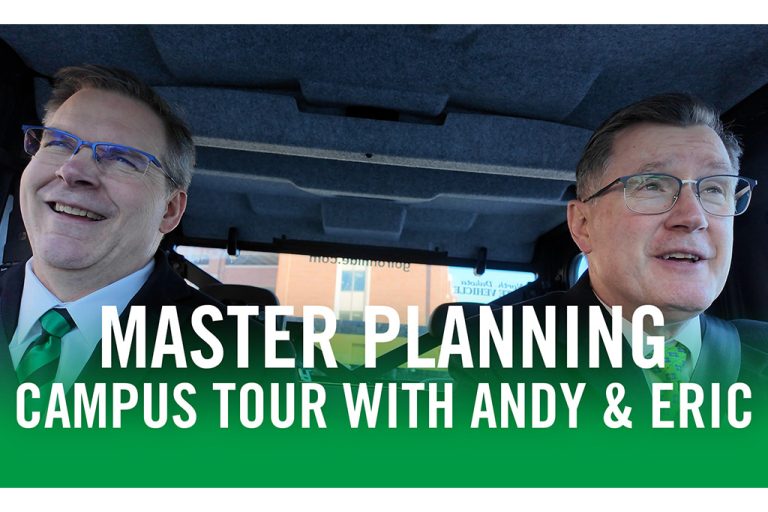
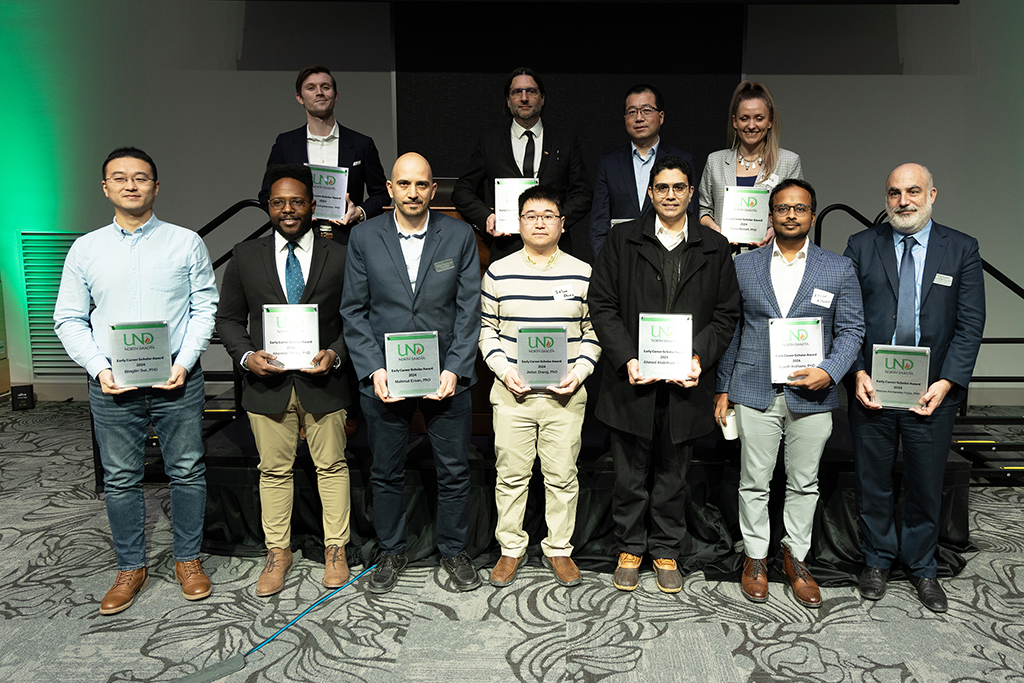
Fifteen faculty members (who made up the six research teams in the most recent cohort) received ceremonial plaques from President Andy Armacost and Provost Eric Link, toward the end of the event. The administrators’ presence at the event generated excitement as they (literally) ran to the stage.
Once there, Link said he knew he wanted to live a life of discovery when he was an elementary school student studying the solar system. He did the math and discovered the amount of time it takes for light from the sun to reach Earth (a bit over eight minutes). Then he asked everyone to remember that similar moment in their own lives.
Playing along in that thought experiment, Armacost recalled how he, at a similar age, had to do a demonstration of how lunar eclipses worked. This he did by suspending a ping-pong ball and a larger ball, then shining a flashlight on them to demonstrate the umbra (the dark shadow of an eclipse) and the penumbra (the part of a shadow in which only some light is blocked, and which, in an eclipse, gets larger with distance from the sun).
Armacost immediately found humor in his childhood celestial discovery.
“The odd part of this is today I was sitting in a meeting, the sun was coming through the window, and somebody said ‘the sun is awfully bright,’ and I said ‘oh, that’s okay, I’m sitting in the penumbra. Allow me to slide over to the umbra and get a little more coverage,’” he said. They looked at me cross eyed and said, ‘What’s wrong with this guy?’”
The comment set the stage for the happy memories to come, as each faculty member came to the stage to receive his or her plaque and take a photo with the president and provost.
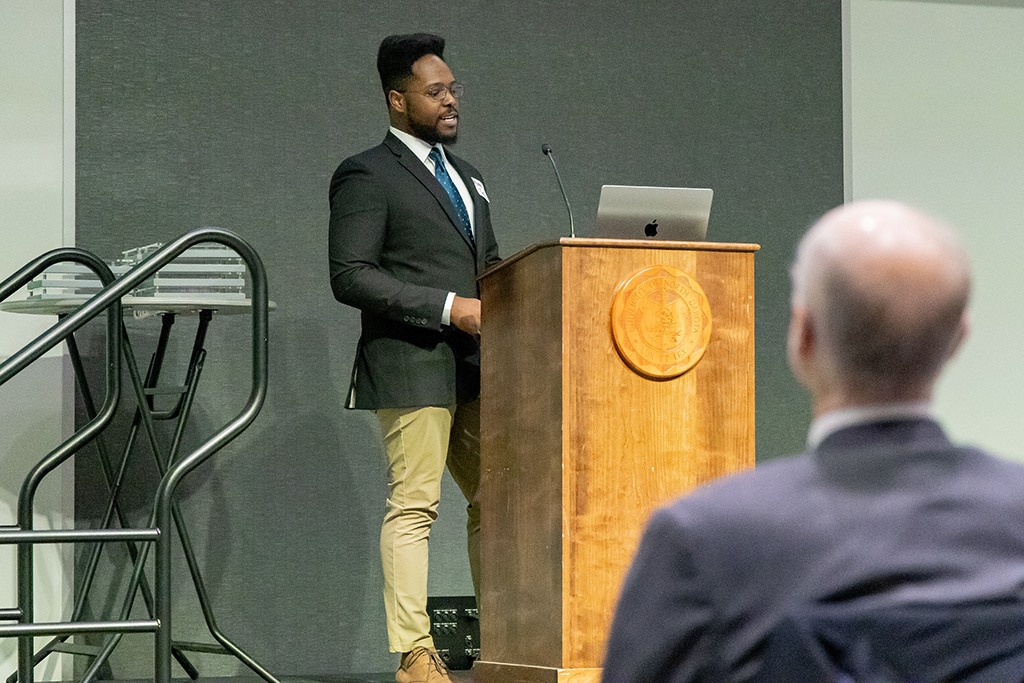
In addition, researchers spoke about their projects.
One of the scholars was Akorede Teriba, assistant professor of Counseling Psychology, who spoke about a mental health initiative he is working on for athletes. Teriba is working on the project with Radomir Ray Mitic, assistant professor of Higher Education, under the tutelage of Rachel L. Navarro, training director and professor of Counseling Psychology. Several students are also involved in the program.
Student athletes face different pressures beyond what other students feel, Teriba told the audience. They need to put in more hours for practice, while making time to care for themselves mentally and physically, on top of having to manage their academic lives at UND.
His project, he said, is meant to understand the presence of psychological fortitude among student athletes. His team also has the goal of moving beyond that understanding and working to increase fortitude. To do this, the team is developing a set of intervention questions student athletes can ask of one another, in a comfortable and private way, to better understand how to overcome difficulties and remain passionate about their sport.
The benefits of the program, he said, are quite clear:
“It’s the difference between increased depression and anxiety versus decreased depression,” he said. The process should lead to better academic and athletic performance while allowing students to “engage with their friends more and be happier.”
Teriba said he wants to roll out his program across UND Athletics, while also approaching the National Collegiate Athletic Association to make the sports governing body aware of it. He also said he would like to expand his research through the National Institutes of Health, so more coaches can understand the nature of psychological fortitude as a way to support their athletes.
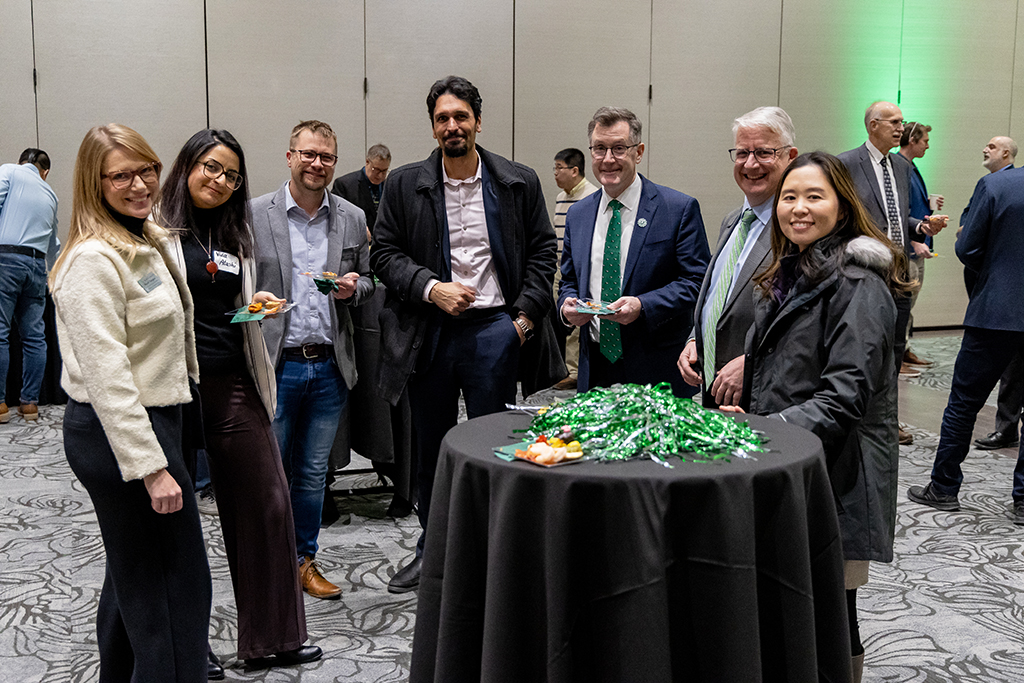
The full 2024 ECSP cohort includes:
- “Learning Molecular Electronic Structure Using Physics-Informed Neural Networks”: Principal Investigator Ayush Asthana, assistant professor of Chemistry; Co-Principal Investigator Ahmed Abdelhadi, assistant professor at the School of Electrical Engineering & Computer Science; Senior Mentor Mark Hoffmann, professor of Chemistry and associate dean at the School of Arts & Sciences.
- “Geopolitical and Geo-Economics Implications on Recent Advances in Space Propulsion and Hypersonic Technologies”: Principal Investigator Francisco Del Canto Viterale, assistant professor of Space Studies; Co-Principal Investigator Marcos Fernandez-Tous, assistant professor of Space Studies; Co-Principal Investigator Chonglin Zhang, assistant professor of Mechanical Engineering; Co-Principal Investigator Brian Urlacher, professor and department chair at the Department of Political Science & Public Administration; Senior Mentor Pablo de Leon, professor and department chair at the Department of Space Studies.
- “Efficient Removal of Perfluorooctanoic Acid (PFOA) Using Magnetic Biomass-Derived Carbon Quantum Dots in Water Treatment”: Principal Investigator Mahmut S. Ersan, assistant professor of Civil Engineering; Co-Principal Investigator Mariia Goriacheva, assistant professor of Chemical Engineering; Senior Mentor Alena Kubatova, professor and department chair at the Department of Chemistry.
- “AI-Driven Advanced Nanomaterials Discovery for Biomedical Applications”: Principal Investigator Binglin Sui, assistant professor of Chemistry; Co-Principal Investigator Jielun Zhang, assistant professor at the School of Electrical Engineering & Computer Science; Senior Mentor Julia Zhao, professor of chemistry.
- “Athletic Mental Wellness: Promoting College Student-Athlete Mental Health and Well-Being”: Principal Investigator Akorede Teriba, assistant professor of Counseling Psychology; Co-Principal Investigator Radomir Ray Mitic, assistant professor of Higher Education; Senior Mentor Rachel L. Navarro, training director and professor of Counseling Psychology.
- “Development of Advanced Propulsion and Orbit Management Technologies for the Deployment and Operation of Constellation of Low Earth Orbit Satellites”: Principal Investigator Chonglin Zhang, assistant professor of Mechanical Engineering; Co-Principal Investigator Hallie Chelmo; Co-Principal Investigator Bryce Christopherson, assistant professor of Mathematics; Co-Principal Investigator Fernandez-Tous; Senior Mentor Gautham Krishnamoorthy, professor of Chemical Engineering.
The incoming ECSP cohort is made up of:
- Mark Kaemingk, assistant professor of Biology, and Sattar Dorafshan, assistant professor of Civil Engineering (with Senior Mentor Taufique Mahmood, associate professor of Geology & Geological Engineering.
- Jesse Caviasca, research engineer, Maria Morrell, and Johannes van der Watt, research assistant professor (with Senior Mentor Daniel Laudal, executive director of the College of Engineering & Mines Research Institute).
- Sherif Gaweesh, assistant professor of Civil Engineering, and Ahmed Abdelhadi, assistant professor in the School of Electrical Engineering & Computer Sciences (with Senior Mentor Daba Gedafa, chair and professor of Civil Engineering).
- Carson Running, assistant professor of Mechanical Engineering, and Binglin Sui, assistant professor of Chemistry (with Senior Mentor Clement Tang, chair and associate professor of Mechanical Engineering).
- Sicong Shao, assistant professor in the School of Electrical Engineering & Computer Sciences, Tingjun Lei, assistant professor in the School of Electrical Engineering & Computer Sciences, and Chonglin Zhang, assistant professor of Mechanical Engineering (with Senior Mentor Prakash Ranganathan, director for Cyber Security Research).
- Johannes van der Watt and Tarek Elderini, instructor in the School of Electrical lEngineering & Computer Sciences (with Senior Mentor Clement Tang, chair of Mechanical Engineering, and Derek Sporbert, director of TRIO Programs).
- Xudong Yu, assistant professor of Communication and Jielun Zhang, assistant professor in the School of Electrical Engineering & Computer Sciences (with Senior Mentor Naima Kaabouch, director of the Artificial Intelligence Research Center (AIR).
- Daile Zhang, assistant professor of Atmospheric Sciences and Shawn Wagner, researcher in Atmospheric Science, (with Senior Mentor David Delene, research professor in Atmospheric Sciences)
****
>> QUESTIONS OR COMMENTS about the UND LEADS Strategic Plan? Your thoughts are welcome! Please contact Mike Wozniak, coordinator of Leadership & Programming, and/or Ryan Zerr, associate vice president for Strategy & Implementation, the co-chairs of the UND LEADS Implementation Committee.
You also may offer your thoughts by visiting the UND LEADS Strategic Plan home page and clicking on the “Provide your feedback” link that you’ll find there.
Thank you for your support of the UND LEADS Strategic Plan!