Roundtable event highlights research in national security
Aided by North Dakota Legislature, UND’s national-security research will boost state’s workforce, says UND VP
Editor’s note: In the UND LEADS Strategic Plan, the “Discovery” core value calls on UND to “infuse creative expression, critical inquiry, and innovation across the students’ learning journeys by supporting comprehensive curricular and co-curricular participation in research.”
This story, which UND Today first published on Jan. 21, describes an event in which UND researchers talked with each other about their National Security-related projects. The explicit goal of the presentations was to encourage interdepartmental, cross-campus teamwork and “co-curricular participation in research,” in fulfillment of the Discovery objective mentioned above.
****
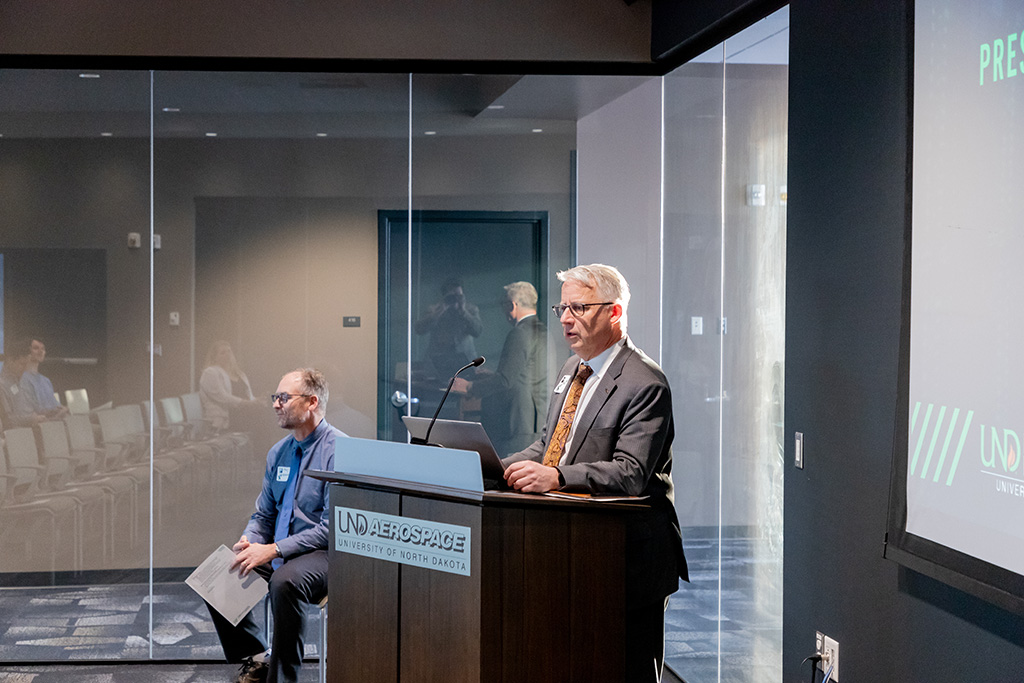
In December, UND faculty members, administrators and students gathered to showcase their research in fields vital to the University’s national security mission.
The event – held in Robin Hall – gave researchers the chance to present their projects and network with colleagues. Additionally, newly hired faculty members supporting national security were recognized.
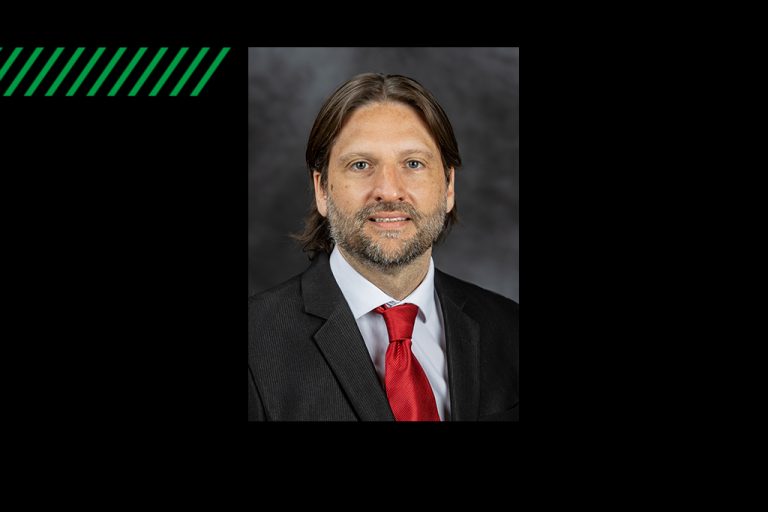
Scott Snyder, vice president for Research & Economic Development, welcomed attendees. Snyder — who is approaching one year on the job – has worked with several entities supporting national security throughout his career, including the U.S. Strategic Command and NASA.
“The fact that national security work was listed as a Grand Challenge is one of the reasons I’m here,” he said. “It’s of great interest to me – both personally and professionally.”
A total of 13 faculty members gave three-minute presentations of their research, covering topics ranging from augmented reality, hypersonics and operating counter unmanned aircraft systems in the Arctic.
Presenters at the Collaborative Approach to National Security Presentation & Networking Event
- Jeremiah Neubert: professor of mechanical engineering.
- Kaitlyn Gura: doctoral student at UND’s School of Medicine & Health Sciences. “Epigenetic Memory in Refractory Lyme Arthritis.”
- Tim Pasch: professor of communications. “Defense Resiliency Platform Against Extreme Cold Weather.”
- Surojit Gupta: professor of mechanical engineering.
- Chris Theisen: executive director of UND’s Research Institute for Autonomous Systems
- Mark Askelson: associate vice president for research-national security
- Hallie Chelmo: assistant professor of mechanical engineering. “Investigating the Formation of Ice Crystal Aggregates.”
- Nuri Oncel and Deniz Cakir: professor of physics and astrophysics and director of UND’s nanofoundry, and associate professor of physics and astrophysics, respectively. “Epitaxial Growth of Vanadium Nitride.”
- David Delene: research professor of atmospheric sciences.
- Amy Whitney: director of UND’s Center for Innovation. “State of North Dakota Defense Supply Chain Analysis.”
- Brian Kalk: chief research officer at UND’s Energy and Environmental Research Center.
- Joe Vacek: professor of aviation. “Handheld Optical Inspection Systems for Real-Time Chemistry.”
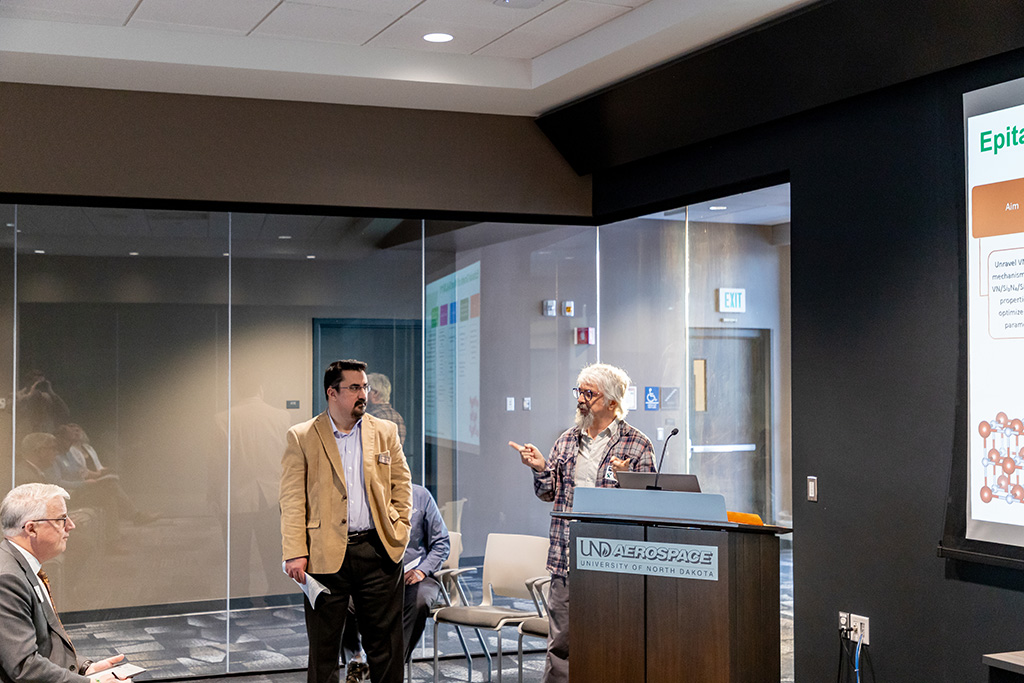
Whitney — who teamed up with 18 individuals from across the state to help conduct her research — said the University’s strength in national security has attracted industry partners that will boost the state’s workforce.
Adopting national security as a Grand Challenge “enabled us to think through question such as, ‘What should some of our strategy be? Where are our strengths and weaknesses in that space?’” she said. “We have a lot of assets in national security that we should be leveraging in new and different ways.”
Additionally, Whitney said, UND’s focus on national security has spurred an increase in cybersecurity education throughout the state. She cited a partnership with Impact Dakota – a Bismarck-based management consulting firm providing workforce training – that offers workshops in the discipline throughout North Dakota.
Askelson praised the patriotism of North Dakotans, and thanked alumni for their steadfast support of UND’s national security mission in recent years. These philanthropic contributions have established endowed professorships in national security and helped fund the construction of UND’s Mark and Claudia Thompson National Security Corridor.
“We are a very defense-friendly state, and our alumni have responded,” Askelson said.
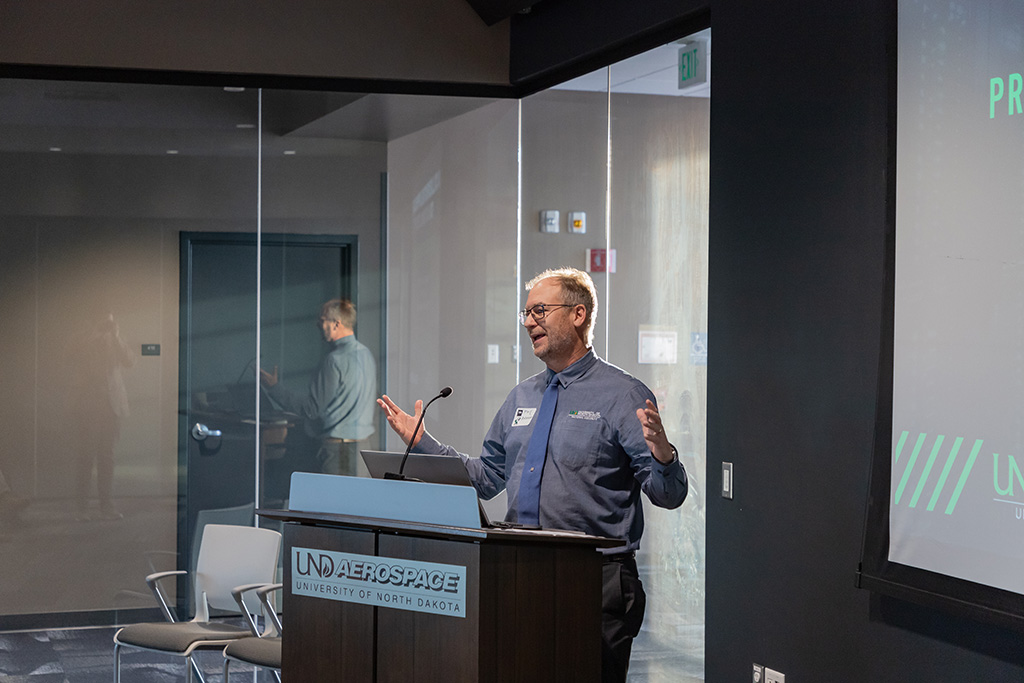
Events such as last month’s help show the North Dakota Legislature the results of the lawmakers’ support, Snyder said. The body has allocated $23 million in national security related funding over the past four years, he said. This has enabled UND to grow its Department of Defense and Department of Homeland Security research funded portfolio to over $50 million from fiscal years 2020-24, up from $8 million in 2015-19.
“These are the stories President Armacost and I will take to Bismarck,” Snyder said. “We are extremely fortunate for the state’s support.”
The Legislature’s investment, he added, has already bolstered research output in fields vital to national security – in particular, satellite testing and design.
“If you invest in UND, you will see a return in workforce development,” Snyder said. “Our students are qualified for important positions that will diversify our state’s economy.”
****
>> QUESTIONS OR COMMENTS about the UND LEADS Strategic Plan? Your thoughts are welcome! Please contact Mike Wozniak, coordinator of Leadership & Programming, and/or Ryan Zerr, associate vice president for Strategy & Implementation, the co-chairs of the UND LEADS Implementation Committee.
You also may offer your thoughts by visiting the UND LEADS Strategic Plan home page and clicking on the “Provide your feedback” link that you’ll find there.
Thank you for your support of the UND LEADS Strategic Plan!