These boots are made for walkin’ — on the moon
Kinesiology researchers tackle lunar-boot challenge, UND scholars write in The Conversation
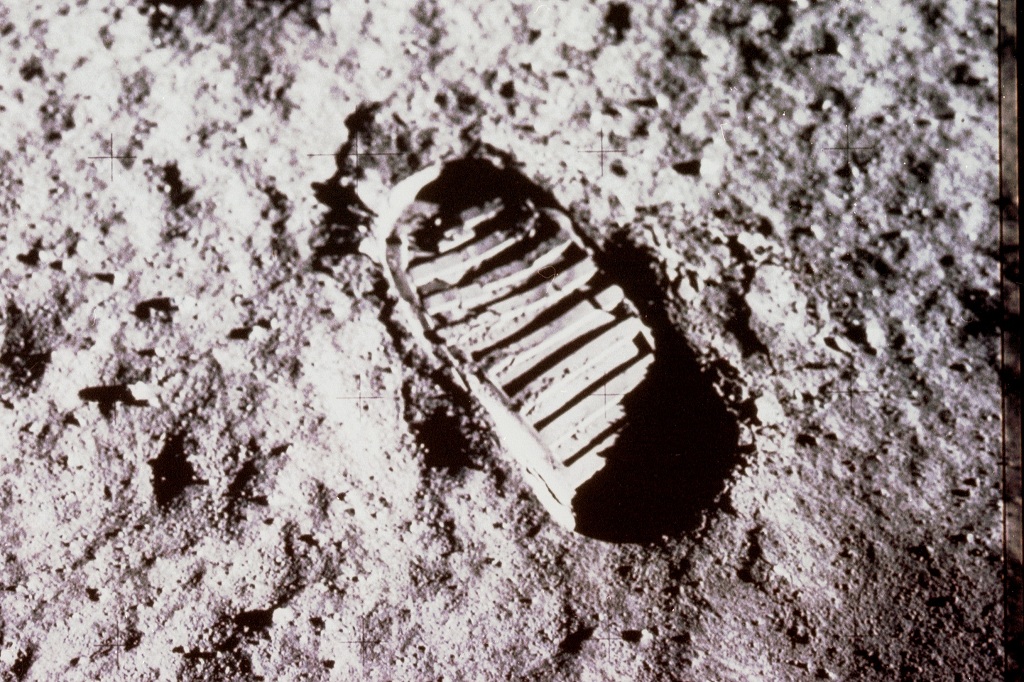
Aldrin, the second man to walk on the Moon, later helped lead the development of the Space Studies program at UND. NASA photo.
Editor’s note: On Jan. 20, The Conversation published an article co-authored by Jesse Rhoades, associate professor of Education, Health & Behavior Studies, and Rebecca Rhoades, researcher in Education, Health & Behavior Studies. The article describes the need for more durable boots worn by astronauts participating in NASA’s Artemis mission — America’s return to the moon.
The article is below and can be read in its original form on The Conversation’s website. As of Jan. 30, the article has been republished by 32 media outlets and read more than 20,000 times, including by readers in the United States, Australia, Canada, South Africa and Argentina, among other countries.
The Conversation is a nonprofit media resource that publishes “explanatory journalism” stories by university scholars and makes those stories available for free and immediate republication. A complete list of all articles authored by UND scholars can be found on The Conversation’s website.
UND faculty members and graduate students who’d like more information on writing for The Conversation are invited to read Introducing The Conversation, a story that appeared in UND Today in 2022. An additional story from last summer, “More than 340,000 readers worldwide,” noted that UND faculty members who’ve written for The Conversation report “outstanding” experiences and say they’d recommend without hesitation that their colleagues become Conversation authors.
Questions? Please contact Tom Dennis, UND associate director of communications, at tom.dennis@und.edu, or Adam Kurtz, UND strategic communication editor, at adam.kurtz.1@UND.edu. Thank you!
****
By Jesse Rhoades and Rebecca Rhoades
The U.S.’s return to the Moon with NASA’s Artemis program will not be a mere stroll in the park. Instead it will be a perilous journey to a lunar location representing one of the most extreme environments in the solar system.
For the Artemis program astronauts, walking on the Moon will require new ways of thinking, the latest technology and innovative approaches to improve boot and spacesuit design.
The Apollo program’s journeys to the Moon 50 years ago were all to the milder, equatorial regions of the lunar surface, where the coolest temperatures reached -9 degrees Fahrenheit (-23 degrees Celsius).
In contrast, the Artemis missions are designed to take astronauts to the Moon’s extreme polar regions, where temperatures can reach -369 degrees Fahrenheit (-223 degrees Celsius). Apollo-era equipment designed for short-term stays in a moderate zone will not be enough for extended stays in this new, more hostile region.
At the University of North Dakota we focus on biomechanics, the study of human movement. Our research explores the effects of extreme environments on human movement patterns and gait, and our lab conducts research that we hope will one day help astronauts explore the Moon while protecting their body.
New boots for the Moon
Of all the equipment astronauts need to explore the Moon, one of the most critical pieces is the boots they’ll use for extravehicular activity – when they step outside their spacecraft and bounce across the lunar landscape. These boots have to hold up to the harsh environmental conditions unique to the lunar south pole.
Since the lunar poles are much colder than other lunar regions, the boots will need to retain heat effectively. The current iteration of the lunar boot uses a rigid thermal plate, which is typically integrated into the sole of the boot. The plate is solid and does not bend or flex. These plates were not used during the earlier Apollo missions.
While it’s necessary to keep astronauts’ feet warm, this addition to the boot prevents the footwear from flexing. The stiff sole restricts the foot’s natural movement, specifically the joint at the big toe, called the the metatarsophalangeal, or MTP, joint. The MTP joint bends and flexes to facilitate normal walking and running gait patterns.
The windlass mechanism
As you walk, the MTP joint allows your big toe to extend forward. Extension of the big toe triggers a mechanism in the foot that converts the flexible landing foot to a ridged pushing foot when you’re about to push forward to step. This mechanism allows the foot to become rigid and support your body weight through your step. Kinesiologists call this mechanism the windlass mechanism.
The windlass mechanism isn’t well studied – particularly under lunar gravity. If this mechanism is vital for walking around on the Moon, it could be a problem that the boots keep an astronaut’s feet from bending.
There are a million little details that have to go right for a Moon mission to succeed – how much flex is in the sole of the boots explorers use is just one that could ultimately influence their health on the Moon.
While an astronaut should be fine over the short term – days or weeks – once astronauts are staying on the Moon for months, they could develop a foot injury that might affect other parts of the body.
Kinesiologists like to examine the human body as a kinetic chain. This is to say, if you hurt part of your lower body, your upper body takes on the load of many of its functions. An issue that begins in the foot may affect the way a person walks and stands, causing further injury up the kinetic chain, through compensatory mechanisms.
So, the kinetic chain describes how an injury in the lower body could cause chronic injury in several other joints further up the body.
As NASA works on sending astronauts back to the Moon, researchers will need to learn more about lunar gait to understand how the foot reacts while moving around under lunar gravity. What they learn will aid designers as they continue to perfect spacesuit designs.