UND’s Discovery of unprecedented technological capability
At UND, living out the ‘Discovery’ core value means leading the way in artificial intelligence, as it relates to law, librarianship and so much more, writers say
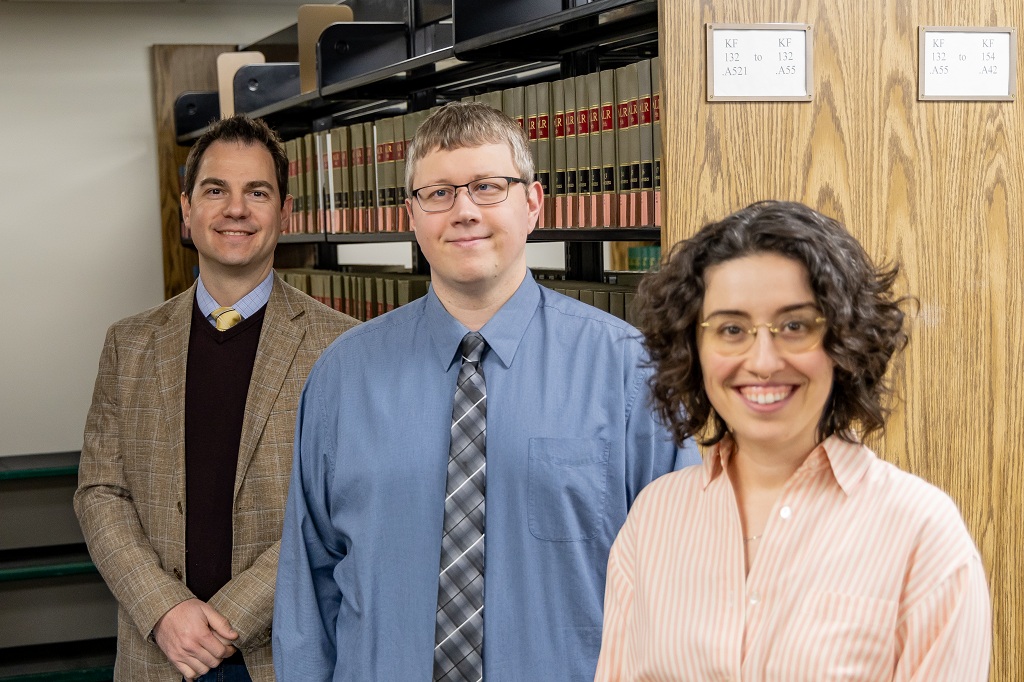
Editor’s note: The following letter, written by Nikola Datzov. associate professor in the School of Law; Devon Olson, research and education librarian with Library Resources at the School of Medicine & Health Sciences; and Kyle Foerster. graduate research assistant in Electrical Engineering, introduces a special edition of UND Today focused on the “Discovery” core value of the UND LEADS Strategic Plan.
As readers may know, UND Today is devoting a special issue on the last Tuesday of each month to the University’s progress on fulfilling the Strategic Plan. The issues consider the plan’s “LEADS” core values — Learning, Equity, Affinity, Discovery and Service — in succession; the issue of UND Today that gets published on Tuesday, Feb. 25, will be devoted to Service.
Comments or questions? Contact Tom Dennis, UND Today editor, at tom.dennis@UND.edu. Thank you for reading!
****
By Nikola Datzov, Kyle Foerster, and Devon Olson
Our Core Value of “Discovery” at UND is focused on “our spirit of inquiry and our desire to better understand the world around us.” There can be no question that recent developments in artificial intelligence (AI) have entirely changed “the world around us” and forced our spirit of inquiry to work overtime in thinking about novel issues across all disciplines.
AI has revolutionized the way we solve problems in a wide range of domains, offering innovative solutions to complex challenges. By processing vast amounts of data quickly and efficiently, AI can uncover patterns and insights that would be nearly impossible for humans to detect.
Thus, its capabilities allow researchers to address evolving challenges in global issues in countless ways.
UND has been at the forefront of innovative research and important national conversations in many disciplines. In this article, we highlight the work of three groups on campus that have served as important voices on AI: the School of Law, the Artificial Intelligence Research Center, and the School of Medicine & Health Sciences Library.
School of Law
Despite the flurry of recent AI scholarship, there exist countless underdeveloped and unanswered legal questions for how existing legal principles, rules and precedents will apply in the context of the AI Revolution. In the academic context, questions abound for how law schools will adapt to preparing law students for the new world that awaits them.
Faculty at the School of Law have been national thought leaders on many of these questions since the early days of AI’s collision with the law. For example, a recent article by Professor Datzov offers a glimpse into the broad AI expertise at UND Law, the many ways our faculty are engaging in AI research and scholarship, and the ways in which many law professors have adapted their curriculum to reflect the changing times.
For example, students begin learning about AI as early as the first week of law school and can now take the “AI & the Law” course (offered by Professor Datzov) to gain “AI literacy.” Beyond the classroom, UND law faculty have written on the role of IP in promoting AI innovation, the ethical obligations and considerations necessary for AI-ready attorneys, the impact of AI on legal writing, the use of AI chatbots and the need for “AI adaptation” in higher education.
In addition to offering their expertise for the North Dakota University System’s AI Forum and other efforts across the state and University of North Dakota, faculty members have served as AI experts at many conferences and panels across the world, including in North Dakota, South Dakota, Indiana, Texas, Missouri, Washington, Rome and Bari, Italy.

Artificial Intelligence Research Center
At the Artificial Intelligence Research Center, the mission is to drive the evolution of cutting-edge AI software and hardware systems, enhancing the human experience in meaningful ways. The center focuses on cultivating expertise and developing curricula to empower the next generation of AI researchers and engineers. The center equips them with the knowledge and skills to create AI solutions that are not only economically viable but also technologically resilient and ethically grounded.
Central to the center’s work is research and development aimed at creating innovative AI solutions that address critical research gaps and challenges. As a result, the center’s researchers and students have been involved in numerous projects funded by federal agencies such as the National Science Foundation, Department of Defense, FAA and NASA, often in collaboration with multiple universities.
Current efforts include two multi-million-dollar projects that aim to integrate predictive modeling with supercomputing for extreme cold-weather research, several projects related to countermeasures to prevent cyberattacks on aircraft, one project to investigate factors that impact drones wireless communication, one project to assess risks in drone-based power line inspections, and several projects that aim to develop AI models to detect diseases such as Alzheimer’s, depression and breast cancer.
School of Medicine & Health Sciences Library
Across campus at the SMHS, facilitating discovery, and thereby improving the health of the people of North Dakota is the core mission of Library Resources. In this work, the SMHS Library has undergone changes reflecting the seismic shifts rocking health care education in the last decade: the retirement of a generation, a shift from physical to electronic services and a reorientation towards interprofessional collaboration.
Happily, these experiences prepared the SMHS Library to respond to the eruption of AI into higher education.
The relocation of librarians into SMHS departmental offices in 2016 renewed integration of librarian research expertise directly into program curricula. As ChatGPT took over the news cycle in 2023, SMHS students were already completing librarian-facilitated coursework examining the impact of algorithms on scholarship.
Class discussions on research methodologies quickly expanded to interrogate the role of AI. Student research culminating in publication on the UND Scholarly Commons (1 million downloads and counting) is built on these expanded information/AI literacy competencies.
Outside the classroom, the Library met a shift in policy towards information accessibility (the Nelson Memo, The National Institutes of Health Data Management and Sharing Policy, and Americans with Disabilities Act Title II) with interprofessional collaboration: forming a workgroup for data management and joining the Campus Accessibility, SMHS AI, and UND Essential Studies Digital Literacy workgroups. The SMHS Library also created resources such as the AI resources guide, and participated in symposia exploring the role of AI literacy in healthcare education.
These changes are as exciting as they are disconcerting. As your colleagues, we are excited to collaborate with you in this expanding space of discovery.
About the authors:
At UND, Nikola Datzov is an associate professor in the School of Law, Devon Olson is a research and education librarian with Library Resources at the School of Medicine & Health Sciences and Kyle Foerster is a graduate research assistant in Electrical Engineering.
****
>> Questions or comments about the UND LEADS Strategic Plan? Your thoughts are welcome! Please contact Mike Wozniak, coordinator of Leadership & Programming, and/or Ryan Zerr, associate vice president for Strategy & Implementation, the co-chairs of the UND LEADS Implementation Committee. You also may offer your thoughts by visiting the UND LEADS Strategic Plan home page and clicking on the “Provide your feedback” link. Thank you for your support of the UND LEADS Strategic Plan!