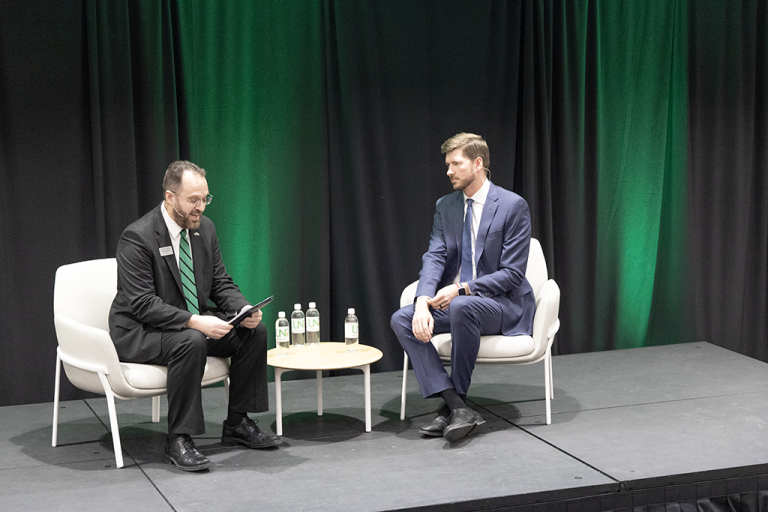
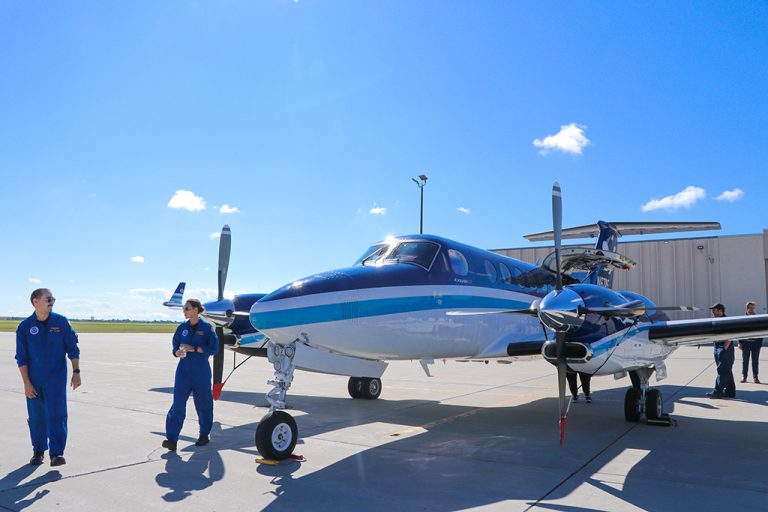
For second year in row, UND team makes FAA Data Challenge finals
Focus of this year’s team: Helping air traffic controllers better communicate with pilots

Working as an air traffic controller can be a demanding job, but a team of UND aviators is making use of artificial intelligence to develop a program that can help controllers better communicate with pilots — and improve safety.
Those efforts have led to the team being named a finalist in the 2024 Federal Aviation Administration Data Challenge. In March, the UND team will travel to Washington, where they will compete against the six other finalist universities for $100,000 in total prize money.
The Data Challenge competition, now in its second year (a UND team competed as a finalist last year as well), is a way for the FAA to listen to proposals that offer solutions to improving aviation safety and efficiency, by using advanced analytics, AI and machine learning programs. Ultimately, the idea is to give university students the chance to help the FAA as the national airspace system adapts to advances in computing and technology.
UND’s FAA DATA Challenge project
The FAA has defined a list of attitudes that pilots may exhibit when faced with stressful situations. These attitudes range from feeling overconfident about a situation (meaning a change in attitude to being more cautious is needed) to feeling helpless in a situation (meaning the pilot needs to be reminded that they are the difference maker in that situation).
Pilots, of course, work to identify and respond to those attitudes within themselves and thereby refocus on how they think about that stressful situation. On the ground, air traffic controllers also can recognize these attitudes, then work to help the pilot think differently about the situation.
The UND team is hoping to make that job easier for the controllers by developing an AI-powered solution to identify those attitudes. That means training a program (not dissimilar to a large language model, of which ChatGPT is a famous example) by exposing it to hours and hours of archival radio footage of communication between plane and tower.
“Our goal is to use radio transmissions to identify any sentences of their dialog that might exhibit those hazardous attitudes, and then, in real time, present that information to air traffic controllers so that they can better handle that aircraft and understand what might be influencing that pilot,” said Caroline Kelley, a member of the UND team and a certified flight instructor.

On the team with Kelley is Zachary Hoff, also a certified flight instructor (and who competed in the challenge last year), and online student Andie Akenson, who is studying for a master’s in Aviation.
Overseeing the team is Brandon Wild, associate professor of Aviation. Wild said he is particularly proud of the fact that UND’s team is made up entirely of aviators. Other schools are sending engineering or computer science teams to grapple with other issues facing the FAA, as the entity looks to evolve the national airspace into a place where machine learning plays a role.
That means the UND team needed to quickly become software engineers in their own right. They have one model that is learning from countless hours of aircraft/tower communication, a voice-to-text program which a controller can read, and another model that assigns a “weight” to certain statements to quickly identify what emotional attitude a pilot is displaying.
“I love to see that our students can become finalists in the Data Challenge without being engineers or computer scientists, but because of their aviation knowledge, and also their knowledge of how aviation data works,” Wild said. “And what I really like is this says a lot about our program and our students, that we’ve been named as finalists in the first two years the FAA has done this.”
Kelley said she is grateful for all the work air traffic controllers do at Grand Forks International Airport, as they help negotiate hundreds of UND aviation student flights on a daily basis. She also wants to ease some of the pressures they face.
“Any way that we can help them do their job more effectively or better, or just even lighten their workload is huge,” she said.
The 2024 FAA Data Challenge began in February last year, with different rounds of project submissions and judging. The finalist showcase is in late March, when students from all the teams travel to Washington to present their final pitches to the FAA.