Three Minute Thesis competition distills complex research
UND graduate students use fast, fun, jargon-free presentations to describe highly technical work
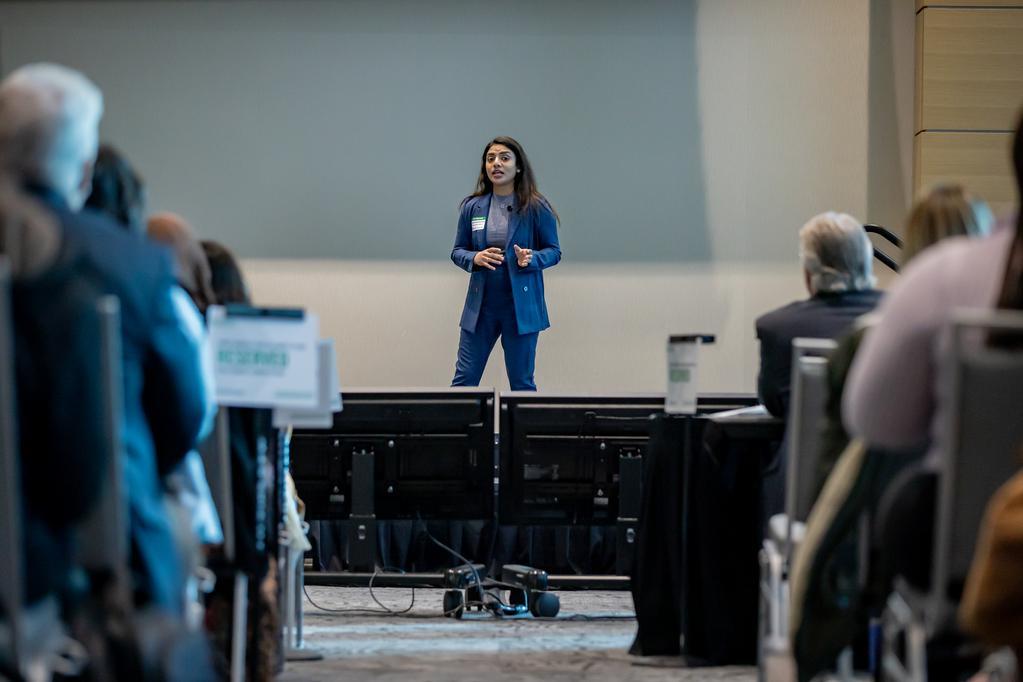
Imagine dedicating years of hard work to a single topic — hundreds of hours in the lab, endless nights buried in textbooks — then have to distill it into a three-minute speech. That’s the challenge grad students face in the School of Graduate Studies’ annual Three Minute Thesis (3MT) competition, which tasks the students with presenting their complex research in clear and concise three-minute packages.
Held at the Memorial Union on Jan. 29, this year’s competition showcased fascinating research being conducted across disciplines at the University and gave competitors a chance to hone their public speaking skills.
Laughter, storytelling make for engaging presentations
For doctoral student Jennifer Wolf, the experience was nerve-wracking and exciting. A remote student from Colorado, she was excited to visit with faculty members and fellow students at UND but found the live audience daunting.
“Faculty came to support me — God bless them — but it made me really nervous,” Wolf said with a laugh. “I went off script and nearly ran out of time, but it was a great experience.”
Wolf, a student in UND’s Indigenous Health doctoral program, presented her research on public health communication. Her framework is based on “zaasijiwan,” an Ojibwe word meaning “it ripples,” and illustrates how health messages spread like ripples in water — starting with one person and expanding outward.
As she prepared her presentation, Wolf focused on clear pronunciation and simple language, stripping away jargon to make her research more accessible. She also found watching her fellow students present to be a valuable experience.
“One part of my framework is using humor because it makes messages memorable,” she said. “And I noticed that some of the best presentations today incorporated jokes to keep things lighthearted.”
To that end, many of the presentations likewise gravitated toward storytelling as students used theatrical gestures, jokes and easy-to-understand analogies to engage the audience.
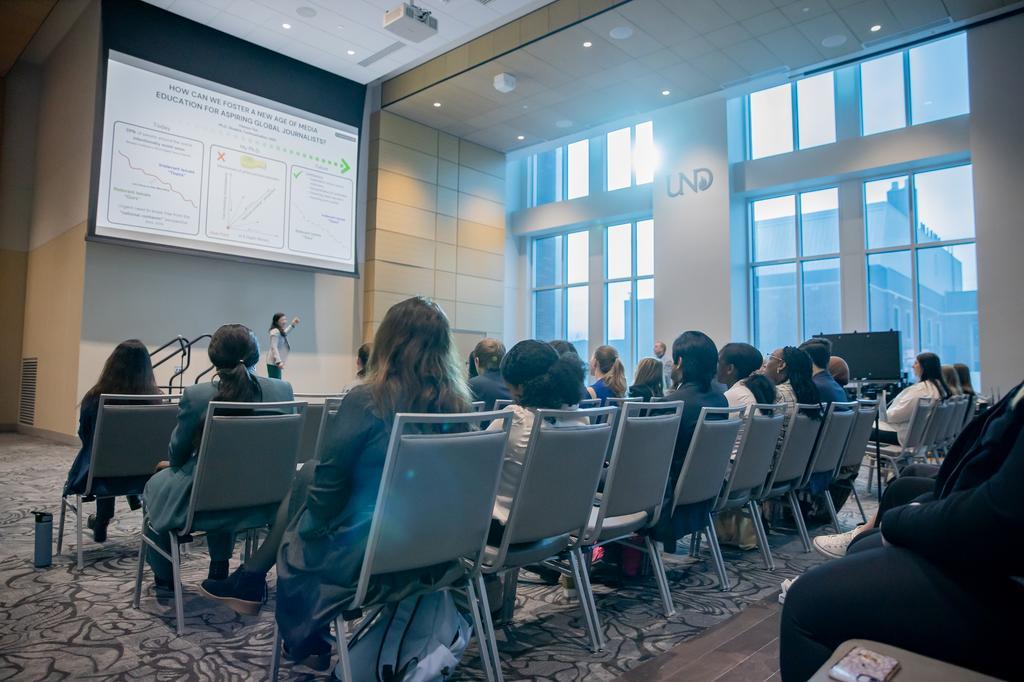
Group and one-on-one coaching was crucial in helping many students streamline their presentations before the main event. Training sessions are an important part of 3MT, and many students attend several such sessions to refine their speeches.
Practice makes perfect
Soojung Kim, chair and graduate program director in the Communication Department, led training sessions and coached several students. During the training, she stressed the importance of simplifying complex ideas.
“Most of these students are studying hard sciences, where there is a lot of jargon and technical detail,” she said. “I tell the students that I’m a social scientist and that if I don’t understand your presentation, nobody would understand it.”
To overcome this, Kim encouraged students to use analogies. A standout example came from Chemical Engineering student Anabella Kajibanga, who placed third for her presentation on using lignin — a plant polymer that aids in healing wounds — as a treatment for antibiotic-resistant infections.
“Imagine making a big, creamy soup with beans,” Kajibanga explained. “Lignin is like uncooked beans in water — they don’t break down easily. But put them in a pressure cooker, and they soften. That’s what we’re doing in the lab.”
These analogies make abstract scientific concepts more relatable and easier to understand, making the bite-sized presentations fun and engaging for attendees.
Kim acknowledged that some students naturally excel at simplifying their research while others initially struggle. Ultimately, Kim said she was pleased to see each student deliver successful speeches.
“I love this event,” Kim said. “It takes a lot of effort from the students, organizers and the tech team, but I think this will serve students well in their disciplines. It helps them to bridge the gap between white-coat experts in university settings and allows them to connect with the public.”
Research for the real world
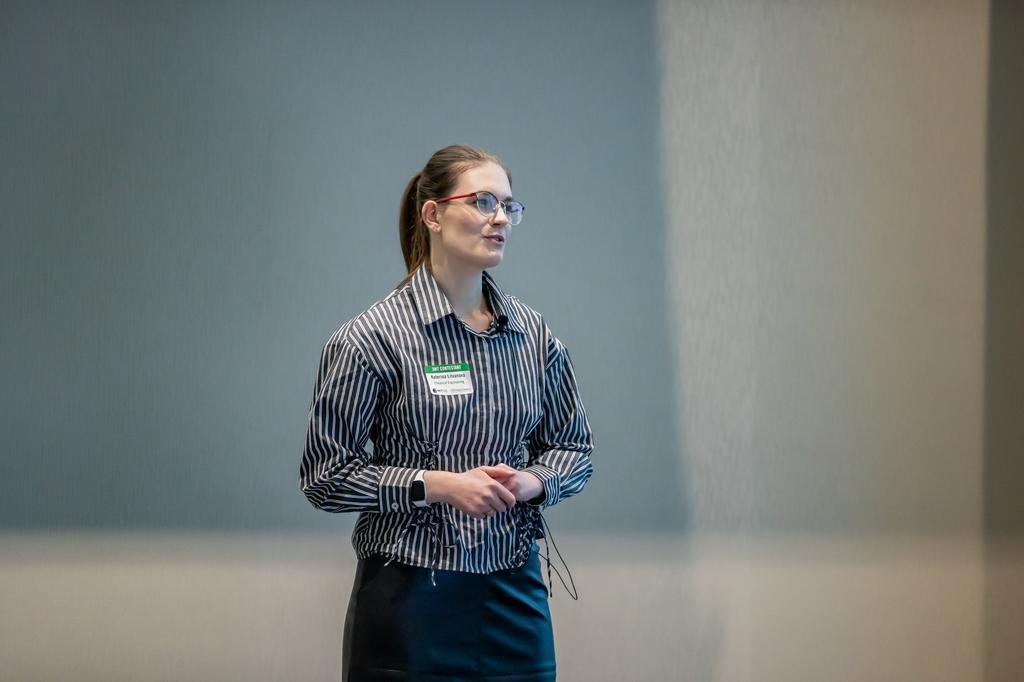
Many of the final round presentations focused on connecting research with real-world impact. Many students’ research had real and practical uses in North Dakota.
Energy Engineering student Rachel Josephs, this year’s first-place winner, exemplified how relevant their research could be. Her presentation focused on storing wind energy using underground salt layers to prevent waste and increase the viability of renewable energy.
“Over 60% of wind energy is wasted because we lack the infrastructure to store it,” Josephs explained. “Imagine losing 60% of your income because there’s no bank to save it in. That’s exactly what’s happening with wind energy.”
Current solutions, such as batteries and hydrogen tanks, can be inefficient and expensive, Josephs said. Josephs’ research proposes a method that promises to save more energy and reduce hydrogen costs, using the salt layers under our feet to store the hydrogen instead.
Her ability to articulate this complex idea clearly and emphasize its relevance and benefits to North Dakotans undoubtedly played a role in her success. She credited her training, which included sessions with last year’s 3MT winner, Temitayo Ikuerowo, with preparing her for the main event.
“The research itself has been a roller coaster,” Josephs said. “I stepped outside my usual field of petroleum engineering into energy. But 3MT has been incredible — it’s a whole new world of learning how to communicate research.”
Josephs said she’ll be able to use the skills she acquired preparing 3MT students for real-world scenarios — job interviews, grant proposals, and public speaking engagements — where they must convey their expertise concisely and convincingly.
Now, Josephs will represent UND at the regional 3MT competition hosted by the Western Association of Graduate Schools in Denver next month.
“I hope to carry the UND flag across the region and maybe even to the nationals competition,” she said. “It’s a huge honor.”