UND CONNECT project focuses on reducing intimate partner violence
Offenders who complete intervention less likely to re-offend, says judge overseeing domestic violence court
UND student and faculty researchers are partnering with the local court system, with the goal of reducing instances of domestic violence in the region.
The initiative is funded through the UND CONNECT program, which sponsors research and experiential learning projects addressing quality of life issues in North Dakota. The researchers were previously funded in their endeavor by the College of Arts & Sciences Undergraduate Research/Creative Activity Fund.
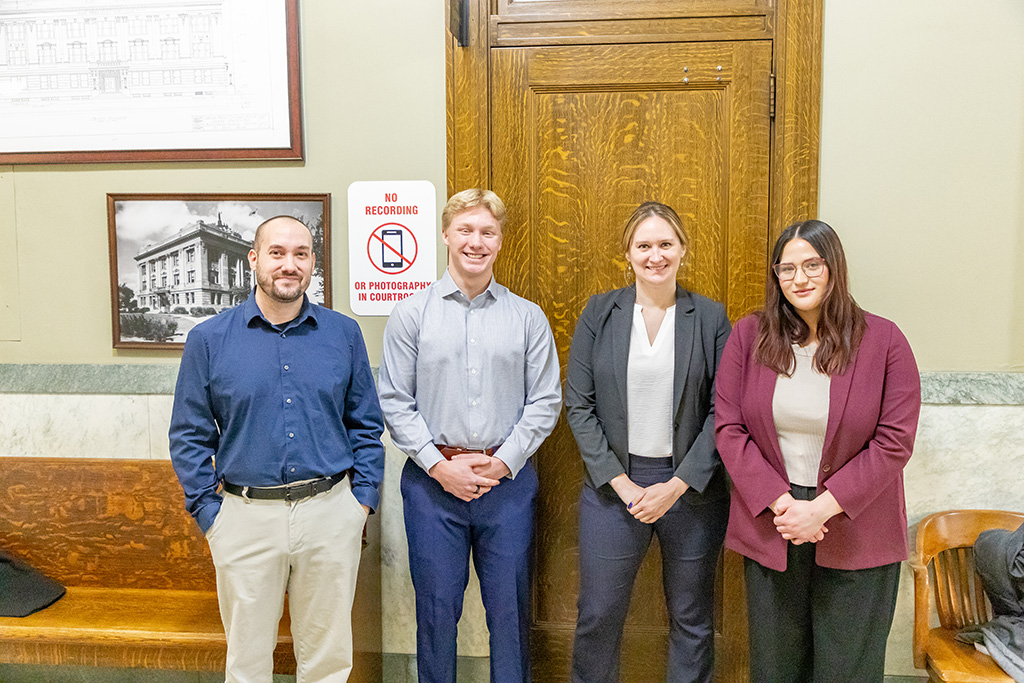
Three UND faculty members — Adam Matz, associate professor and graduate director of Criminal Justice, Ashley Fansher, assistant professor of Criminal Justice and Roni Mayzer, associate professor and department chair of Criminal Justice — are partnering with the Grand Forks County Domestic Violence Court (GFDVC) to assess the court’s efficacy. Matz and Fansher are assisted by two undergraduate students — Jackson Archbold and Kambrya Stephenson — as well as Sierra Schartz, a graduate research assistant.
The court was established in 2018 with the help of a grant from the Office on Violence Against Women (OVW) — an entity of the U.S. Department of Justice. The first and only court of its kind in North Dakota, the GFDVC partners with the Community Violence Intervention Center (CVIC) to implement its programming for participants.
The GFDVC is a post-conviction court – that is, a mandatory component of sentencing for perpetrators of intimate partner violence. Offenders are required to adhere to several conditions while in the program — among them, abstaining from substance use and obtaining full-time employment.
Archbold, who has worked as an undergraduate research assistant on previous projects, said the UND CONNECT program gave him an opportunity to supplement his classroom education.
“I was looking for an opportunity to expand and apply my degree before I graduate,” he said. “I like research, so once I saw this available, I was very grateful to do it.”
Archbold said that by requiring offenders to report regularly, the court allows administrators to better track their progress — as opposed to simply having them on probation.
“Before the court was in place, it was harder to track people because it wasn’t as uniform,” he said.
Judge Jason McCarthy, district court judge for the Northeast Central Judicial District and one of two judges presiding over the GFDVC, said the court has helped reduce recidivism in the community.
“About 85% of those who successfully complete the program will not re-offend within three years,” McCarthy said.
Stephenson added that as a holistic intervention, the GFDVC affords participants an opportunity for self-improvement – an outcome that reduces the likelihood of reoffending.
“One thing we’ve heard from a lot of people is that it doesn’t just help within their relationships, but also within their lives overall,” she said. “There are so many different working parts – finding a stable job, finding community and building yourself and your family back up again.”
McCarthy also praised the role of UND – which has partnered with the Domestic Violence Court for approximately two years – in providing feedback.
“The (UND CONNECT) program has given us invaluable support,” McCarthy said. “It helps us determine if we are being effective – and if not, how we can change.”
Matz said he is hopeful that the research funded through UND CONNECT will have a wide-reaching impact, such as implementing similar interventions throughout the state.
“I think there could be some real interest from the State Legislature on that end,” he said.
Matz added he plans to work with the CVIC on a grant proposal to secure additional funding from the OVW.
“One of the things we’re interested in is risk assessment tools,” he said. “Particularly tools specific to domestic violence that are currently implemented. That could also include training for professionals involved.”
Matz and Archbold will also travel to Denver in March to present their research at the annual meeting of the Academy of Criminal Justice Sciences.